55+ Powerful God Symbols: Hidden Meanings, Divine Protection & Spiritual Significance
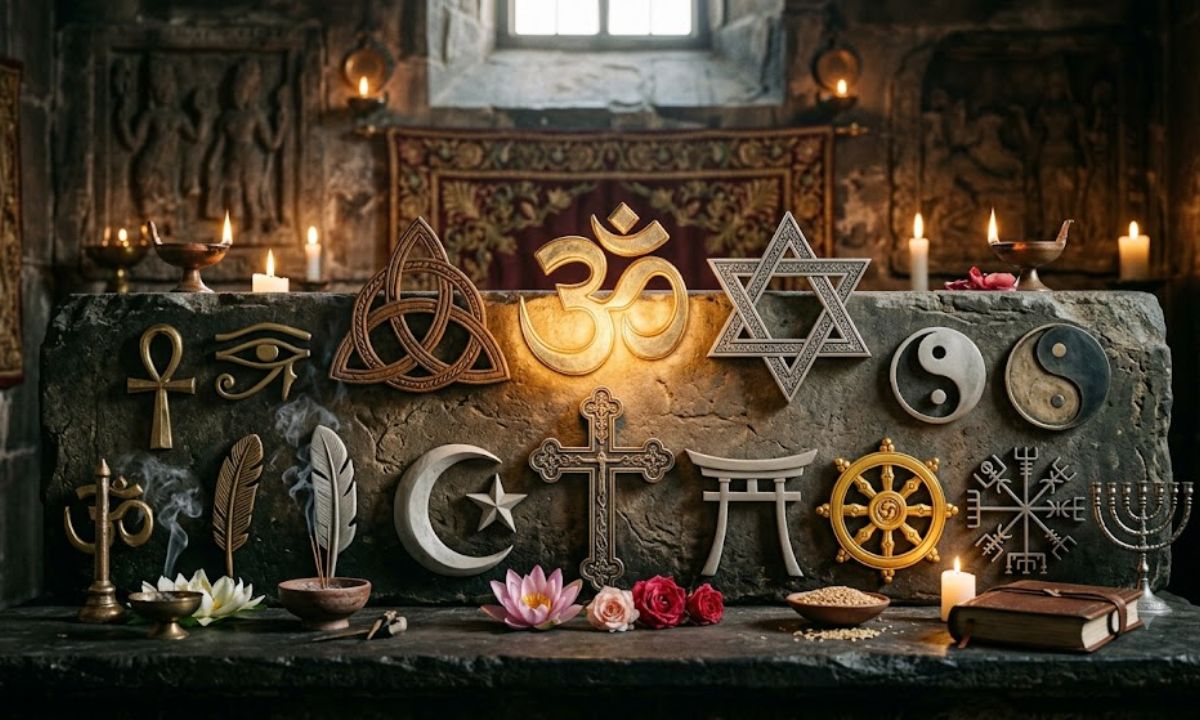
God symbols are visual or written signs that represent a deity, a divine power, or a spiritual idea connecting people to something greater than themselves. You’ve probably seen a handful today without noticing — a cross on a necklace, an Om tattoo, a lightning bolt logo nodding to Zeus.
Religious and spiritual symbols show up everywhere in modern life, from jewelry to home decor to Marvel movies, and most people have no idea where they came from.This guide covers 55+ god symbols and meanings from Greek, Roman, Egyptian, Norse, Hindu, Aztec, and Christian traditions, along with the copy-paste versions people search for.
Anthropologists have documented symbolic religious thinking in human societies going back at least 40,000 years, making symbols one of the oldest forms of human communication. The cross, the most recognized symbol for God in the West, actually predates Christianity by centuries as a solar and directional symbol.
What Are God Symbols?
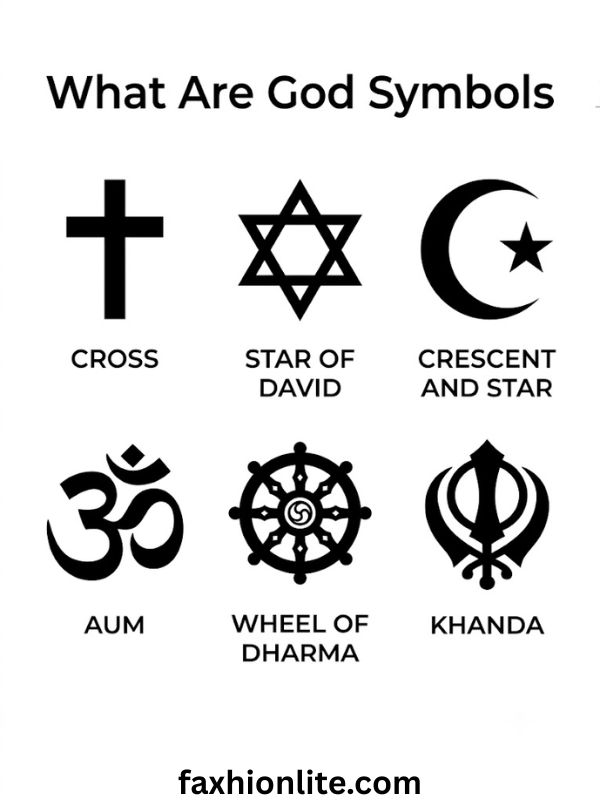
God symbols are images, shapes, or objects that stand in for a deity or divine concept, letting people express faith or feel connected to a higher power without words. Christianity has the cross. Judaism has the Star of David.
Hinduism has Om. Ancient Egypt had the Ankh. Each carries a story tied to a specific god, sacred event, or belief about the universe, compressing complex theology into something you can wear or draw in seconds.
There’s a distinction between a “symbol of God” in the singular monotheistic sense (the cross) and a “deity symbol” tied to one god among many (Zeus’s lightning bolt). Both function the same way psychologically — giving the abstract a physical form.
Ancient believers carved these images into stone or painted them on tombs; today the same symbols exist as emoji and tattoos. Roughly 84% of the world’s population identifies with a religious group, and nearly all rely on visual symbolism as a core teaching tool for concepts too abstract to explain in words.
Copy-and-Paste God Symbols
| Symbol | Name | Tradition |
| ✝ | Latin Cross | Christianity |
| ☦ | Orthodox Cross | Eastern Orthodox |
| ✡ | Star of David | Judaism |
| ☪ | Crescent and Star | Islam |
| ॐ | Om | Hinduism, Buddhism, Jainism |
| ☥ | Ankh | Ancient Egypt |
| ☯ | Yin Yang | Taoism |
| ☬ | Khanda | Sikhism |
These unicode characters display correctly across nearly every phone, computer, and platform. Text versions (like “INRI” on crucifixes, short for the Latin phrase “Jesus of Nazareth, King of the Jews”) remain useful on older apps with limited unicode support.
Powerful God Symbols And Meanings
The most powerful spiritual symbols share three traits: a clear origin story, a connection to protection or power, and a design simple enough to recognize instantly. Thor’s Hammer and the Eye of Horus both fit — representing gods of strength and carrying believed protective energy.
- The Ankh: eternal life, tied to Isis and Osiris
- The Trident: dominion over the sea, tied to Poseidon/Neptune
- The Lightning Bolt: divine authority, tied to Zeus/Jupiter
- The Lotus: purity and awakening, tied to Hindu/Buddhist deities
- The Cross: sacrifice and eternal life, tied to Jesus Christ
The lotus grows from muddy water yet blooms clean — exactly why it represents spiritual growth despite hardship.
Beyond named deities, some shapes carry weight on their own. The spiral (Celtic, Native American, Neolithic art) represents growth and cosmic energy. The triangle (Christian, Hindu, Egyptian) often symbolizes divine trinity.
Sacred geometry — patterns like the Flower of Life and Metatron’s Cube — reflects the idea that mathematics and divine order are the same thing, a concept found independently in Pythagorean philosophy, Islamic architecture, and Hindu temple design.
The mandala, used in Hindu and Buddhist meditation, represents the universe. Carl Jung studied mandalas and concluded they represented the psyche’s drive toward wholeness — what he called individuation.
Greek God Symbols And Meanings
Greek myths were passed down orally and later written by Homer and Hesiod. Symbols served as memory aids, letting people identify a god in a carving or painting without a name attached.
Gods were typically shown through an animal, object, and plant combination — Zeus had the eagle, lightning bolt, and oak tree; Athena had the owl, aegis, and olive tree.
| God | Domain | Primary Symbol |
| Zeus | Sky, thunder | Lightning bolt, eagle |
| Poseidon | Sea | Trident |
| Athena | Wisdom | Owl |
| Apollo | Sun, music | Lyre, laurel wreath |
| Ares | War | Spear, helmet |
| Hermes | Travel, trade | Caduceus |
| Hades | Underworld | Bident, Cerberus |
| Demeter | Harvest | Wheat |
| Hera | Marriage | Peacock |
| Artemis | Hunt | Bow and arrow |
The owl represents Athena’s wisdom because owls see in the dark — a metaphor for insight cutting through ignorance. Hermes’s caduceus (two intertwined snakes) represents balance, which is why it’s controversially used as a medical symbol today, though the single-snake Rod of Asclepius is the historically accurate emblem.
The laurel wreath, linked to Apollo, represents victory — ancient Olympic champions were crowned with it.Zeus’s lightning bolt represents raw divine power; the eagle, authority; the oak tree (tied to the Oracle at Dodona) his connection to prophecy.
Apollo’s symbols reflect his range: the lyre for music, laurel for victory, sun disc for solar association — though Apollo wasn’t originally a sun god; that link solidified later, during the Hellenistic period.
Ares represented war’s brutal, chaotic side, contrasted with Athena’s strategic side. His symbols — spear, helmet, vulture — reflect a reputation Greeks respected less than other war-related figures. Hermes also carried winged sandals and helmet (speed), plus the rooster (new beginnings) and tortoise (he invented the lyre from a tortoise shell).
Hades ruled the underworld with the bident and Cerberus — worth noting he wasn’t equivalent toSatan, just the respected manager of the dead. Pan, god of the wild, is shown with goat horns/legs and the pan flute, an instrument credited to him after the nymph Syrinx transformed into reeds to escape him.
Regional variation mattered too: Athens favored Athena’s owl, while Sparta leaned on Ares imagery. Greek god tattoos remain popular in the US, especially the lightning bolt and owl, often chosen for the values they represent — resilience, intellect — rather than religious devotion. Percy Jackson stays fairly faithful to these classical symbolic associations even while taking liberties with plot.
Across cultures, a “deity symbol” generally falls into one of three categories: an animal companion, a weapon/tool, or a natural element like fire or lightning. Some symbols repeat across unconnected mythologies — serpents represent both danger and wisdom in Greek, Egyptian, and Hindu traditions; suns represent divine authority in Egyptian, Aztec, and Shinto belief — suggesting they tap into something close to universal human psychology.
Other God Symbols by Culture
Roman: Rome borrowed heavily from Greece. Jupiter (Zeus) kept the eagle and lightning bolt; Neptune (Poseidon) kept the trident. Mars (Ares) held a more respected position, since Romans saw military strength as civic virtue rather than chaos.
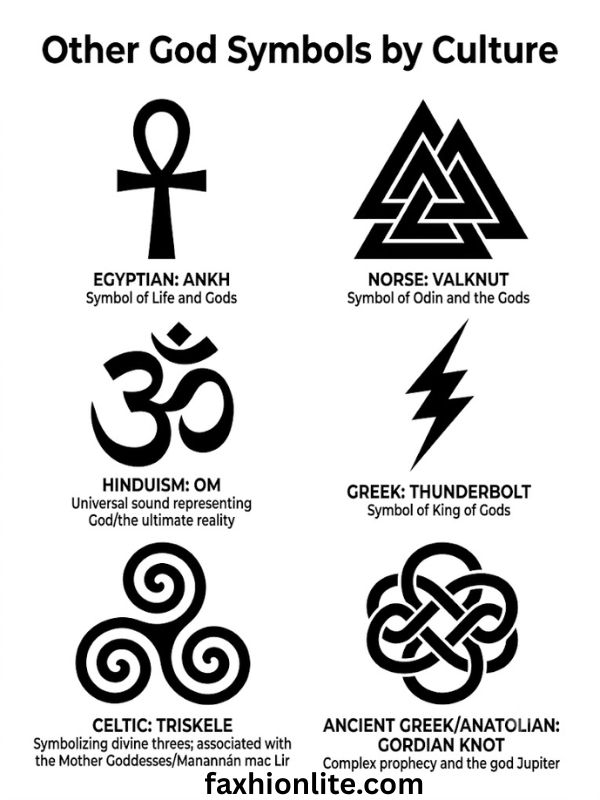
Egyptian: The Ankh represents eternal life, held by Isis and Osiris in tomb art. The Eye of Horus represents protection and royal power, tied to the myth of Horus losing and regaining his eye in battle with Set. The scarab beetle symbolized rebirth, tied to Khepri and the sun’s daily cycle.
Norse: Thor’s Hammer (Mjolnir) represents protection and strength, seeing a genuine modern revival through Asatru practitioners and Marvel films. The Valknut (three interlocking triangles) is tied to Odin and death/the afterlife. Ravens Huginn and Muninn represent thought and memory — Odin’s companions who gathered world information for him.
Hindu: Om represents the sound of the universe itself. The lotus represents purity. The trishul, Shiva’s three-pronged trident, represents destroying ignorance, ego, and desire.
Aztec: Quetzalcoatl, the feathered serpent, represented wind, learning, and the merging of earth and sky. The Sun Stone (often mistaken for a calendar) represented Aztec cosmology and cycles of creation and destruction.
Chaos Symbol: The eight-pointed Symbol of Chaos didn’t come from ancient mythology — it originated in Michael Moorcock’s 1960s fantasy fiction and was later adopted by occult and pagan communities to represent infinite possibility, showing symbolism can be created fresh and still take on real spiritual meaning.
Jesus and Christian Symbols
The cross represents Jesus’s crucifixion and, in Christian theology, humanity’s redemption through his sacrifice. The Ichthys (fish symbol) was used by early Christians as a covert identifier during Roman persecution, since the Greek word for fish formed an acronym for “Jesus Christ, Son of God, Savior.”
The lamb represents Jesus as the “Lamb of God,” reinterpreting Old Testament sacrificial imagery. The Chi-Rho is formed from the first two Greek letters of “Christ.” The anchor served as a disguised cross, also representing hope and steadiness.
Beyond Jesus specifically, the triquetra (three interlocking arcs) represents the Holy Trinity — Father, Son, Holy Spirit as three persons in one God. The dove represents the Holy Spirit, referencing Jesus’s baptism.
Christianity has historically avoided literal images of God the Father due to concerns about idolatry, using abstract symbols like the all-seeing eye in a triangle (divine omniscience) instead.
Across faiths, certain shapes function as a universal symbol for God: a circle (eternity, no beginning or end), a triangle (trinity, or the link between heaven and earth), and radiant light (divine presence in nearly every tradition).
God Symbols in Tattoo Culture
US tattoo culture has embraced religious and mythological symbolism heavily, turning ancient symbols into personal statements. Popular choices include the cross, praying hands, and the Sacred Heart (Jesus’s heart wrapped in thorns, representing love and sacrifice in Catholic tradition).
lacement changes meaning: a small wrist cross signals quiet personal faith, while a large back piece combining symbols and scripture signals a public statement of belief.Symbols not tied to one god — a halo, radiant light — represent “the divine” broadly, appealing to people who are spiritual without following one organized religion.
The Flower of Life, a sacred geometry pattern of overlapping circles, has become a modern tattoo favorite; it isn’t tied to one religion but appears in Egyptian, Greek, and Asian art, and its popularity today stems largely from New Age movements viewing it as evidence of universal divine order.
Why These Symbols Endure
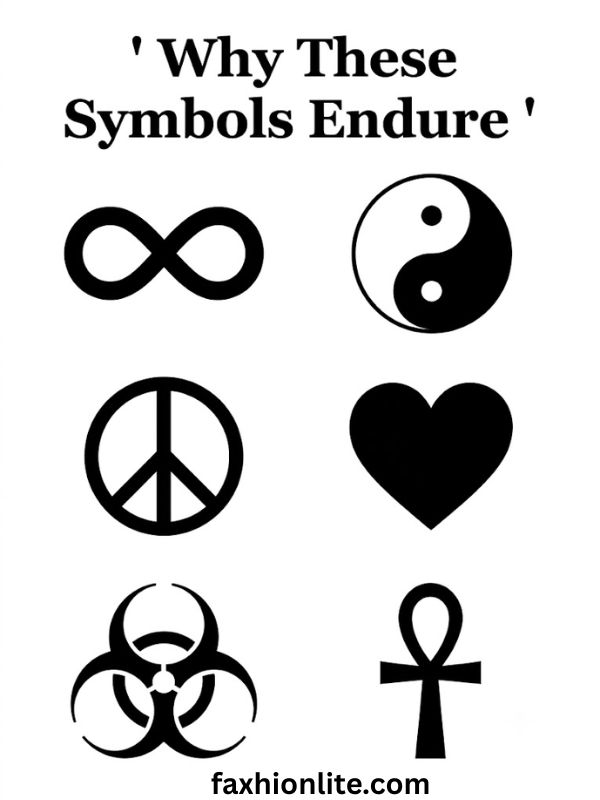
God symbols work on more than one level — spiritual, psychological, and cultural — simultaneously.
Spiritually, symbols act as focal points during prayer and meditation, giving the mind something concrete to hold while reaching toward an abstract concept. Psychologically, Carl Jung’s concept of archetypes explains why symbols feel meaningful even outside their originating religion — certain images (the sun, the circle, the tree) tap into a collective unconscious shared across humanity.
Culturally, symbols carry identity: wearing a Star ofDavid signals connection to Jewish heritage independent of religious observance, functioning as shorthand for “who I am and where I come from.”
Psychologists studying religious cognition note that symbolic thinking is a fundamental feature of human cognition, not a cultural add-on. Symbols compress big ideas — morality, mortality, hope, protection — into something the brain processes instantly, which is why a cross or an Ankh can trigger an emotional response even in someone who couldn’t explain the theology behind it.
There’s also a social component: displaying a symbol signals belonging to a community, whether a congregation, a mythology fandom, or a broader spiritual movement.
Seven Enduring Symbols at a Glance
- The Ankh — Egyptian symbol of life, held by Isis and Osiris, still used in jewelry today.
- The Eye of Horus — protection, health, royal power, tied to Horus’s battle with Set.
- Om — sacred sound across Hinduism, Buddhism, and Jainism, representing the universe’s underlying vibration.
- The Cross — Jesus’s crucifixion and resurrection, though the shape predates Christianity as a solar/directional marker.
- The Star of David — Jewish identity, tied to King David, now on Israel’s flag.
- The Crescent and Star — widely linked to Islam today, though it gained prominence through the Ottoman Empire rather than starting as a religious symbol.
- Thor’s Hammer — Norse protection and strength, revived through Asatru and pop culture.
Positive vs Negative Meaning
Context changes everything. The pentagram represents the five elements (earth, air, fire, water, spirit) in Wiccan and pagan traditions and generally carries a positive, protective meaning — but Hollywood frequently ties it to occult horror, leading people to assume it’s sinister.
The same happens with the Chaos symbol and the inverted cross, which in its original Christian context — the Cross of Saint Peter — represents humility, since Peter reportedly asked to be crucified upside down, believing himself unworthy of dying the same way as Jesus.
Dream Meaning of God Symbols
Dreaming about a specific god symbol often reflects something in a person’s waking life, according to common interpretive frameworks. A cross frequently signals seeking guidance during a difficult period.
Light or a radiant sun is associated with clarity or an approaching decision. A serpent carries almost opposite meanings depending on tradition — danger in some frameworks, transformation or healing in others — echoing the same duality serpents carry in mythology itself.
Frequently Asked Questions
What is the most powerful symbol of God?
The cross, Ankh, Om, and Thor’s Hammer are widely regarded as the most powerful, protective symbols today.
What does the cross symbol represent?
The cross represents Jesus’s crucifixion and, in Christian theology, humanity’s eternal redemption through his ultimate loving sacrifice.
What is the universal symbol for God?
Circles, triangles, and radiant light are commonly used as universal symbols representing eternity, trinity, and divine presence.
What does the Ankh symbolize in Egyptian mythology?
The Ankh symbolizes eternal life and lasting vitality, frequently held by Egyptian gods like Isis and Osiris.
Why do people get god symbol tattoos?
People choose god symbol tattoos to represent meaningful personal values like strength, wisdom, protection, faith, or identity.
Conclusion
God symbols have carried meaning across nearly every human civilization, from Egyptian tombs to modern tattoo parlors. Whether it’s the Ankh, the cross, Thor’s Hammer, or Zeus’s lightning bolt, these images take an idea too big for language, divinity, protection, eternity, and shrink it into something you can hold, wear, or carry with you.
Understanding where a symbol comes from adds real weight to using it, whether for a tattoo, jewelry, or simple curiosity: these aren’t just decorations, but thousands of years of belief distilled into a shape.