
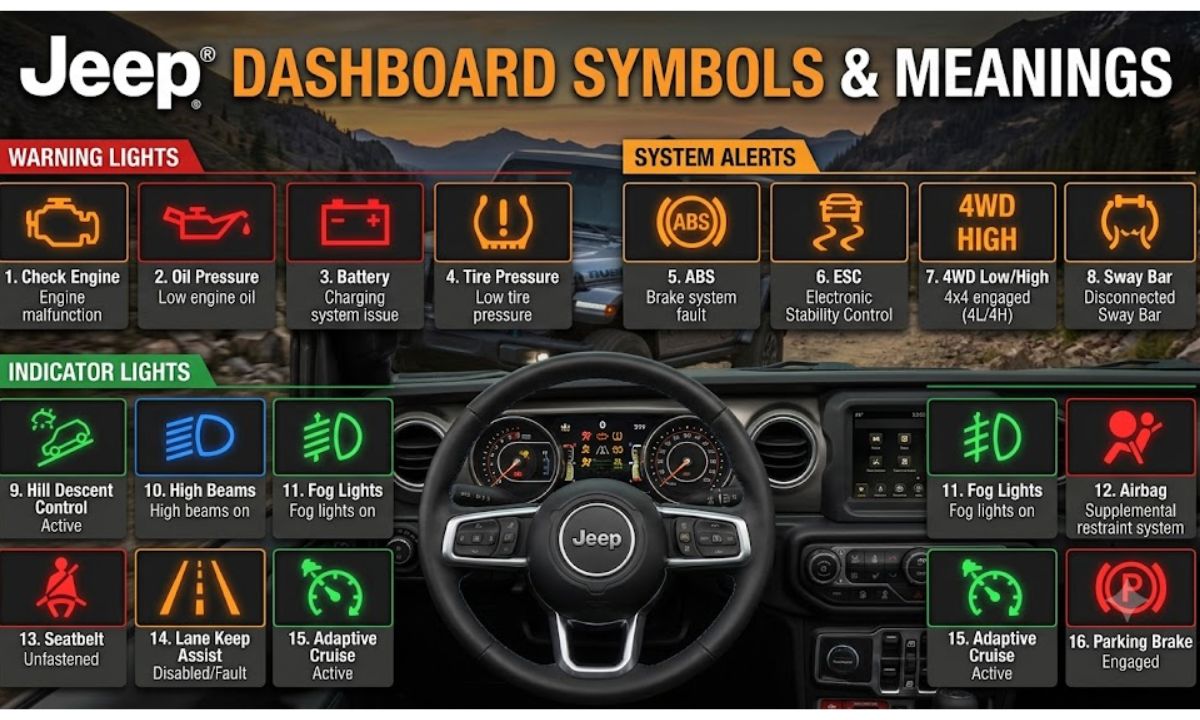
Jeep Dashboard Symbols and Meanings: Warning Lights Explained with Pictures (2026)
Understanding Jeep dashboard symbols and meanings helps you identify potential vehicle problems before they become serious. Dashboard warning lights alert you to issues with the engine, brakes, battery, tires, and other critical systems. Some symbols require immediate attention, while others simply indicate that maintenance is due.
This guide explains the most common Jeep warning lights with clear pictures and easy-to-understand meanings. By learning what each icon represents, you can keep your Jeep safe, reliable, and running smoothly.
What Are Jeep Dashboard Symbols and Meanings?
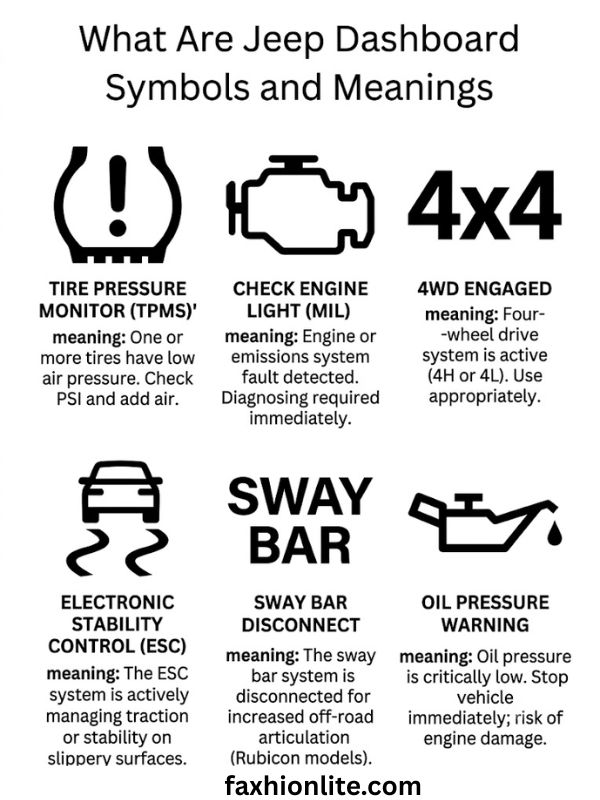
In simple terms, Jeep dashboard symbols are the small pictograms on your instrument cluster that communicate your vehicle’s status without using words. They exist so you don’t have to read a paragraph while driving 70 miles an hour down the highway.
These icons cover everything from your engine and oil pressure to your tires, brakes, and airbags. Jeep, like most automakers, follows a shared visual language for these symbols so drivers can recognize a battery warning or a coolant warning even if they’ve never owned that specific model before. This shared design comes from an international standard for automotive symbols, which is why a check engine light on a Jeep Wrangler looks almost identical to the one on a Ford or a Toyota.
The color of each symbol tells you how fast you need to react. A red light usually means pull over as soon as it’s safe. A yellow or amber light means the issue needs attention soon but usually isn’t an emergency. A green or blue light just confirms a feature, like your headlights or adaptive cruise control, is turned on. Once you understand this color logic, half the confusion around dashboard symbols disappears.
Jeep Dashboard Symbols And Meanings Guide
Think of this section as your quick reference before diving into the specifics. Every Jeep instrument cluster follows the same basic pattern: a symbol lights up, its color tells you the urgency, and your owner’s manual gives you the exact next step for your model and year.
The fastest way to identify an unfamiliar symbol is to check three things at once: the shape of the icon, its color, and whether it’s flashing or steady. A steady check engine light, for example, usually means you can keep driving carefully and schedule service soon. A flashing check engine light is a different story entirely. It typically signals an active engine misfire, and continuing to drive can damage your catalytic converter, sometimes leading to a repair bill running into the thousands of dollars.
Your Jeep’s Uconnect infotainment system can also help decode unfamiliar warnings. Many 2022 and newer Jeep models display a written message alongside the symbol, which cuts down on guesswork significantly. Older models with analog clusters rely purely on the icon, so keeping a reference guide handy (or bookmarking this page) makes a real difference.
Jeep Dashboard Symbols And Meanings PDF
If you want something you can keep in your glovebox, a printable PDF cheat sheet is genuinely useful. It gives you a quick visual reference without needing cell service or an app, which matters if you’re driving somewhere remote in a Wrangler or Gladiator.
Jeep’s official owner’s manuals, available by model and model year directly from Jeep, are actually the most authoritative source for your exact vehicle. Since symbol sets can shift slightly between model years (especially with the move to digital clusters in newer Grand Cherokee and Wagoneer-family vehicles), your manual will always be more accurate than a general guide for edge cases.
Our recommendation: save a digital PDF version to your phone and keep a printed copy in your glovebox. That way, you’re covered whether you’re checking a symbol in a parking lot with full signal or troubleshooting somewhere with zero bars. It only takes a few minutes to set up, and it pays off the first time a light you don’t recognize turns on.
What Does A Mean On Jeep Dashboard?
This is one of the most searched questions among Jeep owners, and the answer is usually simple. The “A” symbol on most Jeep dashboards refers to the Auto Start Stop system, a fuel-saving feature that automatically shuts off your engine at a stop (like a red light) and restarts it the moment you take your foot off the brake.
When the “A” appears in white or green, it just means Auto Start Stop is currently active and working normally. If the “A” symbol shows up with a slash through it, or turns amber, it typically means the system has been turned off or has detected a fault, sometimes triggered by low battery charge, cold temperatures, or the hood being open.
If you notice the “A” inside a circle and it won’t turn off no matter what you do, don’t panic right away. This is often just a sign that conditions aren’t right for the system to engage, such as a cold engine or low cabin temperature setting. If it persists across multiple drive cycles, it’s worth having a technician check your battery health, since a weak battery is the most common real cause behind a stuck Auto Start Stop warning.
Jeep Models Dashboard Symbols Explained
Different Jeep models share a common core set of warning lights, but each one adds its own model-specific icons based on drivetrain, trim level, and available features. A Wrangler off-roader sees different indicators than a Grand Cherokee L family hauler.
Knowing your specific model matters because a symbol that means one thing on a Gladiator (like a payload or towing alert) might not even exist on a Compass. Model year also plays a role. Jeep’s shift toward the Uconnect 5 infotainment system in 2022 and later models introduced more customizable digital clusters, which display richer warning messages alongside the traditional icons.
Below, we break down the dashboard symbols specific to each major Jeep model currently on the road, plus the discontinued Patriot, which plenty of owners still search for since these vehicles remain common on used car lots and secondhand fleets.
Jeep Cherokee Dashboard Symbols And Meanings
The Jeep Cherokee uses a fairly standard warning light set, with a few features unique to its Selec-Terrain drive system. This icon shows up as a dial or terrain-style symbol and lets you know which driving mode (snow, sport, sand, mud) is currently active.
Cherokee owners also frequently see Uconnect-related alerts, since the Cherokee has offered advanced infotainment integration for several model years running. These aren’t mechanical warnings; they’re usually notifications about updates or paired device status.
Model year matters a lot here. The newer Cherokee generation (KL platform) added more driver assist icons, including lane departure and forward collision warnings, that older Cherokee models simply don’t have. If you’re driving an older Cherokee and see an unfamiliar safety icon, double check whether your trim even includes that feature before assuming something’s broken.
Jeep Wrangler Dashboard Symbols And Meanings
Wrangler dash lights lean heavily toward off-road functionality. You’ll commonly see icons for 4×4 lock, front axle disconnect, and tire pressure monitoring, all of which matter more on a Wrangler than on a typical commuter SUV.
Rubicon trims add an electronic sway bar disconnect icon, which lets you know when the front sway bar has been disengaged for better wheel articulation on the trail. This is a feature indicator, not a warning, so seeing it lit up in green just confirms the system engaged successfully.
Wrangler owners should also pay close attention to their soft-top or hardtop related alerts if equipped, along with tire pressure warnings, since off-road driving on rocky terrain is one of the fastest ways to trigger a TPMS light. A sudden tire pressure warning mid-trail is common and usually resolves once you’re back on pavement and pressures normalize.
Jeep Compass Dashboard Symbols And Meanings
The Compass shares most of its warning light set with other Jeep crossover models, but it’s known among owners for one recurring complaint: a check engine light that comes back repeatedly, often tied to emissions system sensors or a loose gas cap.
Compass dashboards also include standard TPMS, ABS, and airbag warning icons, plus Selec-Terrain indicators on trims equipped with the feature. If you’re shopping for a used Compass, checking dashboard warning history through a diagnostic scan is a smart move before you buy.
Owners frequently report that resetting the check engine light without fixing the underlying sensor just leads to the light returning within a few drive cycles. If your Compass shows this pattern repeatedly, it’s worth having a certified technician run a full diagnostic rather than repeatedly clearing the code yourself.
Jeep Grand Cherokee Dashboard Symbols And Meanings
The Grand Cherokee, especially higher trims, includes a wider set of luxury-oriented warning icons compared to other Jeep models. Air suspension warnings are one of the most notable, since many Grand Cherokee trims offer adjustable ride height.
Adaptive cruise control, blind spot monitoring, and night vision indicators (on equipped trims) are also common on this model. These are driver assist features, so their icons typically show in blue or green when active rather than red or amber.
The Grand Cherokee L, Jeep’s three-row variant, adds a few of its own alerts related to its longer wheelbase and added seating configuration, including additional seatbelt reminder icons for third-row passengers. If you’re new to a Grand Cherokee L, expect a slightly busier dashboard than a standard two-row Grand Cherokee.
Jeep Gladiator Dashboard Symbols And Meanings
As a truck, the Gladiator’s dashboard symbols reflect real work use. Towing and payload warnings are common, along with differential lock icons for drivers using the vehicle off-road with a trailer or heavy bed load.
The Gladiator shares much of its 4WD system with the Wrangler, so many of the same off-road specific icons (transfer case, sway bar disconnect on Rubicon trims) apply here too. Owners hauling equipment or trailers should pay particular attention to transmission temperature warnings, since heavy towing is one of the fastest ways to overheat transmission fluid.
If a transmission temperature icon appears during a tow, the safest move is to pull over and let the vehicle idle in neutral for ten to fifteen minutes to cool down before continuing. Ignoring this warning during sustained towing is one of the more common ways owners cause expensive internal transmission damage.
Jeep Avenger Dashboard Symbols Explained
The Avenger is Jeep’s electric model, and its dashboard reflects that with a completely different set of priority icons compared to gas-powered Jeeps. Battery charge level, regenerative braking status, and charging port connection are the primary indicators drivers need to understand.
Unlike a traditional fuel gauge, the Avenger’s battery icon typically shows a percentage alongside estimated range, giving a more precise readout than older analog fuel gauges ever could. Regenerative braking indicators let you know how much energy is being recovered as you slow down, which is a genuinely new concept for drivers coming from gas-powered Jeeps.
As more US buyers start considering electric SUVs, understanding EV-specific dashboard language matters more each year. Expect to see similar battery and charging icons appear across future electric Jeep models as the lineup expands.
Jeep Warning Lights And Symbol Meanings
This section covers the exact warning light categories and phrasing that Jeep owners search for most often, since people describe the same symbols in slightly different ways depending on what they remember seeing.
Every Jeep warning light falls into one of three color categories, and that color tells you almost everything about urgency before you even identify the exact icon. Red demands immediate action. Amber or yellow means service soon but generally allows continued careful driving. Green or blue simply confirms an active feature.
Because search habits vary so much, we’re covering the same core information under a few different phrasings below, since “Jeep warning lights,” “Jeep light symbols,” and “Jeep dashboard symbol meanings” are often typed by people looking for the exact same answer.
Jeep Dashboard Symbols
This is the broadest way people search for this topic, and it usually means someone saw an unfamiliar icon and wants a general reference. The core set includes check engine, oil pressure, battery, brake, ABS, airbag, coolant temperature, tire pressure, traction control, and 4WD indicators.
Jeep Warning Lights Symbols
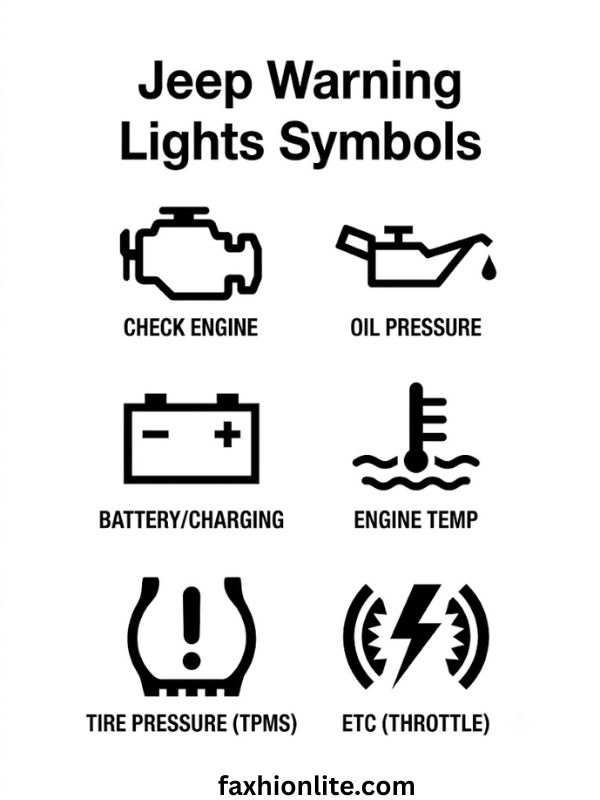
This phrasing usually reflects someone specifically worried about a red or amber light rather than a general status indicator. Red warning lights (oil pressure, brakes, overheating) require the most urgent response, while amber ones (check engine, TPMS) usually allow safe continued driving in the short term.
Jeep Warning Lights
Used broadly to describe any illuminated dashboard icon, this search often comes from someone trying to figure out if their vehicle is safe to keep driving. As a rule of thumb, if you’re ever unsure, treating any unfamiliar red light as urgent is the safer default.
Jeep Light Symbols
This phrasing sometimes actually refers to exterior lighting icons rather than warning lights, including headlights, fog lights, and high beam indicators. These are typically green or blue and simply confirm which exterior lights are currently on.
Jeep Dashboard Lights Meaning
This search usually reflects someone wanting to understand what to do next rather than just identify the symbol. The general rule: red means stop soon, amber means schedule service, and green or blue means everything is working as expected.
Meaning Jeep Dashboard Symbols
This reversed phrasing is common in voice search, since people often speak questions differently than they type them. The answer remains the same regardless of phrasing: color plus symbol shape together tell you the full story.
Jeep Dashboard Symbol Meanings
A near-identical variation to the plural version above, this phrasing typically comes from someone comparing multiple sources to double check a symbol’s meaning before deciding whether to visit a dealership.
Jeep Patriot Warning Lights
Even though Jeep discontinued the Patriot years ago, plenty of owners still drive them today, and used Patriot models remain common across the US. Patriot dashboards use a fairly basic warning system: check engine, ABS, oil pressure, battery, and brake warnings, without many of the advanced driver assist icons found on newer models.
Because the Patriot is no longer in production, parts availability and dealership familiarity with its specific dash symbols can vary. If you own one, keeping a printed symbol reference handy is especially useful since not every mechanic sees this model daily anymore.
Jeep Dashboard Symbols A With Circle
This specific icon, an “A” enclosed in a circle, almost always relates to the Auto Start Stop system discussed earlier in this guide. When lit in white or green, the system is active. When it appears with a slash or in amber, the system has either been manually disabled or detected a condition preventing it from functioning normally, such as low battery charge or extreme temperatures.
Deep Symbolic Meaning of Jeep Dashboard Symbols
Beyond their mechanical function, dashboard symbols tap into something deeper about how humans interact with machines. Understanding this angle helps explain why a small icon can trigger such a strong emotional reaction the moment it lights up.
Spiritual Level
On a symbolic level, warning lights function almost like ancient signal fires. A red light says stop, pay attention, something needs care right now. This mirrors how humans have used visual alerts for centuries, long before cars existed, to communicate urgency across distance without words.
Your Jeep’s dashboard, in this sense, becomes a kind of ongoing conversation between you and your machine. It’s constantly telling you what it needs, and learning to listen to that conversation builds a stronger sense of trust and control over your vehicle.
This isn’t mystical in a literal sense. It’s simply a recognition that humans respond to visual signals on a level deeper than pure logic, which is exactly why automakers chose universal icons over written text in the first place.
Psychological Level
Psychologically, humans process visual alerts faster than written instructions. Red is processed by the brain as an alert color faster than most other colors, which is exactly why automakers universally chose red for the most urgent warnings.
This explains a common phenomenon called warning fatigue, where drivers who see a minor amber light stay on for weeks start ignoring it entirely, sometimes right up until a more serious red warning finally appears. Understanding this pattern in yourself is genuinely useful, since it’s one of the leading reasons drivers end up with expensive repairs that could’ve been caught early.
Color psychology also plays into driver confidence. Seeing a green confirmation light (like cruise control engaged) actually reduces stress during a drive, while an unexpected red light spikes it immediately, even before the driver consciously identifies what the symbol means.
Cultural Level
Culturally, the shift from text-based dashboards to symbol-based ones represents a major change in how vehicles communicate across language barriers. A driver in Texas and a driver in Tokyo can both recognize a battery warning icon instantly, without either needing to read English or Japanese.
This standardization happened gradually over decades as automakers realized text-only dashboards created real safety problems for international markets and non-native speakers. Icons solved that problem elegantly, and it’s part of why the same basic symbol set now appears across nearly every major car brand worldwide.
Jeep, as a global brand selling vehicles across dozens of countries, benefits directly from this shared visual language. It’s one less thing that has to be localized separately for each market the company sells into.
Types and Variations of Jeep Dashboard Symbols and Meanings
Here’s a breakdown of the ten warning lights Jeep owners encounter most often, along with what each one actually means and what to do when it appears.
| Warning Light | Color | Action Needed |
| Check Engine | Amber (red if flashing) | Schedule service soon; pull over if flashing |
| Oil Pressure | Red | Stop immediately |
| Battery Charge | Red | Get charging system checked soon |
| TPMS | Amber | Check and inflate tires |
| ABS | Amber | Drive carefully, schedule service |
| Traction Control | Amber/Green | Check road conditions, mode selected |
| Airbag | Red | Service immediately for safety |
| Coolant Temperature | Red | Pull over and let engine cool |
| 4WD Indicator | Green/Amber | Confirms mode or signals a fault |
| Brake Warning | Red | Check fluid and parking brake status |
1. Check Engine Light
The check engine light is one of the most common warnings a Jeep driver will ever see, and it covers a huge range of possible issues, from a loose gas cap to a failing catalytic converter. A steady light usually means you can keep driving carefully and get it checked within a few days.
A flashing check engine light is a completely different situation. It typically signals an active engine misfire, and continuing to drive risks serious damage to your catalytic converter. If this happens, reduce speed, avoid heavy acceleration, and get to a service center as soon as safely possible.
Diagnostic scan tools can read the exact stored code causing the light, which takes the guesswork out of the situation. Many auto parts stores offer free code reading, making this one of the easiest warning lights to diagnose without a dealership visit.
2. Oil Pressure Warning Light
Shaped like an oil can, sometimes shown dripping a drop of oil, this light means your engine has lost adequate oil pressure. This is one of the most urgent lights on the entire dashboard, since running an engine without proper lubrication can cause damage within minutes.
If this light comes on, pull over immediately and shut off the engine. Once it’s cooled, check your oil level using the dipstick. If oil is low, adding the correct type can resolve the issue temporarily, but you should still have the system inspected soon after.
If the light stays on even after adding oil, or if you notice oil leaking underneath the vehicle, towing to a service center is the safer choice rather than continuing to drive.
3. Battery Charge Warning Light
Shaped like a small battery, this light means your charging system isn’t working properly, which usually points to a failing alternator rather than the battery itself. If it stays lit while the engine runs, your vehicle is essentially running on stored battery power alone.
Reducing electrical load (turning off unnecessary accessories, lights, or climate control) can extend your driving time until you reach a service center. This is especially relevant for Wrangler and Gladiator owners running winches, auxiliary lighting, or other power-hungry accessories off-road.
Left unaddressed, a failing charging system will eventually leave you stranded once the battery fully depletes, so this warning shouldn’t be ignored for more than a day or two.
4. Tire Pressure Monitoring System Light
Shown as an exclamation mark inside a flat tire outline, this light indicates one or more tires has fallen below the recommended pressure. Cold weather is a frequent trigger, since tire pressure typically drops roughly one PSI for every ten degree drop in temperature.
Checking all four tires, plus your spare if equipped, and inflating them to the pressure listed on your driver’s door sticker usually resolves this. The light often resets automatically after a few miles of driving once pressure is corrected.
If the light stays on despite correct pressure, you may have a faulty sensor or a slow leak that needs professional attention, particularly common after installing new tires that haven’t had their sensors recalibrated.
5. ABS Warning Light
The letters “ABS” inside a circle indicate a problem with your anti-lock braking system, which helps maintain steering control during hard braking. This doesn’t mean your regular brakes have failed, but it does mean you’ll lose the anti-lock benefit during an emergency stop.
You can typically continue driving with this light on, but you should have it inspected fairly soon, especially before winter driving season when hard braking situations become more likely.
Combined with a brake warning light, an ABS alert becomes more urgent, since it may indicate a broader issue with your braking system’s sensors or hydraulic components.
6. Traction Control Light
This light blinks briefly during active use, letting you know the system is actively managing wheel slip on a slippery surface. That’s completely normal and simply confirms the system is doing its job.
If the light stays on continuously rather than blinking, it usually means traction control has been manually disabled, which some drivers do intentionally for off-road use or deep snow where slight wheel spin actually helps momentum.
If the light stays on and you didn’t disable it yourself, that combination usually points to a sensor fault worth having checked, particularly on Wrangler and Gladiator models used frequently off-road.
7. Airbag Warning Light
Shown as a seated figure with a circle in front, this light indicates a fault has been detected somewhere in your airbag system. This is a safety-critical warning that shouldn’t be ignored, since it could mean your airbags won’t deploy properly in an accident.
Common causes include a loose seat sensor connection, aftermarket seat cover installation interfering with sensors, or a genuine electrical fault in the system.
Because this directly affects passenger safety, getting this light diagnosed promptly at a service center is one of the more important warnings on this entire list, even though it doesn’t affect your ability to drive normally.
8. Coolant Temperature Warning Light
Usually shown as a thermometer icon, sometimes resembling a small boat on water, this light means your engine coolant temperature has exceeded safe limits. Towing, hot weather, or a coolant leak are common triggers.
If this light comes on, pull over as soon as it’s safe and let the engine cool before checking coolant levels. Never open a radiator cap while the engine is still hot, since pressurized coolant can cause serious burns.
Continuing to drive with an overheating engine risks warping the cylinder head or blowing a head gasket, both of which are far more expensive repairs than simply pulling over and waiting for the engine to cool.
9. 4WD Indicator
This icon confirms your four wheel drive system is currently engaged, common on Wrangler and Gladiator models switching between 2WD, 4WD High, and 4WD Low modes. In green, it’s simply informational.
If a “SERV 4WD” message or amber 4WD warning appears instead, it typically means the transfer case or a related component needs service. Sometimes cycling the system off and back on resolves a temporary glitch.
If the light persists after cycling the system, you’ve likely lost 4WD capability until the issue is repaired, which matters significantly for winter driving or off-road use.
10. Brake Warning Light
This light can mean several different things depending on context: parking brake engagement, low brake fluid, or a genuine brake system malfunction. If it’s on simply because your parking brake is engaged, releasing the brake typically clears it immediately.
If the light stays on with the parking brake released, checking your brake fluid level is the next step, since low fluid often points to worn brake pads needing replacement soon.
Combined with an ABS light or unusual pedal feel (soft, spongy, or requiring extra pressure), this warning should be treated urgently rather than something to schedule for next month.
Jeep Dashboard Symbols Across Cultures
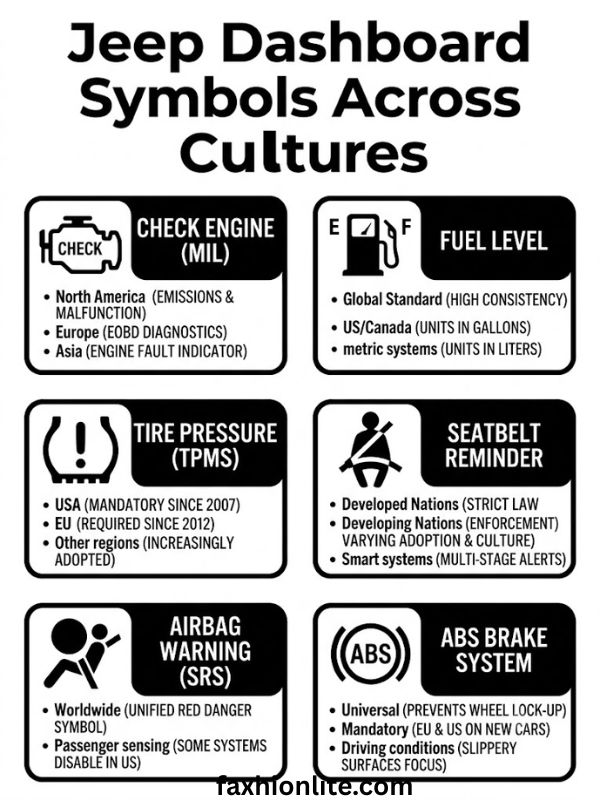
Since Jeep sells vehicles globally, it’s worth understanding how dashboard standards shift slightly depending on region, even though the core symbol language stays largely consistent everywhere.
United States
US-market Jeeps follow standards set largely through automotive engineering organizations based in North America, with English-first text labels appearing alongside icons on digital displays. This is the symbol set covered throughout this guide.
Europe
European-market Jeeps, including the Avenger which currently sells primarily overseas, follow slightly different international standards, though the visual icons themselves remain nearly identical to US versions. Multi-language digital displays are more common given Europe’s linguistic diversity.
Japan
Japanese-market vehicles follow their own regional standards body guidelines, generally aligning closely with global icon conventions while adapting cluster layout for right-hand-drive configurations, which affects where certain warning displays are positioned.
Middle East
Jeep’s Wrangler and Grand Cherokee models remain particularly popular across Middle Eastern markets, where extreme heat makes coolant temperature and tire pressure warnings especially relevant given the climate’s impact on both systems.
Modern Global Interpretation
The broader trend across all regions is a move toward standardized, universal pictograms regardless of country, paired with increasingly customizable digital clusters like Jeep’s Uconnect 5 system. This reduces regional variation over time rather than increasing it.
Jeep Dashboard Symbols in Art, Movies and Pop Culture
Jeep’s brand identity carries a distinct cultural weight tied to adventure, military heritage, and rugged independence, dating back to the original Willys MB used during World War II. This heritage shows up frequently in film, television, and advertising, where a lit dashboard warning often becomes a small storytelling device signaling trouble ahead for characters on a journey.
It’s a running gag in plenty of shows for a character to notice a dashboard light and simply ignore it for episodes at a time, which is entertaining on screen but genuinely risky in real driving. This pop culture trope actually reflects real world warning fatigue, the same psychological pattern discussed earlier in this guide.
Jeep’s grille design and overall silhouette, closely tied to its military origins, remain instantly recognizable across advertising and media, reinforcing the brand’s association with rugged capability rather than everyday commuting, even though most Jeeps today spend the majority of their time on paved roads.
Spiritual and Dream Meaning of Jeep Dashboard Symbols
Dreaming about a car with warning lights or mechanical trouble is a fairly common dream theme, and it’s worth noting upfront that this section is about folklore and interpretation, not actual vehicle diagnostics. If your real Jeep has a warning light on, refer to the earlier sections of this guide rather than dream symbolism.
In dream interpretation traditions, a vehicle often represents a person’s sense of control or direction in life, so dashboard warnings appearing in a dream are sometimes interpreted as a subconscious signal that something in the dreamer’s life needs attention. This is a loose, symbolic reading rather than anything mechanical or scientific.
Some interpret a persistent dream about ignored warning lights as reflecting real world anxiety about unresolved responsibilities. Again, this is purely a folklore and psychological framing, included here because people do search for it, not because it reflects any actual automotive diagnosis.
Positive vs Negative Meaning
Dashboard symbols generally fall into two broad categories once you strip away the specific mechanical details: confirmations that something is working, and warnings that something needs attention.
Positive
Green and blue indicator lights represent the positive side of dashboard communication. These confirm that a feature, like adaptive cruise control, 4WD engagement, or your Selec-Terrain mode, is actively working exactly as intended. Seeing these lights should give you confidence rather than concern.
Negative
Red and amber warning lights represent the negative side, flagging something that needs your attention, ranging from a minor maintenance reminder to a genuine safety concern. Learning to quickly tell these two categories apart is the fastest way to reduce dashboard-related stress while driving.
Why Humans Are Attracted to Dashboard Symbols
Dashboard symbols succeed because they reduce cognitive load, meaning your brain processes a simple icon faster than it would process a written sentence. This matters enormously while driving, where every second of distraction carries real risk.
Studies on driver attention consistently show that pictogram-based warnings are processed and understood faster than text-based alternatives, which is precisely why automakers standardized icons decades ago rather than relying on written dashboard messages alone. This design choice wasn’t arbitrary. It came directly from research into how drivers process information under time pressure.
This same principle explains why humans are drawn to symbols more broadly, not just in cars. Simple, universally recognizable shapes communicate faster and more reliably than language ever could, especially across different countries, age groups, and literacy levels. Jeep’s dashboard, in that sense, is really just a small example of a much bigger truth about how humans prefer to receive urgent information.
Frequently Asked Questions
What do Jeep dashboard warning lights mean?
Jeep dashboard warning lights indicate vehicle conditions, safety alerts, or maintenance needs, helping drivers identify problems before serious damage occurs.
Which Jeep dashboard symbols require immediate attention?
Red warning lights, including engine temperature, oil pressure, battery, and brake alerts, require immediate action to prevent costly repairs.
Can I drive with a Jeep check engine light on?
A steady check engine light allows cautious driving temporarily, but flashing lights require immediate inspection to avoid engine damage.
Why does my Jeep dashboard show multiple warning lights?
Multiple dashboard warnings may indicate battery issues, electrical faults, sensor failures, or charging system problems requiring professional diagnosis promptly.
Where can I find all Jeep dashboard symbols explained?
This guide explains common Jeep dashboard symbols with meanings, warning levels, and recommended actions using clear pictures for easy identification.
Conclusion
Understanding Jeep dashboard symbols and meanings doesn’t require memorizing every single icon your vehicle could ever display. It just requires knowing the basics: red means stop soon, amber means schedule service, and green or blue means a feature is working correctly. From there, identifying the specific symbol becomes much easier.
Most warning lights point to simple, affordable fixes when caught early, whether that’s topping off oil, adjusting tire pressure, or tightening a gas cap. The real risk comes from ignoring a light for too long and letting a minor issue become an expensive one.
Bookmark this guide or download a printable version for your glovebox, and you’ll never be caught off guard by an unfamiliar light on your Jeep’s dashboard again.