New York Symbols You Need to Know & What They Really Mean
New York symbols are some of the most powerful and recognized images in the entire world. From the glowing torch of the Statue of Liberty to the electric lights of Times Square, these symbols tell the story of a place built on freedom, ambition, and diversity. They don’t just represent a city or a state, they represent an idea that millions of people across the globe deeply believe in.
What makes these symbols so special is that they speak to everyone. Whether you’re a lifelong New Yorker, a first-time visitor, or someone who has never set foot in the state, you already know what New York stands for. You feel it when you see the Brooklyn Bridge, the Empire State Building, or that simple but unforgettable “I ♥ NY” logo. These aren’t just images, they’re emotional connections to something much bigger than any one person or place.
What Are New York Symbols?

New York symbols are the official and cultural emblems that represent the identity, history, and values of both New York State and New York City. They range from legally designated state symbols like the Eastern Bluebird and the Rose, to culturally adopted icons like the Brooklyn Bridge and the yellow taxi cab.
What makes New York’s symbols unique is that they operate on two distinct levels. First, there are the official state symbols, designated by the New York State Legislature. These include the state bird, flower, tree, animal, motto, and seal. Second, there are the cultural and iconic symbols that weren’t chosen by any government body but became globally recognized through history, media, immigration, and everyday life.
Think of it this way: no one voted for the yellow taxi to be a symbol of NYC. But show that image anywhere in the world and people instantly think of New York. That kind of organic symbolism is actually more powerful in many ways than anything written into law.
The distinction matters because it helps you understand how a place builds its identity over time. Official symbols reflect what a state values in nature and heritage. Cultural symbols reflect how a city lives, breathes, and presents itself to the world.
Powerful New York Symbols That Define Identity
New York’s symbols are deeply tied to its history of immigration, ambition, and reinvention. No other state or city in America carries the same symbolic weight on the global stage.
New York Symbols And Meanings
Every New York symbol carries a specific meaning rooted in history and lived experience. The Statue of Liberty means freedom and welcome. The Empire State Building means human ambition. The beaver on the state seal means economic industriousness, honoring the fur trade that built early New York’s economy. Even the humble pretzel cart on a Manhattan sidewalk carries meaning, representing the city’s working-class immigrant food culture.
Understanding these meanings helps you see New York not just as a geography but as a living text. Every landmark, every emblem, every motto is a sentence in a long story about what human beings can build when they gather from every corner of the earth.
New York State Symbols
New York State has a surprisingly rich collection of officially designated symbols. Here’s a quick reference:
| Symbol | Official Designation | Year Adopted |
| State Bird | Eastern Bluebird | 1970 |
| State Flower | Rose | 1955 |
| State Tree | Sugar Maple | 1956 |
| State Animal (Mammal) | Beaver | 1975 |
| State Motto | Excelsior | 1778 |
| State Fish | Brook Trout | 1975 |
| State Gem | Garnet | 1969 |
| State Fruit | Apple | 1976 |
Each of these was chosen to reflect something genuine about New York’s natural environment or historical identity. The apple, for example, connects to New York’s long agricultural heritage and explains why New York City earned the nickname “The Big Apple.”
New York State Bird

The Eastern Bluebird (Sialia sialis) is New York’s official state bird, adopted in 1970. It’s a small thrush with a vivid blue back, rusty-orange breast, and white belly. You’ll find it perched on fences and low branches across rural and suburban New York, especially in orchards and open meadows.
What makes the Eastern Bluebird a fitting symbol is its character. It’s peaceful, non-aggressive, and associated across many cultures with happiness and renewal. During the mid-20th century, Eastern Bluebird populations declined sharply due to habitat loss and competition from invasive species like the European Starling.
Conservation efforts, particularly the installation of nesting boxes across the state, helped bring them back. Choosing the Eastern Bluebird as the state bird was in part a recognition of that conservation work and a commitment to protecting New York’s natural spaces.
NY State Bird And Flower
Together, the Eastern Bluebird and the Rose form a pairing that reflects two sides of New York’s character: the quiet natural beauty of its countryside and the classic elegance it’s always aspired to.
While the bluebird represents hope and restoration, the rose represents love, strength, and timeless beauty. For students creating school projects or anyone curious about New York’s natural identity, these two symbols are the perfect starting point.
New York State Flower
New York’s official state flower is the Rose, adopted in 1955. What’s interesting here is that New York didn’t designate a specific species of rose. The entire genus Rosa is the state flower, which makes New York one of the few states broad enough in its floral symbolism to embrace all varieties. Red roses, white roses, climbing roses — they’re all equally representative.
The rose was chosen by popular vote of New York schoolchildren in 1955, which gives it a democratic quality that many official symbols lack. It shows up in gardens across every borough of New York City and across every county of the state. The New York Botanical Garden in the Bronx maintains one of the most impressive rose collections in North America.
New York State Animal
The Beaver (Castor canadensis) became New York’s official state mammal in 1975. This choice is deeply historical. The beaver fur trade was the economic engine that drove European settlement of the region in the 1600s.
The Dutch colony of New Netherland, which later became New York, was largely built on the beaver pelt trade. You can still see the beaver on the official seal of New York City, where it appears at the bottom of the shield alongside two flour barrels and a pair of Native American figures.
The beaver is also an ecological symbol. Beavers are ecosystem engineers, creating wetlands that support dozens of other species. Choosing the beaver as a state symbol quietly nods to the importance of environmental stewardship.
New York State Tree
The Sugar Maple (Acer saccharum) was designated as New York’s state tree in 1956. If you’ve ever driven through upstate New York in October, you already know why. The sugar maple produces some of the most spectacular fall foliage on earth, with leaves that turn brilliant shades of red, orange, and gold.
But the sugar maple is more than just beautiful. It produces maple syrup, is one of the most valuable hardwood timber species in North America, and plays a critical role in northeastern forest ecosystems. New York is one of the leading maple syrup-producing states, and the sugar maple is deeply woven into the fabric of rural New York life.
New York State Motto
“Excelsior” has been New York’s official motto since 1778, making it one of the longest-running state mottos in American history. Translated from Latin, it means “Ever Upward,” a phrase that captures the perpetual ambition that defines New York’s character.
The motto appears on the state seal, the state flag, and countless official documents. Henry Wadsworth Longfellow wrote a famous poem titled “Excelsior” in 1841, inspired by this spirit of striving, which cemented the word’s cultural resonance.
Even Marvel Comics used “Excelsior!” as the signature catchphrase of Stan Lee, the New York-born creator of Spider-Man, Iron Man, and the X-Men. The word carries an almost mythic energy that feels perfectly suited to a state that has always dared to reach higher.
Iconic New York City Symbols

New York City’s symbols are recognized in every country on earth, appearing in films, advertisements, art, and fashion across every culture.
Symbols Of New York City
The NYC flag and seal are the official symbols of the city government, featuring three windmill sails (Dutch heritage), two flour barrels (colonial commerce), a beaver (the fur trade), and a bald eagle perched on top. The figures of a sailor and a Native American man flank the shield, representing the city’s origins at the intersection of indigenous and colonial worlds.
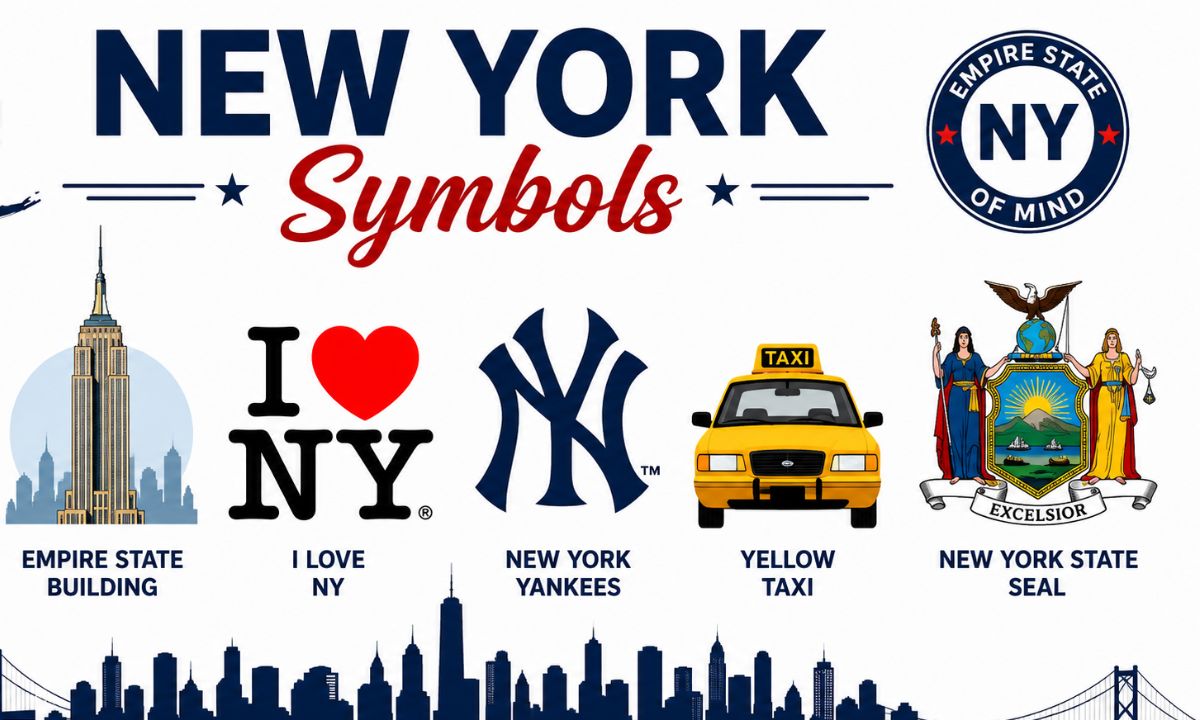
Beyond the official, the cultural symbols of New York City form a visual language understood globally. The Statue of Liberty, the Brooklyn Bridge, the Empire State Building, the yellow taxi, and Times Square are the five pillars of that visual language. Together they communicate freedom, achievement, urban energy, accessibility, and spectacle.
Brooklyn Symbols
Brooklyn has developed such a powerful identity that it functions almost like a city-within-a-city, with its own symbolic vocabulary. The Brooklyn Bridge is its most famous symbol, but the Coney Island Cyclone roller coaster, the Barclays Center, Brooklyn brownstones, and the Brooklyn Nets logo all carry strong symbolic weight.
Culturally, Brooklyn represents creative grit, artistic independence, and immigrant resilience. Neighborhoods like Bed-Stuy, Williamsburg, and Flatbush each carry their own symbolic identities tied to specific immigrant communities and cultural movements. The Brooklyn accent itself has become a cultural symbol, instantly communicating a particular kind of tough, warm, street-smart New York character.
I Love New York Symbol
Few logos in history have achieved what Milton Glaser’s “I ♥ NY” design accomplished. Created in 1977 during one of New York City’s darkest periods, when the city was near bankruptcy and crime rates were rising, the logo was originally designed as a temporary tourism campaign. Glaser reportedly sketched the first draft on a scrap of paper in the back of a taxi cab.
The genius of the design is its simplicity. A capital “I,” a red heart, and the letters “NY” in a bold serif font. Anyone can reproduce it by hand. Anyone can read it instantly. It transcends language, age, and culture. The logo was so successful that it was never retired, and it launched an entire global genre of city branding that continues today. Cities from Amsterdam to Tokyo have created their own versions, but none has matched the original.
Types and Variations of New York Symbols
Statue of Liberty
The Statue of Liberty, formally named Liberty Enlightening the World, was a gift from France to the United States, designed by sculptor Frédéric Auguste Bartholdi and completed in 1886. Standing 305 feet tall including its pedestal, it was the tallest structure in New York for years after its completion.
Every element of the statue is symbolic. The torch represents the light of freedom and knowledge. The crown has seven rays, representing the seven continents and seven seas. The broken chains at Liberty’s feet represent the abolition of slavery and the end of oppression.
The tablet in her left hand is inscribed with the date July 4, 1776. The statue faces southeast, toward the Atlantic Ocean, welcoming all who arrive by sea, which for millions of immigrants meant the first sight of their new country.
Empire State Building
The Empire State Building was completed in 1931 after just 410 days of construction, a feat that still astonishes architects and engineers today. At 1,454 feet to the top of its antenna, it held the title of world’s tallest building for 40 years. Designed in the Art Deco style by the firm Shreve, Lamb and Harmon, it represents the boundless economic optimism of the 1920s, even though it was completed at the height of the Great Depression.
What makes the Empire State Building a symbol rather than just a building is its role in popular culture. King Kong climbed it in 1933. Cary Grant and Deborah Kerr used it as a meeting place in An Affair to Remember. Tom Hanks and Meg Ryan stood on its observation deck in Sleepless in Seattle. The building changes the color of its antenna lights to commemorate events, holidays, and causes, turning it into a living symbol that responds to the world around it.
Brooklyn Bridge
The Brooklyn Bridge, completed in 1883 after 14 years of construction, was the longest suspension bridge in the world when it opened. Chief engineer John Roebling died before it was finished, and his son Washington Roebling completed the project while suffering from decompression sickness contracted during construction. His wife, Emily Warren Roebling, played a crucial role in supervising the final years of construction, making her one of the first women to lead a major engineering project.
The bridge is a symbol of human perseverance and connection. Its Gothic-style stone towers have appeared in thousands of photographs, paintings, and films. Every day, thousands of pedestrians walk its elevated wooden boardwalk, making it one of the few iconic landmarks in the world that you can genuinely experience by walking through it.
Yellow Taxi
The yellow taxi cab became an official symbol of New York street life in 1967 when the city standardized the color yellow for all licensed medallion cabs to make them easier to spot. Before standardization, cabs came in various colors and were harder to identify.
The yellow cab represents something genuinely democratic about New York: the idea that anyone, regardless of status, can hail a cab on the street and get where they’re going. It also represents the city’s relentless pace.
Yellow cabs appear in hundreds of films as visual shorthand for urban life, from Taxi Driver to Midnight Cowboy. Even as ride-sharing apps like Uber have reduced their numbers, the yellow cab remains a beloved visual symbol of a particular New York era.
Deep Symbolic Meaning
New York symbols carry meaning on multiple layers that most people never stop to examine.
Spiritual Level
On a spiritual level, the Statue of Liberty’s torch has been interpreted as a symbol of enlightenment in the philosophical tradition of the Enlightenment movement. The idea that reason and freedom illuminate human life is literally represented as a flame held aloft. The motto “Excelsior” functions as a spiritual aspiration, encouraging perpetual growth and reaching beyond one’s current limitations.
Psychological Level
Psychologically, New York symbols trigger powerful emotional responses because they’ve been repeated across media for over a century. The sight of the NYC skyline creates feelings of excitement, aspiration, and possibility in people who have never even visited the city. This is the power of place symbolism: when a location becomes associated with certain values often enough, those feelings become automatic.
Cultural Level
Culturally, New York symbols function as a shared language. When someone wears an “I ♥ NY” shirt in Tokyo or gets a Statue of Liberty tattoo in Brazil, they’re borrowing New York’s cultural vocabulary to say something about their own values: their love of freedom, their admiration for ambition, their connection to the idea of reinvention. New York’s symbols have become globally available in a way that most city symbols simply haven’t.
Positive vs Negative Meaning
Positive Meaning
New York symbols carry enormously positive associations for most people. They represent freedom, opportunity, ambition, creativity, diversity, and resilience. For immigrants and their descendants, symbols like the Statue of Liberty carry deeply personal meaning, representing the moment their families arrived in a new country and built new lives.
Negative Meaning
At the same time, critics point out that New York symbols can obscure difficult realities. The gleaming skyline doesn’t show the city’s housing inequality. The “I ♥ NY” brand was created during a time of deep civic crisis and was partly designed to paper over those problems with positive imagery.
The Statue of Liberty, for all its beauty, stands in a harbor that millions of enslaved Africans were brought through before abolition. Understanding the shadow side of symbols doesn’t diminish them but makes your understanding of them more honest and complete.
FAQs
What is the most famous New York symbol?
The Statue of Liberty is the most universally recognized New York symbol in the world. It appears on official government materials, tourism campaigns, and in the cultural consciousness of people across every continent.
Why are New York symbols so popular?
New York’s status as a global media capital means its symbols get repeated in films, television, music, and advertising more than any other American city. That repetition builds global recognition over generations.
Are New York symbols only landmarks?
Not at all. New York symbols include official state designations like the Eastern Bluebird and the Rose, cultural symbols like the yellow taxi and the bagel, phrases like “Excelsior,” and graphic designs like the “I ♥ NY” logo.
What do New York symbols mean spiritually?
The Statue of Liberty’s torch represents enlightenment and the light of reason. The motto “Excelsior” functions as a spiritual call to perpetual growth. Many people also interpret the Brooklyn Bridge as a symbol of connection across divides, both literal and metaphorical.
How are New York symbols used in media?
New York symbols serve as instant visual shorthand in films, TV shows, and advertising. Directors use a shot of the NYC skyline or the Brooklyn Bridge to establish setting, mood, and themes within seconds, without a single line of dialogue.
Conclusion
New York symbols are far more than decorations or tourist merchandise. They’re the condensed stories of a place that has shaped the world’s understanding of freedom, ambition, and human possibility. From the officially designated Eastern Bluebird perched on an upstate fence to the glowing Empire State Building piercing the Manhattan sky, every symbol carries layers of history, meaning, and emotion.
What makes New York’s symbols extraordinary is that they belong to everyone. You don’t have to be a New Yorker to feel something when you see the Statue of Liberty. You don’t have to have ridden in one to know exactly what a yellow taxi means. These New York symbols have transcended geography and become part of how humanity talks about its own deepest aspirations.