100+ Squid Game Symbols and Their Hidden Meanings You Never Noticed
Squid Game symbols are the circle, triangle, and square shapes, along with the masks, colors, and numbers used throughout the show to represent hierarchy, control, and class division. If you’ve watched the series and felt like something deeper was going on beneath the surface, you weren’t imagining it.
Most people watch Squid Game for the tension and the shocking twists. But underneath that drama sits a carefully built visual language. Hwang Dong-hyuk, the show’s creator, has said the geometric shapes were the very first images he thought of when he conceived the series, tracing back to childhood games where kids drew circles, triangles, and squares on the ground.
That single detail changes how you see the whole show. This isn’t set decoration, it’s a system, and once you know how to read it, you’ll notice it everywhere, from the guards’ masks to the shape of the arena itself.
What Are Squid Game Symbols?

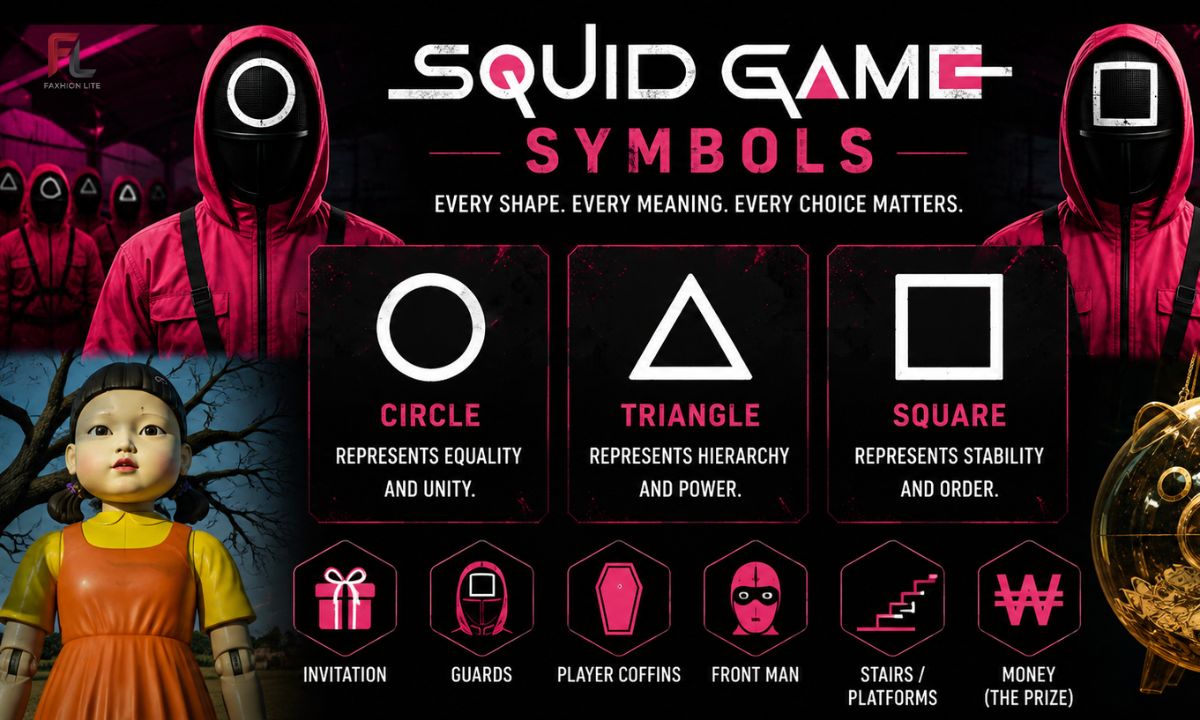
Squid Game symbols are the recurring visual markers, mainly the circle, triangle, and square, that the show uses to represent rank, identity, and power. They appear on masks, uniforms, invitation cards, and even the playing field itself.
In a show with very little dialogue explaining its own internal rules, the shapes act as shorthand. A circle mask means low-level labor. A triangle mask means armed enforcement. A square mask means management. The Front Man, who oversees the entire operation, sits above all three.
There’s also a linguistic layer a lot of Western viewers miss. The circle, triangle, and square roughly correspond to Korean consonants that together can be read as an abbreviation of “Ojingeo Geim,” the original Korean title for Squid Game. The shapes aren’t just hierarchy markers, they’re a coded signature of the show’s own name, hidden in plain sight since the first episode.
Fact: In Squid Game, the circle, triangle, and square masks worn by guards correspond directly to rank, with circle as the lowest level, triangle as armed enforcement, and square as management.
Deep Symbolic Meaning
The deeper meaning behind Squid Game symbols works on three separate levels: spiritual, psychological, and cultural. Each layer explains a different reason why these shapes hit so hard emotionally.
Geometric shapes have carried meaning across human history long before Squid Game existed, showing up in religious art, architecture, and mythology across nearly every culture on earth. The show borrows that deep well of association and repurposes it for a modern story about debt, desperation, and survival.
Spiritual Level
On a spiritual level, the circle, triangle, and square in Squid Game echo older ideas about existence, cycles, and ascension. The circle stands for wholeness and the endless nature of life and death. The triangle often represents movement upward, whether spiritual ascension or a warning of danger. The square ties to grounding and stability.
You can see traces of these associations in Korean shamanistic tradition, where circular motifs often represent the continuous cycle of fate. The show never explains this outright, but the visual grammar lines up closely enough to feel intentional.
There’s also something quietly unsettling about how the game traps its players in a loop, since the circle never really closes until someone wins or dies, mirroring cyclical fate where characters feel powerless against a system that keeps turning regardless of what they want.
Psychological Level
Psychologically, Squid Game’s symbols work as tools of control and dehumanization. The masks strip identity from both the guards and, eventually, the players, who lose their names and become numbers pinned to green tracksuits.
Researchers studying group behavior have long noted that removing personal identity, a concept sometimes called deindividuation, makes people more likely to follow orders without question, even harmful ones. The Squid Game guards in their identical masks are a clear example. You never see their faces or learn their names, and that anonymity makes their obedience feel automatic and mechanical.
Sharp angles like the triangle also tend to read as more threatening than soft, rounded shapes, a pattern designers have used for decades in warning signage. By the time you consciously register a triangle mask as dangerous, your brain has already reacted to it.
Cultural Level
Culturally, the symbols double as commentary on class division and economic inequality. Hwang Dong-hyuk has described the shapes as representing the endless competition built into late-stage capitalism, with each guard rank standing in for a different rung on a larger social ladder.
This lines up with the show’s broader themes. The players are drowning in debt before they ever step onto the game floor, and the guards are themselves trapped in a rigid system with almost no room to move up. Nobody escapes the structure, not even the people running it, a sharp piece of social commentary delivered without a single line of dialogue.
Types / Variations of Squid Game Symbols
The three core Squid Game symbols, circle, triangle, and square, each carry a distinct meaning tied to rank and power. Together, they form a hierarchy that governs almost every interaction on screen.
Circle
The circle symbol represents the lowest rank among the masked workers, the players themselves, and broader themes of unity and entrapment. Circle-masked staff handle basic tasks like cleaning, food service, and body removal.
Beyond rank, the circle also stands in for the players as a group, who enter the game as equals, at least on paper, all wearing the same numbered tracksuit. That surface-level equality is part of the show’s cruelest irony, since real survival odds are anything but equal once the games begin. The circle also closes the loop quite literally, mirroring the trapped, repetitive nature of debt the players are running from.
Triangle
The triangle symbol marks the mid-level enforcers, the armed guards who maintain order and eliminate players who break the rules. Sharp corners and an upward point give the triangle a natural sense of alertness and threat.
This isn’t accidental. Triangles show up constantly in real-world hazard design, from road signs to safety labels, because the human eye reads angular shapes as warnings faster than rounded ones. So even before a triangle guard raises a weapon, the shape itself has already signaled danger.
Triangle guards sit in the middle of the chain of command, taking orders from square-ranked managers and enforcing them on circle-ranked workers and the players, making them the most visible face of the game’s brutality despite holding the least actual power.
Square
The square symbol represents management and top-level authority, including the Front Man, who oversees the entire operation from behind a black mask. Squares suggest stability, structure, and control, fitting for the rank that gives every order.
Interestingly, the square is also the shape of the arena itself in several key games, reinforcing the idea that the competition exists inside a rigid structure built by people at the top. This rank rarely appears in large numbers, mirroring real-world power structures where authority concentrates in the hands of a few.
Combined Symbol System
Circle, triangle, and square together form a complete power pyramid, similar to military ranks or corporate org charts, a functioning model of institutional control condensed into three shapes.
Once you see the shapes as a single connected system, the show’s social commentary becomes clearer. Nobody in a mask is free, not even the ones giving orders. The Front Man himself answers to unseen investors, proving the hierarchy extends far beyond what viewers see on screen.
Squid Game Symbols Across Cultures
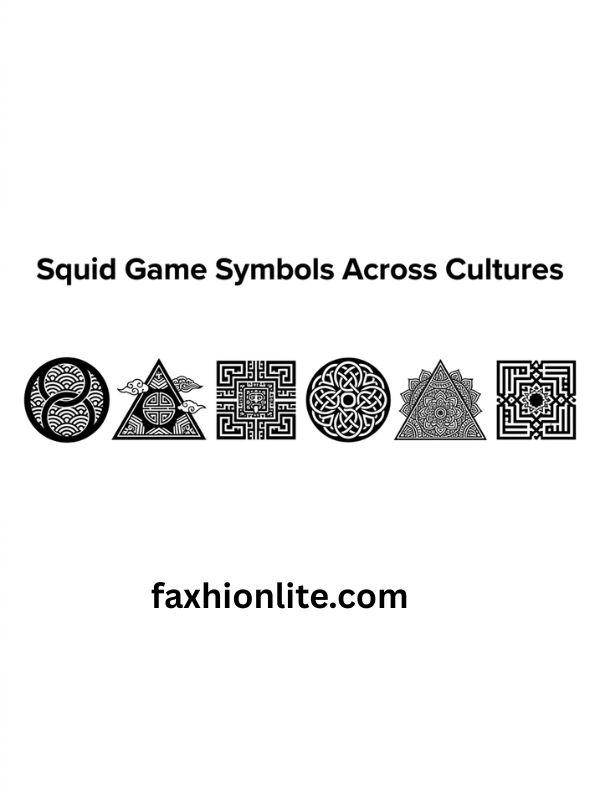
Squid Game symbols draw from a mix of Korean tradition, ancient philosophy, and modern global visual culture, which is why the shapes resonate with audiences who’ve never set foot in South Korea.
Korean Culture
The circle, triangle, and square trace back to a real Korean children’s game of the same name, drawn on the ground with chalk. Kids competed to move across the shapes without getting pushed out, a gentler version of the deadly competition the show depicts.
Confucian ideas about hierarchy and collective duty echo through the show’s guard system, where rank determines both responsibility and consequence, while the bold color palette of the pink guard uniforms and teal player tracksuits draws on modern Korean design sensibilities.
Ancient Greek Influence
Long before Squid Game, Greek philosophers like Plato treated geometric shapes as expressions of ideal forms, with the circle standing for perfection and completeness. That sacred geometry tradition, expanded by Pythagorean thought, treated basic shapes as building blocks of the universe.
Western audiences may not consciously connect the show’s shapes to Greek philosophy, but the underlying associations run deep enough in Western visual culture that the symbolism still lands.
Eastern Philosophy
Broader Eastern philosophy, including Taoist and Buddhist ideas about cyclical time and impermanence, adds another layer to the circle’s meaning. Life, death, and rebirth as an unbroken loop maps neatly onto a game where losing means death and winning just means surviving to the next round.
This philosophical backdrop also explains the show’s minimalist visual style, where simple shapes and flat colors reflect an aesthetic tradition that values restraint over excess.
Modern Global Culture
Once Squid Game became a global phenomenon, its symbols took on a life of their own outside the show. Circle, triangle, and square masks became Halloween costumes, meme templates, and brand collaboration designs within months of release, a rapid symbol adoption that says a lot about how universally readable simple geometry can be.
Digital Age Symbolism
Online, the shapes evolved into their own shorthand, showing up in emoji combinations, fan art, and TikTok trends built around guessing which shape a creator would draw next. The symbols became a kind of internet-native logo, instantly recognizable without needing the show’s title attached.
Squid Game Symbols in Art, Movies & Pop Culture
Squid Game’s shapes have influenced fashion lines, murals, tattoo designs, and parody videos since the show’s debut. Artists have reinterpreted the circle, triangle, and square in everything from streetwear graphics to gallery installations about surveillance and control.
Similar symbol systems show up elsewhere in dystopian fiction, though rarely this cleanly. Masked hierarchies appear in films exploring authoritarian control, and numbered identity systems echo classic dystopian literature where names get replaced with digits to strip away individuality.
Fact: Masks marked with a circle, triangle, or square denote three separate ranks among Squid Game’s guards, with circles as the lowest rank and squares reserved for managers and the Front Man.
What sets Squid Game apart is how fast its imagery crossed into unrelated industries, proving the symbolism works independently of the show’s plot.
Spiritual & Dream Meaning of Squid Game Symbols
Many viewers search for what it means to dream about Squid Game, and the shapes carry loose symbolic interpretations outside the show’s context. A circle in a dream often reads as unfinished business or a feeling of being trapped in a cycle. A triangle can suggest a warning or pressure from authority. A square might point to a need for stability or a feeling of being boxed in.
These interpretations lean on folklore rather than clinical psychology, so treat them as reflective prompts rather than firm predictions.
Positive vs Negative Meaning
Like most powerful symbols, the meaning behind Squid Game’s shapes shifts depending on the context and the intent behind them.
Positive Meaning
On the positive side, the circle can represent unity and a shared starting point, since every player enters the game wearing the same uniform and number. The shapes as a whole can also read as a reminder of collective humanity, since the players’ real strength comes from cooperating with each other.
Negative Meaning
On the negative side, the same shapes represent surveillance, control, and the erasure of identity. The masks strip guards of humanity just as thoroughly as the numbers strip the players of theirs, and the rigid hierarchy leaves almost no room to escape an assigned role.
Why Humans Are Attracted to These Symbols

Humans are naturally drawn to simple geometric shapes because the brain processes basic patterns faster than complex imagery. This is the same principle that makes flags, religious symbols, and corporate logos rely on clean lines rather than intricate detail.
Squid Game’s shapes benefit from this cognitive shortcut. A circle, triangle, and square are instantly recognizable, which is exactly why they translate so well into merchandise, memes, and fan discussion. Mystery adds another layer of pull, too.
Once fans realized the shapes carried hidden meaning tied to hierarchy and the show’s Korean title, discussion exploded across Reddit threads and YouTube breakdowns trying to decode every appearance.That combination of simple design and layered meaning is a rare mix, memorable enough for casual viewers and deep enough to reward close analysis.
Frequently Asked Questions
What does the circle, triangle, and square mean in Squid Game?
The circle marks the lowest guard rank, triangle marks armed enforcers, and the square marks top management.
Why do Squid Game guards wear masks?
Masks hide the guards’ identities, enforce anonymity, and reflect the show’s deeper themes of control and dehumanization.
What do the numbers on Squid Game players’ uniforms mean?
Numbers replace names, stripping every player’s identity and turning each participant into just an anonymous, disposable competitor.
What does the Squid Game logo actually represent?
The logo’s circle, triangle, and square shapes secretly spell out the show’s own original Korean title initials.
Are Squid Game symbols based on real Korean traditions?
Yes, the shapes come from an actual Korean children’s game traditionally drawn on the ground with chalk.
Conclusion
Squid Game symbols work because they operate on so many levels at once. The circle, triangle, and square aren’t just masks and set pieces. They’re a coded map of power, a nod to childhood games, a hidden reference to the show’s own title, and a sharp piece of commentary on class and control, all wrapped into three basic shapes.
Next time you rewatch the show, pay attention to how often those three forms repeat, from the opening title sequence to the final arena. You’ll likely catch details you missed the first time, and that’s really the point. Great symbolism rewards a second look.