73+ Iconic USA Symbols That Shaped America’s History & Identity (2026)
USA symbols are the flags, animals, monuments, and cultural icons that represent the nation’s history, values, and identity. There are more than 70 of them once you count official emblems, state symbols, and unofficial cultural icons together.
Some were created by an act of Congress. Others grew out of folklore, war, and everyday life. Together they show how a young American experiment in democracy built one of the world’s most recognizable national identities.
This guide covers the official national symbols of USA government records alongside the unofficial ones people search for most. It also looks at why these images still move people two centuries later.
Quotable fact: The bald eagle became the official national bird of the United States in 1782, when the Continental Congress approved its use on the Great Seal.
Quotable fact: The Statue of Liberty was a gift from France, dedicated in 1886 in New York Harbor, and it remains one of the most photographed American monuments in the world.
What Are USA Symbols?
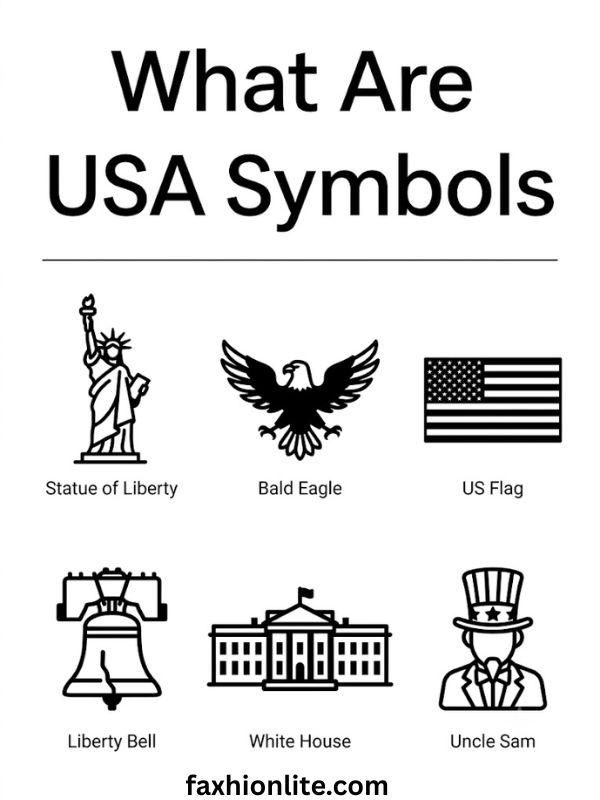
USA symbols are the visual and cultural markers, ranging from the flag to the bald eagle, that stand in for the country’s shared history, values, and sense of national identity. They work like a shorthand. Instead of explaining what American values are in a paragraph, you show someone a flag or an eagle, and the meaning lands instantly.
These symbols fall into two broad categories. Official national emblems are the ones formally recognized by the federal government, such as the flag, the Great Seal of the United States, and the bald eagle.
Unofficial cultural symbols are things Americans have adopted over time through habit and shared experience, like apple pie, baseball, or the cowboy hat. Neither category was designed all at once. Most of these symbols were added over 250 years, shaped by wars, waves of immigration, and shifting political needs.
It helps to think of USA symbols the way you’d think of a family photo album. Some images are formal portraits, carefully chosen and preserved in law. Others are candid snapshots that just happened to stick around because people liked them. Both types matter, and both show up constantly in classrooms, textbooks, and everyday conversation about what it means to be American.
Exploring American Identity Through National Icons
American identity is built partly through shared symbols, because a country of over 330 million people needs common reference points to feel like one nation rather than fifty separate states. National icons give people, regardless of background or region, a shared visual language.
This matters more than it might seem. Sociologists who study national identity point out that large, diverse countries rely heavily on symbols precisely because everyday life looks so different from state to state.
A rancher in Montana and a software engineer in Boston may have almost nothing in common day to day, but both recognize the flag, both know what the bald eagle stands for, and both understand what the Statue of Liberty means. That shared recognition is doing real cultural work.
USA Symbols And Meanings
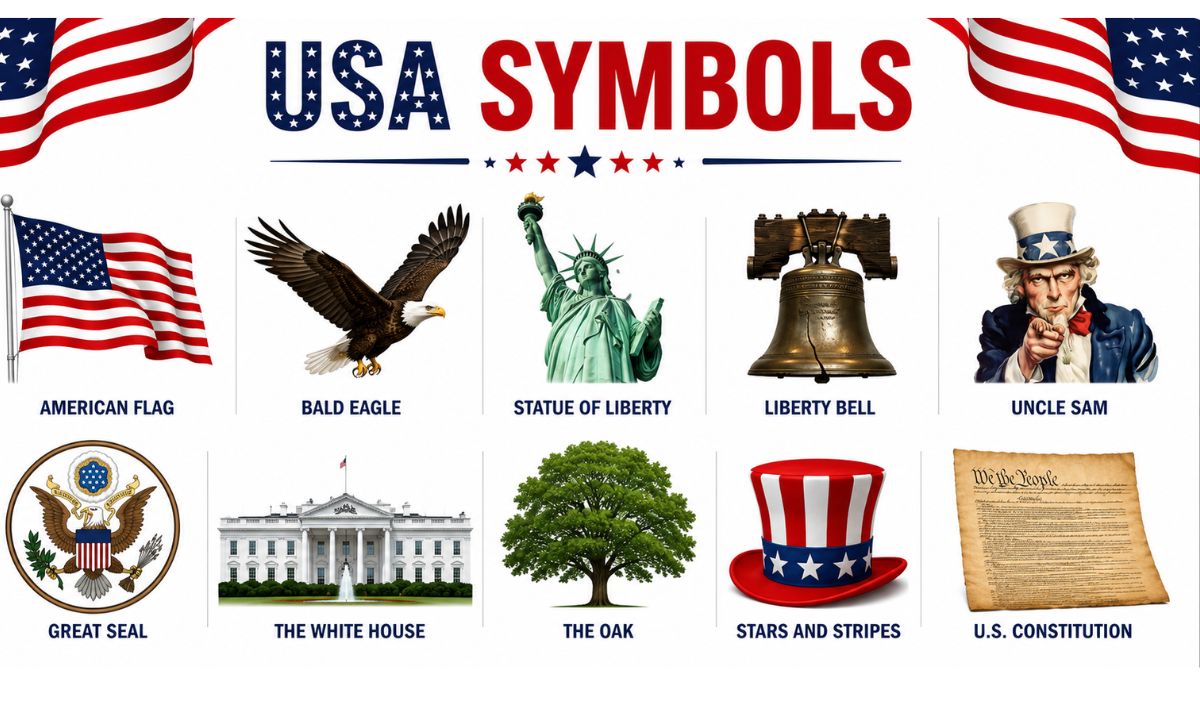
Every major USA symbol carries a specific, intentional meaning. The flag’s stars represent the fifty states while the stripes represent the original thirteen colonies. The bald eagle represents strength, freedom, and long life. The Statue of Liberty’s torch represents enlightenment, and her broken chains at her feet represent freedom from tyranny.
The Liberty Bell represents the announcement of independence, cracks and all. Understanding these meanings turns a simple picture into a piece of American history you can actually explain.
United States National Symbols
The federally recognized national symbols of USA government include the American flag, the bald eagle as national bird, the Great Seal of the United States, the national anthem “The Star Spangled Banner,” the rose as the national flower, and the oak as the national tree. Each was adopted through a specific act of Congress rather than informal tradition, which is part of what separates official symbols from cultural ones.
U.S. State Symbols List
Beyond the national level, every one of the fifty states has its own flag, bird, flower, and motto. Texas flies the Lone Star flag, a nod to its brief history as an independent republic. California’s flag features a grizzly bear, an animal that is now extinct within the state’s own borders.
Maryland’s flag is widely considered one of the most visually distinct in the country, combining the family crests of Lord Baltimore’s ancestors. These state-level symbols add local identity on top of the shared national one.
USA Symbols Eagle
The bald eagle was chosen as the national bird in 1782 after a lengthy debate within the Continental Congress. A popular myth claims Benjamin Franklin lobbied hard for the turkey instead, though historians note this idea comes mostly from a private letter Franklin wrote to his daughter, not a formal congressional push. The eagle was ultimately selected because of its size, its long lifespan, and its exclusive presence in North America, which made it feel distinctly American in a way a European-native bird never could.
USA Symbols For Kids
For younger readers, USA symbols are easiest to learn through simple, memorable facts: the flag has fifty stars for fifty states, the eagle is America’s national bird, and the Statue of Liberty holds a torch and a book.
Teachers often pair these facts with coloring activities or short classroom presentations, since young children retain symbolic information better through repetition and visuals than through text alone.
National Symbols Of Usa Presentation
Teachers and students building a classroom presentation on national symbols of USA typically structure it around six to eight slides: an introduction slide, then one slide each for the flag, the bald eagle, the Statue of Liberty, the Great Seal, and the Liberty Bell, followed by a closing slide with discussion questions like “which symbol do you think best represents freedom, and why?” This structure keeps the presentation focused while still covering the major icons.
USA Symbols Copy And Paste
People searching for copy and paste USA symbols usually want quick text-based icons for messages or social media, such as the flag emoji 🇺🇸, the eagle emoji 🦅, and the star symbol ⭐. These small text symbols let people express patriotism quickly in texts, captions, or comments without needing an actual image file.
Popular Images And Patriotic American Signs
Patriotic American signs and images are the visual shorthand people reach for around holidays like the Fourth of July, Memorial Day, and Veterans Day. These images range from the deeply official, like the Great Seal, to the casually cultural, like red, white, and blue bunting on a porch.
Images matter here in a very literal sense. Searches for American symbols and pictures spike heavily around national holidays, which tells you people are not just curious about history. They are actively looking for material to use in classroom projects, party decorations, or social posts. This makes visual clarity just as important as historical accuracy when covering this topic.
It’s also worth noting that patriotic imagery isn’t static. Uncle Sam, for example, started as a Civil War era nickname and became a fully illustrated character during World War I recruitment posters, particularly the famous “I Want You” image. That means even the “classic” patriotic images most people picture today are themselves products of specific historical moments, not ancient traditions.
American Symbols Pictures
The most searched American symbol pictures include the flag waving against a blue sky, the bald eagle in flight, the Statue of Liberty’s torch close up, and the White House at dusk. These specific compositions show up repeatedly because they photograph well and instantly communicate the intended patriotic tone.
Famous American Symbols
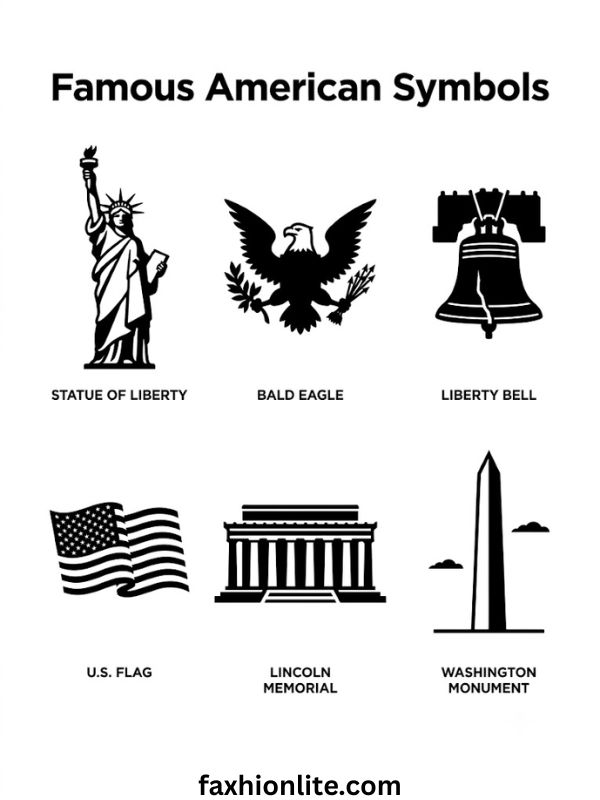
The five most globally recognized American symbols are the Statue of Liberty, the bald eagle, the American flag, Mount Rushmore, and the White House. International visitors often name the Statue of Liberty first, since it was historically the first sight many immigrants saw when arriving by ship in New York Harbor.
Usa Symbols Worksheet
Educational worksheets on USA symbols typically include matching activities, where students connect a symbol to its meaning, plus fill in the blank questions and a short coloring section. These worksheets are popular with homeschool parents and elementary teachers building a unit around Presidents Day or the Fourth of July.
Usa Symbols Of Freedom
The clearest symbols of freedom in American culture are the Statue of Liberty, the Liberty Bell, and the flag itself, since all three trace directly back to the country’s founding fight for independence from British rule. The Statue of Liberty in particular was designed with broken chains at her feet, a detail many visitors miss but one that was very intentional.
Symbol Of United States
If someone is searching for the single symbol of the United States, the answer is almost always the American flag, since it is the one image used across government buildings, military uniforms, courtrooms, and international diplomacy more consistently than any other symbol.
Symbols Of The Usa
Beyond the flag and eagle, broader symbols of the USA include baseball, jazz music, the Hollywood sign, and Route 66, all of which represent American culture rather than American government specifically.
National Symbols Of United States
This is the government facing side of the topic again, and it circles back to the same formally adopted list: the flag, the bald eagle, the Great Seal, the national anthem, and the national motto “In God We Trust,” which was formally adopted by Congress in 1956.
Pictures Of United States Symbols
People looking for pictures of United States symbols are typically building a report, slideshow, or classroom display and want a clean visual set covering the flag, the eagle, the Statue of Liberty, and the Capitol building together in one place.
Symbols Of America
At its broadest, symbols of America stretch past government icons entirely into everyday culture: cowboy hats, the bald eagle, apple pie, the American dream itself as a concept, and even fast food culture, all of which foreign observers often name when asked what feels distinctly American.
Learning About American Culture And History
American culture and history are deeply intertwined with its symbols, since most of the icons covered in this guide were created during, or directly because of, a specific historical event. You cannot separate the Liberty Bell from the American Revolution, or the Statue of Liberty from the era of mass immigration through Ellis Island.
This connection is exactly why symbols make such effective teaching tools. A single image, like the Betsy Ross flag with its circle of thirteen stars, can anchor an entire lesson about the founding colonies without requiring a student to memorize dates first. The symbol becomes the entry point, and the history follows naturally from there.
It is also worth noting that American symbols have continued evolving well past the founding era. The Pledge of Allegiance, the national motto, and even certain uses of the bald eagle on currency were all added or adjusted well into the twentieth century, showing that this is a living tradition rather than something frozen in 1776.
Us History Symbols
Symbols tied specifically to American history include the Betsy Ross flag from the Revolutionary era, the Gadsden flag with its coiled snake and “Don’t Tread On Me” motto, and the Liberty Bell, which rang out to mark the reading of the Declaration of Independence in Philadelphia.
United States Symbols
Taken as a full set, United States symbols blend the founding era icons with newer additions like the moon landing flag planted in 1969, which added a modern chapter to a story that started with thirteen colonies.
Symbol Usa
On currency, in passports, and on federal documents, the eagle from the Great Seal is the most consistently used symbol USA government agencies rely on, appearing on the dollar bill, official seals, and military insignia alike.
What Are 5 Symbols That Represent America?
The five symbols most commonly cited as representing America are the American flag, the bald eagle, the Statue of Liberty, the Great Seal of the United States, and the Liberty Bell. These five appear together consistently across textbooks, government websites, and museum exhibits.
Symbols Of The United States
Looking past the top five, secondary symbols of the United States include Uncle Sam, Mount Rushmore, and the eagle imagery found on nearly every branch of the military’s official seal.
Symbols Of Usa
Regional culture adds another layer here, since symbols of USA identity shift depending on location, from cowboy culture across the West to lighthouses along the New England coastline.
Usa Symbols Coloring Pages
Free coloring pages for USA symbols typically feature simple outlines of the flag, the bald eagle, the Liberty Bell, and the Statue of Liberty, sized for different age groups from toddlers through upper elementary students.
Usa Symbols Drawing
Basic drawing tutorials for USA symbols usually start with the flag’s rectangle and stripes before moving to the eagle’s wingspan, since both can be broken down into simple geometric shapes that are approachable for beginners.
Usa Symbols Images
High quality, royalty free images of USA symbols are commonly available through public domain government sources such as the Library of Congress, which maintains extensive historical photo archives free for public use.
Eagle Usa Symbols
Beyond its role as the national bird, the eagle appears on the presidential seal, on military medals, and on the back of several coins, making it one of the most visually repeated symbols in the entire federal government.
Usa Symbols For Kindergarten
For kindergarten age children, the simplest entry point is color recognition. Red, white, and blue on the flag, brown and white on the bald eagle, and green for Lady Liberty’s copper patina.
Usa Symbols Wallpaper
Wallpaper style searches for USA symbols usually favor the flag waving in wind or the bald eagle in flight, both of which translate well to phone and desktop screen dimensions.
Usa Symbols Clipart
Clipart versions of USA symbols simplify these icons into flat, easily recognizable shapes, ideal for classroom worksheets, newsletters, or simple digital projects.
Turning Point Usa Symbols
It’s worth clarifying that Turning Point USA symbols refer to the branding of a political nonprofit organization founded in 2012, which is separate from official national symbols of the United States government.
Usa Symbols Of Nationalism
National symbols can express pride and unity, though they are sometimes used within political movements to signal specific ideological positions, which is a distinction worth understanding rather than ignoring.
Georgia Usa Symbols
As one state example, Georgia’s official symbols include the brown thrasher as state bird and the Cherokee rose as state flower, both chosen to reflect the state’s specific natural heritage.
Deep Symbolic Meaning
USA symbols carry meaning on more than one level, operating simultaneously as spiritual imagery, psychological anchors, and cultural touchstones depending on how a person engages with them.
Historians of religion and folklore have long noted that national symbols often borrow structure from spiritual imagery, even in officially secular governments. The torch held by the Statue of Liberty, for instance, echoes older symbols of enlightenment and guidance found across many cultures, long before it became specifically American.
Psychologically, repeated exposure to the same national symbols, from childhood pledges to holiday decorations, builds what social scientists call a shared in-group identity. This is not unique to the United States, but the scale and consistency of American symbol use, especially in schools and media, makes the effect particularly strong here.
Spiritual Level
On a spiritual level, the eagle is often read as a symbol of vision and higher perspective, while the Statue of Liberty’s torch represents guidance and hope, themes that predate American history but were deliberately folded into these designs.
Psychological Level
Psychologically, national symbols function as identity anchors. Seeing a flag or hearing the anthem can trigger a strong emotional response tied to belonging, memory, and shared experience, even for people who rarely think about politics day to day.
Cultural Level
Culturally, symbols get transmitted generation to generation through school pledges, holiday traditions, and media repetition, which is part of why a five year old and a ninety year old can recognize the same flag and feel a similar, if not identical, sense of connection to it.
Types Of USA Symbols
USA symbols generally fall into six major categories that show up again and again across education, government, and pop culture: the flag, the bald eagle, the Statue of Liberty, the Great Seal, the White House, and the Liberty Bell.
Each of these six carries its own origin story, and each was adopted or built during a different chapter of American history, spanning from the Revolutionary War through the late nineteenth century. Together they form the backbone of nearly every “top USA symbols” list you will find anywhere online.
What makes these six worth studying individually, rather than lumping them into one general list, is that each answers a slightly different question about the country. The flag answers “who are we as a union.” The eagle answers “what traits do we value.” The Statue of Liberty answers “what do we offer newcomers.” The sections below break down each one specifically.
The American Flag
The American flag has been redesigned twenty seven times since 1777, each change reflecting the addition of new states to the union. The current fifty star design has been in place since 1960, following Hawaii’s admission as the fiftieth state. Its colors are not decorative. Red stands for valor, white for purity, and blue for justice and vigilance, a meaning formally recorded in early congressional records.
The Bald Eagle
The bald eagle earned its spot as national bird in 1782 for its size, longevity, and status as a species found only in North America. Interestingly, the bald eagle nearly went extinct in the twentieth century due to pesticide use, and it was only removed from the U.S. endangered species list in 2007, a conservation success story that runs parallel to its symbolic importance.
The Statue Of Liberty
The Statue of Liberty was designed by French sculptor Frédéric Auguste Bartholdi and dedicated in 1886 as a gift from France, commemorating the alliance between the two nations during the American Revolution. Standing in New York Harbor, she holds a torch symbolizing enlightenment and a tablet inscribed with the date of American independence, July 4, 1776.
The Great Seal
The Great Seal of the United States features the bald eagle holding an olive branch and arrows, symbolizing the power of peace and war, alongside the Latin motto “E Pluribus Unum,” meaning “out of many, one.” This seal appears on official documents, the back of the one dollar bill, and every U.S. passport issued today.
The White House
The White House has served as the residence and workplace of every U.S. president since John Adams in 1800. Beyond its practical role, it functions symbolically as the visual shorthand for executive power itself, appearing constantly in news coverage, film, and political commentary as a stand in for the presidency.
The Liberty Bell
The Liberty Bell, housed in Philadelphia, rang to mark public readings of the Declaration of Independence and later became a rallying symbol for the abolitionist movement in the nineteenth century. Its famous crack, which occurred sometime after casting, has ironically become part of its identity rather than a flaw people try to hide.
USA Symbols Across Cultures
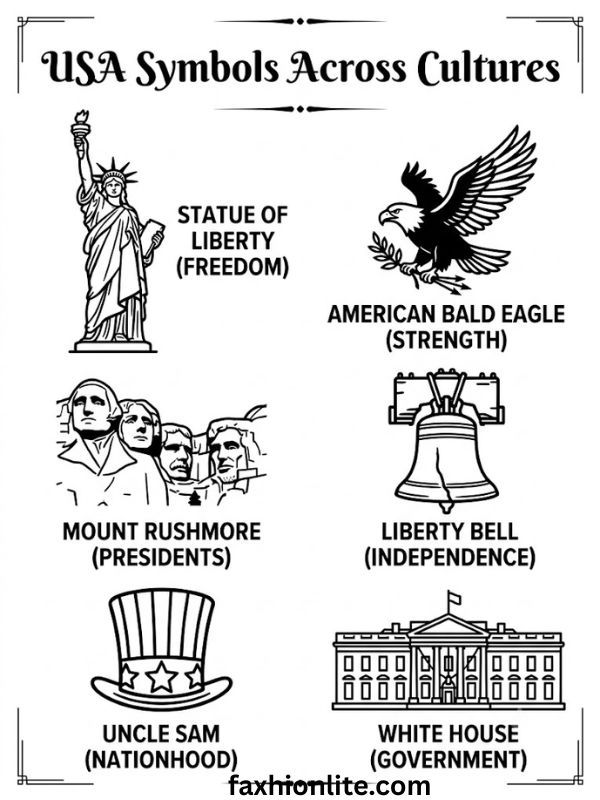
USA symbols are not purely American inventions. Many draw on much older traditions from ancient Rome, European heraldry, and Indigenous cultures, blended together into something new.
This blending is easy to miss because American symbols feel so self contained today. But the eagle as a symbol of power dates back to ancient Rome, where it appeared on legionary standards centuries before the United States existed. Early American designers borrowed this visual language deliberately, hoping to associate the new republic with the authority of older, respected civilizations.
At the same time, colonial ties to Britain and France shaped early design choices, while Indigenous nations across North America held their own long standing relationship with animals like the eagle, often centered on spiritual respect rather than political power. Recognizing all of these layers gives a fuller, more accurate picture than treating American symbols as if they appeared out of nowhere in 1776.
Ancient Perspective
The eagle’s association with strength and authority predates America by well over a thousand years, tracing back through the Roman Empire and other ancient civilizations that used the bird on military standards and imperial imagery.
European Influence
Colonial ties to Britain and France directly shaped early American symbol design, including heraldic elements borrowed for state seals and the general visual language used on early flags and government documents.
Indigenous Cultures
Many Native American nations view the eagle as a sacred messenger between people and the divine, a spiritual relationship that exists independently of, and considerably predates, its use as a government emblem.
Modern Global View
Internationally, American symbols like the Statue of Liberty and the flag are often the most immediately recognizable representations of the United States, frequently used in foreign media as visual shorthand for American culture, policy, or influence.
USA Symbols In Art, Movies, And Pop Culture
USA symbols appear constantly across art, film, and pop culture, often carrying more emotional weight in these contexts than in textbooks. The raising of the flag at Iwo Jima, captured in a 1945 photograph, became one of the most reproduced images in American history and later inspired the Marine Corps War Memorial.
The Statue of Liberty has closed out major films for decades, appearing in the final scenes of movies like Planet of the Apes and Ghostbusters II, often used to signal either hope or a shocking reveal about America’s fate.
Comic book characters lean on these symbols too. Captain America, created in 1941, wears the flag directly on his costume, using the American symbol system as literal character branding during a period of real world war.
Even literature draws on this imagery. F. Scott Fitzgerald’s The Great Gatsby uses the idea of the American dream, itself a kind of symbolic concept, as a central theme, even without referencing the flag or eagle directly.
Music, fashion, and advertising continue this trend today, with red, white, and blue color schemes appearing constantly around national holidays. This ongoing reuse across generations of media is part of why these symbols stay so recognizable, since each new generation encounters them again through movies, games, and music rather than solely through history class.
Spiritual And Dream Meaning Of USA Symbols
From a folklore and cultural interpretation standpoint, dreaming about the American flag is sometimes read as a sign of personal ambition or a desire for freedom and independence in one’s own life, while dreaming about an eagle is often associated with vision, clarity, or rising above a difficult situation.
These interpretations come from cultural storytelling traditions rather than scientific research, so they are best understood as symbolic folklore rather than factual claims.
Positive Vs Negative Meaning
USA symbols generally carry positive associations like freedom and unity, though the same symbols have occasionally been adopted by political movements in ways that create more divided reactions.
Positive Meanings
On the positive side, USA symbols consistently represent freedom, resilience, opportunity, and hope, values that show up repeatedly across immigration history, military service, and civic education.
Negative Meanings
On the more complicated side, national symbols have at times been used within political or nationalist movements in ways that some Americans view as exclusionary rather than unifying, which is part of why public opinion on certain symbols has shifted depending on the era and the context in which they’re displayed.
Why Humans Are Attracted To USA Symbols
Humans are drawn to USA symbols because they simplify complex ideas like freedom, democracy, and national identity into single, memorable images that trigger an emotional response faster than words can. This is not unique to American culture. Every nation relies on symbols for the same basic psychological reason: shared visual shorthand builds group belonging faster than shared philosophy alone.
What makes the American case particularly strong is scale and repetition. From the Pledge of Allegiance recited daily in schools to the flag appearing on everything from stamps to sports uniforms, the average American encounters these symbols thousands of times before adulthood. That repetition, according to social identity research, is exactly what turns a simple image into a deeply felt marker of belonging.
Frequently Asked Questions
What are the 7 symbols of the USA?
The flag, bald eagle, Statue of Liberty, Great Seal, Liberty Bell, White House, and Uncle Sam together.
What is America’s most recognized symbol?
The American flag is widely considered America’s single most recognized and internationally identifiable national symbol overall today.
Why is the bald eagle the symbol of America?
Congress chose the bald eagle in 1782 for its strength, longevity, and uniquely distinct North American presence.
What do the colors of the American flag mean?
Red represents valor, white represents purity, and blue represents justice, vigilance, and enduring national perseverance throughout history.
What are unofficial symbols of America?
Baseball, apple pie, cowboy hats, jazz music, and Route 66 represent America’s unofficial cultural symbols nationwide today.
Conclusion
From the fifty stars on the flag to the crack running through the Liberty Bell, USA symbols tell a story that words alone cannot fully capture. They stretch across official government emblems, state specific icons, classroom worksheets, and even the movies and comic books people grew up with. Some, like the bald eagle, nearly disappeared and had to be protected before they could keep serving as a symbol of freedom.
Others, like the Statue of Liberty, were never meant to be permanent government emblems at all, yet became some of the most recognized images in the world. Each one still carries the same core values of unity, courage, and hope that shaped the country from the very beginning.