
Ares Symbols Explained: 10 Powerful Meanings of the God of War
Ares symbols reveal the powerful and often misunderstood world of Ares, the Greek god of war. His spear, helmet, shield, armor, and other warrior attributes represent strength, courage, battle, protection, and conflict. Unlike a simple war emblem, each symbol reflects a different side of Ares and his role in Greek mythology.
From Ares’ spear symbolism to the meaning of his helmet, shield, and sacred animals, these ancient images carry deeper messages about power, aggression, bravery, and survival. In this guide, you’ll discover the 10 most powerful meanings of Ares symbols, their place in Greek mythology, and why these warrior symbols still capture attention today.
What is Ares and His Symbols?

Ares is the Greek god of war, especially the violent, chaotic, and physically aggressive side of combat. His major symbols include the spear, helmet, shield, armor, sword, chariot, and certain animals associated with war and its aftermath.
In Greek mythology, Ares is the son of Zeus and Hera and one of the Twelve Olympian gods. He is often portrayed as a powerful warrior who rushes into battle rather than carefully planning it. This distinction becomes important when comparing Ares with Athena, who also has strong connections to warfare but represents strategy, tactical intelligence, and disciplined military thinking.
Ares represents a very human part of war. His mythology explores what happens when courage becomes rage, when bravery becomes recklessness, and when strength becomes destruction. His symbols work in much the same way. The spear suggests attack, the helmet suggests readiness, and the shield suggests defense, while the vulture and serpent can evoke darker ideas surrounding battle, death, and danger.
Ares Symbols And Meanings
The most important Ares symbols and meanings revolve around warfare, physical courage, aggression, protection, conflict, and the warrior identity. His imagery isn’t limited to one object because Ares represents an entire experience of battle.
His most recognizable attributes are the spear and helmet. The shield, armor, and sword complete the image of an armed Greek warrior. His chariot and horses add movement and force, transforming him from a standing soldier into a divine figure charging into battle.
Modern readers sometimes treat every Ares symbol as having a fixed spiritual meaning. That’s not quite accurate. Ancient Greeks didn’t use a standardized symbol system like modern logos. Instead, artists and poets repeatedly used recognizable attributes to identify the god.
Ares Symbols Tattoos
Ares tattoo symbols have become popular because warrior imagery easily translates into modern designs. A helmet can represent courage, a spear can represent determination, and a shield can symbolize protection.
An Ares tattoo can also communicate a personal message. Someone might choose the imagery to represent overcoming hardship, defending personal boundaries, surviving a difficult period, or developing an inner warrior spirit.
A useful approach is to combine symbols according to the meaning you want. A helmet and spear can suggest battle readiness and courage, while a shield and spear can represent the balance between defense and action. These modern tattoo meanings are personal interpretations rather than fixed ancient rules.
Ares Personality
Ares has one of the most emotionally intense personalities in Greek mythology. He is passionate, aggressive, proud, impulsive, and strongly connected with the excitement and danger of combat.
His personality is important because it explains why Ares symbolism has both positive and negative meanings. Courage can be admirable, but uncontrolled courage can become recklessness. Strength can protect others, but unchecked strength can cause destruction.
Ares also reminds us that Greek mythology didn’t always portray its gods as perfect moral examples. The Olympian gods often displayed jealousy, anger, desire, pride, and other human traits. Ares is especially useful for exploring anger and aggression because his stories place those emotions directly at the center of his character.
Ares God Of War
Ares is best known as the Greek god of war and battle. More specifically, he represents the violent and chaotic reality of combat rather than the careful planning of military strategy.
That difference is easiest to understand through Athena. Both deities can be connected with warfare, but Athena is strongly associated with strategy, wisdom, tactical thinking, and organized defense. Ares is more closely linked with the physical clash of armies, bloodshed, courage, and battle fury.
This makes Ares an unusually useful symbol of war and conflict. He doesn’t represent only victory. His mythology also reflects fear, loss, anger, destruction, and the unpredictable consequences of violence.
Ares Characteristics
The major Ares characteristics include courage, aggression, physical strength, impulsiveness, passion, pride, and a readiness to fight.
His traditional warrior image reinforces these traits. Armor protects the body, the helmet protects the head, the shield provides defense, and the spear creates offensive power. Together, these objects form a visual vocabulary of battle readiness.
Yet Ares isn’t simply a symbol of violence. Some ancient traditions also connect him with courage, protection, city defense, and the strength required to resist enemies. His symbolism becomes more interesting when you recognize that strength under pressure can be constructive or destructive depending on how it is used.
Ares Roman Name
The Ares Roman name is Mars, the Roman god of war. However, saying that Mars is simply Ares with a different name misses an important cultural distinction.
The Romans gave Mars a particularly important place in Roman religion and identity. Mars was closely connected with Roman military power and the legendary origins of Rome through Romulus and Remus. His importance therefore extended beyond the battlefield.
The difference between Ares and Mars shows how mythology changes between cultures. Greek Ares often embodies the frightening reality of battle, while Roman Mars developed a more prestigious and civic role. This is one reason the Ares vs Mars comparison matters when studying ancient mythology.
Ares Animal
Several animals are associated with Ares in ancient and later traditions. The serpent is identified as a sacred animal in some classical source traditions, while the vulture and certain birds are connected with war omens and battlefield imagery.
The dog is also frequently included in modern lists of Ares animals, although its status should not be presented with the same certainty as the better documented attributes such as the helmet and spear.
The important point is that animal symbolism around Ares tends to emphasize instinct, danger, conflict, death, or the darker environment of warfare. These animals help communicate the parts of battle that weapons alone cannot express.
Ares Facts
Here are some useful facts about Ares:
| Fact | Answer |
| Greek name | Ares |
| Roman counterpart | Mars |
| Parents | Zeus and Hera |
| Main domain | War and battle |
| Status | Olympian god |
| Main attributes | Spear, helmet, shield, armor |
| Associated animals | Serpent, vulture, birds, and later dog traditions |
| Major contrast | Athena’s strategic warfare |
| Famous relationship | Aphrodite |
| Common themes | Courage, aggression, conflict, violence |
Ares is also associated with Phobos and Deimos, personifications of fear and terror. Their presence around Ares reinforces the idea that warfare isn’t just about physical strength. Fear is part of the battlefield experience too.
Another important fact is that Ares wasn’t always portrayed as an unstoppable winner. Greek myths frequently show him being defeated, wounded, restrained, or outsmarted. That makes his mythology more realistic than the modern fantasy version of a god who always wins.
Ares Symbols Greek Mythology
The Ares symbols in Greek mythology are best understood as recurring attributes rather than a single sacred emblem. Ancient artists commonly depicted him as an armed warrior.
His helmet and spear are particularly strong identifiers. The shield, armor, and sword appear as part of his broader military equipment. In some artistic and literary traditions, he also appears with a chariot and horses.
One lesser known point is that Ares could be difficult to distinguish from an ordinary armed warrior in ancient art. Unlike Athena, who may be identified by distinctive attributes such as the aegis and owl, Ares often looks deliberately like the idealized Greek soldier. His symbolism is therefore embedded in the complete warrior image.
Symbols Of Ares And Their Power
The power of Ares symbols comes from their connection to action, battle, courage, protection, and conflict. Each object expresses a different part of the warrior experience.
The spear attacks, the shield protects, and the helmet prepares the warrior to enter danger. Together, they create a symbolic balance between offense and defense.
This is why the strongest interpretation of Ares symbolism isn’t simply “power.” It is power under pressure. Ares represents what human beings do when confronted with danger, competition, fear, or conflict.
Ares Symbols And Animals
The animals associated with Ares add another dimension to his mythology. The serpent can suggest danger, instinct, and a force that is difficult to control, while the vulture evokes the aftermath of battle and death.
Birds connected with war omens also fit the ancient Greek understanding of signs. People in the ancient world often interpreted unusual natural events through religious and divinatory frameworks.
The dog, commonly included in modern Ares symbol lists, can be read through themes of instinct, aggression, loyalty, and guardianship. However, it’s better to describe this as a broader symbolic association rather than claiming that every ancient Greek worshipper considered the dog Ares’ primary sacred animal.
Ares Symbols And Meanings

The meaning of Ares symbols changes depending on the object.
The spear represents attack, courage, and direct confrontation. The helmet represents preparation and protection. The shield represents defense and survival. Armor represents resilience. The sword can symbolize close combat and decisive action.
Together, these objects create ten major ideas often associated with Ares symbolism: war, courage, strength, aggression, protection, conflict, determination, destruction, survival, and warrior identity.
The deeper lesson is that Ares symbolism is rarely purely positive. The same courage that helps someone face danger can become recklessness if it isn’t controlled.
Ares Symbols And Powers
The Ares powers and symbols are closely connected because his objects visually express his divine role. He is a god of combat, so his weapons and armor communicate his authority.
Ancient descriptions portray Ares as a powerful warrior equipped with armor and a spear. His chariot, drawn by extraordinary horses, adds another expression of speed and battlefield force.
Rather than imagining Ares as a modern fantasy character with a fixed list of superpowers, it is more accurate to think of his powers as mythological domains. He embodies combat, battle fury, courage, violence, and military force.
Ares Symbols And Attributes
Ares’ major attributes include his helmet, spear, shield, armor, and sometimes sword. These items make him recognizable as an armed warrior.
His attributes also communicate social ideas about ancient warfare. A helmet isn’t just protective equipment. It visually identifies someone as a combatant. A shield represents both personal survival and the collective military formation.
This makes Ares’ warrior symbolism more sophisticated than it first appears. His weapons represent individual action, while his armor and shield suggest the practical reality of surviving within organized combat.
Symbols Of Ares
If you want the simplest answer to “what are the symbols of Ares,” start with the spear and helmet. Add the shield, armor, sword, chariot, and associated animals for a broader picture.
| Ares symbol | Main symbolic idea |
| Spear | Attack and courage |
| Helmet | Readiness and protection |
| Shield | Defense and survival |
| Armor | Strength and resilience |
| Sword | Combat and decisive action |
| Chariot | Movement and battlefield force |
| Vulture | Death and aftermath |
| Serpent | Danger and instinct |
These meanings should be treated as interpretations grounded in mythology, not as a rigid ancient Greek dictionary of symbols.
God Ares Symbol
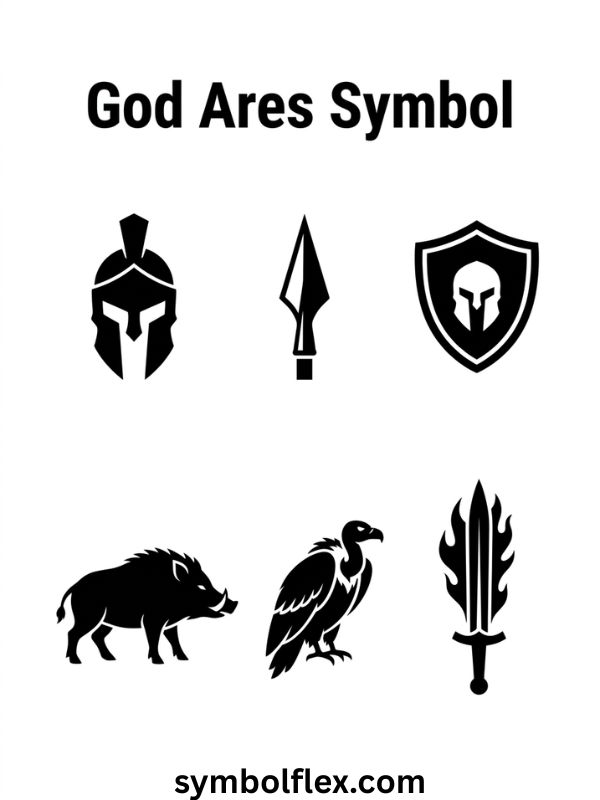
There isn’t one universal Ares symbol equivalent to the lightning bolt of Zeus or the trident of Poseidon. Instead, Ares is recognized through a group of recurring warrior attributes.
If someone asks, “What is the symbol of the Greek god Ares?” the most useful short answer is the spear and helmet. They are among his strongest visual identifiers.
That distinction matters because modern websites sometimes present large lists of symbols as if every item had equal historical status. Ancient mythology is more complicated. Some objects are strongly documented, while others come from later artistic traditions or modern interpretations.
Ares God Symbol
The Ares god symbol is essentially the visual language of the Greek warrior. A helmet, spear, shield, and armor immediately communicate battle.
Ancient Greek art frequently used recognizable attributes to identify gods. However, Ares could look remarkably similar to ordinary armed warriors, which means context often mattered.
His symbolism therefore works on two levels. The first is identification: the helmet and weapons tell you who the figure may be. The second is meaning: those same objects communicate courage, violence, defense, and military strength.
Ares Special Symbols
The most special thing about Ares symbols is their contrast. His most obvious objects are weapons, but his animal associations bring attention to what happens after the fighting.
The spear represents the moment of attack. The shield represents survival during conflict. The vulture points toward the battlefield’s aftermath. The serpent adds another layer of instinct and danger.
This makes Ares a powerful symbol for the complete cycle of conflict, from preparation and confrontation to fear, destruction, and survival.
Ares Helmet Symbol
The Ares helmet symbolizes battle readiness, protection, warrior identity, and courage in the face of danger.
A helmet is also one of the most practical symbols associated with a war god. It protects a vulnerable part of the body while visually transforming a person into a soldier ready for combat.
In modern symbolism, an Ares helmet can therefore represent being prepared for a difficult challenge. It can work as a metaphor for emotional armor too, although that interpretation belongs primarily to modern psychology and personal symbolism rather than ancient Greek religion.
Ares Powers And Symbols
Ares’ powers and symbols can be understood through a simple relationship: the weapon represents action, while the armor represents endurance.
His spear expresses offensive power. His shield expresses defense. His helmet expresses readiness. His chariot expresses movement and force.
Together they create a complete picture of the warrior archetype. Ares isn’t simply about winning. His symbolism is about entering conflict despite uncertainty, fear, and danger.
What Is Ares Symbol Of Power?
Ares is a symbol of raw martial power, courage, aggression, physical strength, and the force of conflict.
His most important lesson is that power has consequences. Strength can protect people, but aggression can also destroy. Courage can inspire action, but impulsiveness can create unnecessary danger.
That tension is one reason Ares remains fascinating today. His symbolism doesn’t simply celebrate power. It asks what happens when power is driven by anger.
Deep Symbolic Meaning of Ares Symbols
The deeper symbolism of Ares can be understood through three lenses: spiritual, psychological, and cultural. Each gives the same warrior imagery a different meaning.
Ancient Greeks didn’t necessarily interpret Ares through modern self development language. Modern readers often do. The key is to keep those interpretations separate from historical religious beliefs.
Ares becomes especially meaningful when viewed as a warrior archetype representing the human response to threat, competition, fear, and conflict.
Spiritual Meaning
The modern spiritual meaning of Ares symbols can involve courage, strength, protection, personal boundaries, and determination.
Someone may see Ares as an image of the inner warrior, the part of a person that refuses to surrender when facing adversity. A shield may represent emotional protection, while a spear may represent the courage to act.
These are modern spiritual interpretations rather than universal ancient Greek teachings. Ancient religion was more complex than today’s social media lists of “spiritual meanings.”
Psychological Meaning
The psychological meaning of Ares symbols centers on aggression, competition, anger, courage, fear, and the fight response.
Ares can represent the energy that pushes someone to confront a threat. That energy isn’t automatically bad. Healthy assertiveness can help people establish boundaries and defend themselves.
The problem begins when anger controls judgment. In this sense, Ares becomes a useful psychological metaphor for the difference between controlled strength and uncontrolled aggression.
Cultural Meaning
The cultural meaning of Ares has changed over time. Greek audiences could view him through the complicated realities of warfare, while Roman culture developed Mars into a more central figure of military and civic identity.
Modern culture has transformed Ares again. Movies, games, comics, tattoos, and fantasy stories often turn him into a superhuman warrior.
That evolution reveals something important about mythology. Symbols survive because people continually reinterpret them. The spear remains a weapon, but its meaning can shift from ancient warfare to modern ideas of courage and personal power.
Types / Variations of Ares Symbols
The different types of Ares symbols are mostly objects connected with warfare. Each one tells a slightly different story.
The strongest symbols are the spear, helmet, shield, and armor. Other imagery, including the sword and chariot, expands the picture.
Spear
The Ares spear represents direct action, combat, courage, and offensive power.
Unlike a symbol of passive strength, the spear points outward. It communicates movement and confrontation.
For modern readers, spear symbolism can represent determination and the willingness to face a difficult problem directly.
Helmet
The Ares helmet represents readiness and protection.
It also communicates identity. Putting on a helmet means entering a different role, from ordinary person to warrior.
Modern Ares helmet symbolism can therefore suggest mental toughness, preparation, and resilience.
Shield
The Ares shield represents defense, survival, and protection.
A shield is especially interesting because it reminds us that warfare isn’t only about attacking. Survival requires defense too.
Modern interpretations can connect the shield with personal boundaries, emotional protection, and standing firm under pressure.
Vulture
The vulture represents the darker side of battlefield symbolism.
Vultures are associated with death and the aftermath of violence, making them a natural image for the destructive consequences of war.
This symbol prevents Ares mythology from becoming a simple celebration of military power. War produces consequences, and the vulture represents what remains afterward.
Dog
The dog appears in modern lists of Ares symbols and can be interpreted through instinct, aggression, loyalty, and guardianship.
However, its historical status deserves caution. The serpent has stronger documentation as a sacred animal in some classical source traditions.
This distinction is useful because it separates well documented ancient attributes from later symbolic interpretations, which is something many simplified mythology articles fail to do.
Ares Symbols Across Cultures
Ares belongs to Greek mythology, but his identity became part of a larger Mediterranean history of war gods and warrior traditions.
His Roman counterpart Mars developed a different cultural role, while modern writers sometimes compare him with war related figures from Norse or Egyptian mythology.
These comparisons can be useful, but they shouldn’t be mistaken for evidence that Ares was directly borrowed from those cultures.
Ancient Greece
In ancient Greece, Ares represented the frightening and violent side of warfare.
He was not simply the god of military strategy. Athena occupied a stronger position in strategic warfare, while Ares embodied battle fury and physical confrontation.
His symbols therefore fit the battlefield: spear, helmet, shield, armor, and war chariot.
Roman Interpretation
The Roman interpretation of Ares centers on Mars.
Mars became one of the most important Roman gods and was closely connected with Roman military identity and the foundation myths of Rome.
This is why Mars cannot be treated as a perfect copy of Ares. The two share a broad war god identity, but their cultural roles developed differently.
Norse Influence
Ares has no direct Norse identity or origin. Norse mythology developed independently around its own gods and traditions.
Still, comparisons can be useful. Tyr is associated with law, courage, and war, while Odin has strong connections with warfare, death, magic, and wisdom.
The comparison shows that different cultures can create different versions of the warrior archetype without making them the same deity.
Egyptian Culture
Ares is not an Egyptian god, but Egyptian mythology also contains powerful war deities.
Sekhmet, for example, is strongly associated with destruction, violence, protection, and divine power. Montu has important connections with warfare and kingship.
Comparing these figures with Ares can reveal how different civilizations used divine characters to explore war, protection, power, and destruction.
Modern Culture
Modern culture has turned Ares into a highly recognizable warrior character.
He appears in comics, movies, television, video games, novels, artwork, and mythology inspired tattoos. These versions often exaggerate his armor, weapons, supernatural strength, or personality.
The result is sometimes very different from ancient mythology. Modern Ares is frequently written as a straightforward villain or unstoppable fighter, while the original mythology gives him a more complicated place among the Olympian gods.
Ares Symbols in Art, Movies & Pop Culture
Ares has appeared in ancient Greek art for centuries, particularly in scenes showing armed warriors and mythological battles.
In classical art, he can be shown with a helmet, spear, shield, and armor. His battle with Heracles was also represented in ancient Greek vase painting.
Modern popular culture has changed his image considerably. Movies and games often turn Ares into a larger than life warrior with exaggerated weapons and powers.
This is important when researching Ares in popular culture. A symbol appearing in a video game isn’t automatically an ancient Greek symbol. The best way to understand Ares is to distinguish historical mythology from fictional adaptation.
Spiritual & Dream Meaning of Ares Symbols
The spiritual and dream symbolism of Ares often centers on conflict, courage, anger, protection, and personal strength.
If someone dreams about a warrior, spear, shield, or Ares himself, the image may personally evoke a confrontation, challenge, fear, or need for protection. But dreams don’t have one scientifically established meaning.
A useful way to interpret such imagery is to ask what the symbol represents in your own life. A shield might remind one person of protection and another of emotional defensiveness. The meaning depends on context.
Modern dream symbolism should therefore be treated as reflection rather than prediction. Ares can be a useful archetype for thinking about the inner warrior, but there is no universal rule saying that dreaming of Ares predicts a specific event.
Positive vs Negative Meaning of Ares Symbols
Ares symbols have both positive and negative meanings because warfare itself contains opposing forces.
The positive side emphasizes courage, resilience, protection, determination, and the ability to face adversity. The negative side involves rage, violence, recklessness, revenge, destruction, and uncontrolled aggression.
This duality is one of the strongest reasons Ares remains relevant. His symbols can represent the strength needed to survive without pretending that conflict is always noble.
Positive Meaning
The positive side of Ares symbolism includes courage, bravery, strength, resilience, protection, confidence, and determination.
A warrior doesn’t have to be someone who seeks conflict. In modern symbolic language, the warrior can be a person who faces hardship without giving up.
This is why Ares imagery can function as a symbol of strength and courage even though the ancient god himself is strongly associated with violence.
Negative Meaning
The negative side includes anger, aggression, violence, recklessness, revenge, pride, chaos, and destruction.
Ares mythology repeatedly demonstrates that physical power isn’t enough. Strength without judgment can lead to defeat as easily as victory.
That makes the negative symbolism valuable. Ares can represent not only the courage to fight, but also the danger of allowing anger to choose the fight for you.
Why Humans Are Attracted to Ares Symbols
People are drawn to Ares symbols because warrior imagery provides a simple visual language for difficult human experiences.
A spear can communicate determination. A shield can represent protection. A helmet can suggest readiness. These meanings are easy to understand even without knowing the complete mythology.
There is also a psychological attraction to the warrior archetype. People often admire characters who remain strong under pressure, defend others, overcome obstacles, and refuse to surrender.
The most interesting modern interpretation of Ares may therefore be the inner warrior. It doesn’t require celebrating violence. Instead, it can represent resilience, courage, boundaries, and the ability to confront challenges while learning to control anger.
Frequently Asked Questions
What is the main symbol of Ares?
The spear and helmet are the most recognizable symbols of Ares, representing warfare, courage, strength, and battle readiness.
What animals are associated with Ares?
Ares is associated with the serpent, vulture, and other war related animals symbolizing danger, death, instinct, and conflict.
What does the Ares spear symbolize?
The Ares spear symbolizes direct combat, offensive power, courage, determination, and the willingness to confront danger without hesitation.
What does the Ares helmet represent?
The Ares helmet represents protection, preparation, warrior identity, courage, and readiness to face dangerous challenges during battle.
What is Ares’ Roman name?
Ares’ Roman counterpart is Mars, who became an important deity associated with military power, protection, and Rome’s identity.
Conclusion
Ares symbols represent war, courage, strength, protection, aggression, conflict, and the complicated power of the warrior spirit. The spear and helmet are among the clearest symbols, while the shield, armor, sword, chariot, and animal associations add deeper layers.
Ares is more than a simple Greek god of war. His mythology explores the emotional reality of conflict: fear, anger, courage, pride, violence, victory, and defeat. His contrast with Athena also shows that warfare can be understood through both raw force and strategic intelligence.
The difference between Ares and Mars is equally important. Ares reflects the Greek imagination of battle, while Mars developed a broader and more prestigious role in Roman military and civic culture.