
60+ Mysterious Filipino Symbols and Their Hidden Meanings You’ve Never Noticed
Filipino symbols are visual codes that carry centuries of history, spiritual power, and cultural identity within their lines, colors, and forms. Long before the Philippines became a nation, its people were already communicating profound truths through symbols carved into gold, tattooed onto warrior skin, woven into cloth, and written in elegant ancient scripts. Today, those same symbols are experiencing a powerful revival, and millions of Filipino-Americans are leading the charge.
Whether you’re tracing your roots, planning a meaningful tattoo, or simply curious about one of the most visually rich cultures in Southeast Asia, this guide covers everything. You’ll discover national emblems, ancient warrior markings, indigenous spiritual symbols, and the hidden meanings most people walk right past.
What Are Filipino Symbols?
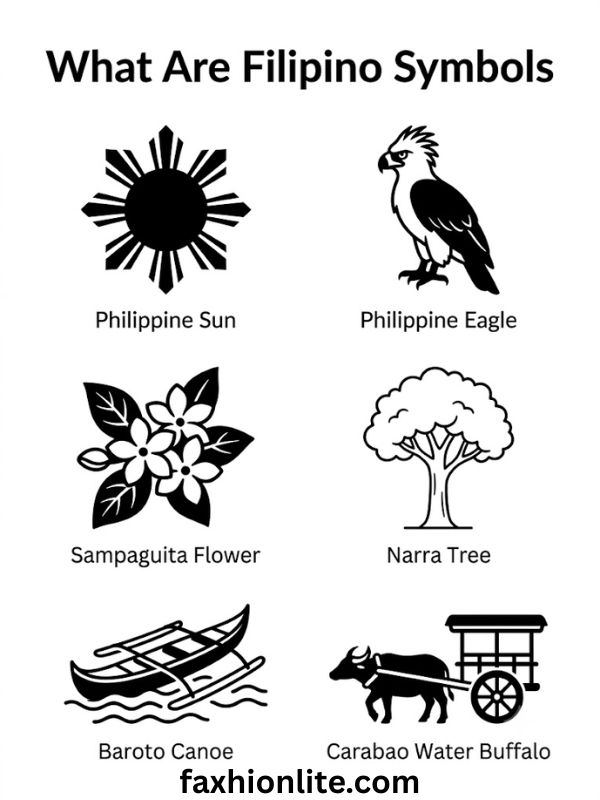
Filipino symbols are visual, written, or artistic representations that carry cultural, spiritual, historical, or national meaning within Philippine society. They aren’t just decorative elements. Each one functions as a compressed story, a community value, or a spiritual message passed down through generations.
The Philippines has over 7,000 islands and more than 180 languages and dialects. That diversity produced an incredibly rich symbolic landscape. Different regions developed their own unique visual languages, from the flowing geometric patterns of Mindanao’s Maranao people to the bold warrior tattoos of the Visayan pintados and the intricate batok markings of the Igorot people in the Cordillera mountains.
What makes Filipino symbolism especially fascinating is its layered history. Indigenous animist traditions existed long before Spain arrived in 1565. Then came 333 years of Spanish colonization, followed by American rule. Each wave left its mark, but the original symbols didn’t disappear. They adapted, merged, and survived. Today’s Filipino symbols are living proof of a culture that refused to be erased.
Filipino Cultural Symbols And Their Meanings
Filipino Symbols and Meanings
Filipino cultural symbols cover a wide range, from animals and plants to written scripts and woven patterns. Here’s a quick reference for some of the most recognized ones:
| Symbol | Meaning |
| Sampaguita Flower | Purity, humility, and devotion |
| Carabao (water buffalo) | Hard work, patience, and rural strength |
| Sarimanok Bird | Good fortune, divine blessing, and beauty |
| Narra Tree | National strength, endurance, and pride |
| Parol (star lantern) | Faith, hope, and community during Christmas |
| Philippine Eagle | Freedom, power, and national sovereignty |
| Baybayin Script | Pre-colonial identity, cultural revival |
| Agimat (amulet) | Spiritual protection and supernatural power |
These symbols show up everywhere in Filipino daily life, from government buildings and school textbooks to festival decorations and family altars. For the Filipino diaspora in the US, many of these symbols serve as emotional anchors to a homeland thousands of miles away.
Filipino Flag
The Philippine flag is one of the most symbolically dense national flags in the world. Every element carries specific meaning, and understanding it transforms a familiar image into a powerful cultural statement.
The flag’s blue stripe represents peace, truth, and justice. The red stripe stands for patriotism and the valor of the Filipino people. The white equilateral triangle on the left symbolizes equality and the Katipunan revolutionary movement that fought for independence from Spain.
Inside the triangle sits a golden sun with eight rays. Each ray represents one of the eight provinces that first revolted against Spanish rule: Batangas, Bulacan, Cavite, Laguna, Manila, Nueva Ecija, Pampanga, and Tarlac. The three five-pointed stars at each corner of the triangle represent the three major island groups: Luzon, Visayas, and Mindanao. One remarkable fact that most people don’t know: the Philippine flag is the only national flag in the world that displays two different official meanings based on orientation. When displayed with the red stripe on top, it signals a state of war. Blue on top means peace.
Filipino Symbols Tattoos
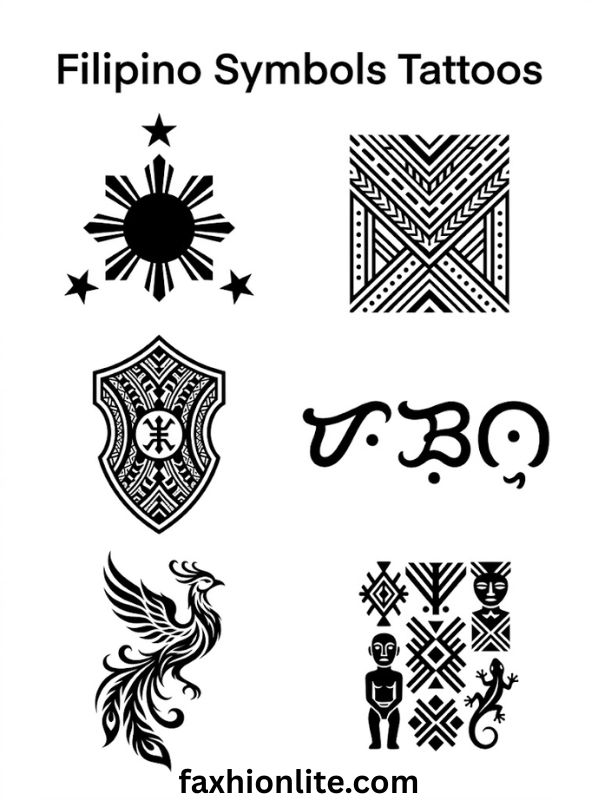
Filipino tattoo symbolism has deep pre-colonial roots. The Visayan people were called pintados, meaning “painted ones,” by the Spanish because their bodies were covered in intricate tattoo designs. These weren’t decorative choices. Each marking recorded a warrior’s achievements, social rank, and spiritual protection.
Today, Filipino tribal tattoos are experiencing a global revival, especially among Filipino-Americans in their 20s and 30s seeking a physical connection to their heritage. The most popular choices include Baybayin script (often used to spell names or meaningful words), the Sarimanok bird, the eight-rayed sun, and Kalinga batok patterns from the indigenous Kalinga people of northern Luzon.
Before getting any Filipino symbol tattooed, research matters. The same design can carry completely different meanings across regions. A pattern honored as a symbol of courage in one province might carry a mourning connotation in another. Consulting artists with genuine knowledge of Philippine indigenous traditions, rather than just stylistic familiarity, makes the difference between a meaningful tattoo and an accidental misrepresentation.
Filipino Symbols Letters
Baybayin is the most well-known pre-colonial ancient Filipino writing system. It’s an abugida script, meaning each character represents a consonant-vowel syllable rather than a single letter. The script contains 17 basic characters and was widely used across Luzon before Spanish missionaries introduced the Latin alphabet.
What’s striking about Baybayin is that it was written on perishable materials like bamboo and leaves, which is why so few original examples survive. The Spanish documented it in the late 1500s and early 1600s, giving us most of what we know today. Despite centuries of dormancy, Baybayin is now undergoing an active revival. The Philippine government has proposed legislation to officially bring it back into schools and public signage.
For Filipino-Americans, learning to read and write in Baybayin has become a meaningful act of cultural reclamation. Writing your name in this ancient script connects you to a lineage that colonizers tried to overwrite.
National Symbols Of The Philippines
What Are the 10 National Symbols of the Philippines
The Philippine government has officially designated national symbols that represent the country’s natural beauty, values, and identity. Here’s the core list:
- National Bird: Philippine Eagle
- National Flower: Sampaguita (Jasminum sambac)
- National Tree: Narra (Pterocarpus indicus)
- National Fruit: Philippine Mango
- National Fish: Bangus (Milkfish)
- National Animal: Carabao
- National Gem: South Sea Pearl
- National Leaf: Anahaw Palm
- National Sport: Arnis (a Filipino martial art)
- National Hero: José Rizal
Each choice was deliberate. The carabao, for example, wasn’t chosen because it’s powerful. It was chosen because it works steadily without complaint, a quality Filipinos deeply admire and see in themselves.
Philippines National Bird
The Philippine Eagle (Pithecophaga jefferyi) is one of the largest, most powerful eagles on Earth, and it’s found only in the Philippines. It’s critically endangered, with fewer than 800 remaining in the wild, making it one of the rarest birds on the planet.
The eagle was officially declared the national bird in 1995. Before that, the monkey-eating eagle (its former common name, now considered inaccurate) was already a deeply respected symbol in indigenous Mindanao communities. The Bagobo tribe, for instance, regarded it as a sacred protector of the forest.
As a Filipino cultural symbol, the Philippine Eagle represents more than national pride. It embodies sovereignty, fierce independence, and the idea that some things are worth protecting at all costs. Conservation efforts for this bird are seen by many Filipinos as inseparable from protecting Filipino cultural identity itself.
National Tree of the Philippines
The Narra tree (Pterocarpus indicus) is one of the most beloved trees across Southeast Asia, but in the Philippines, it carries a special symbolic weight. Its wood is exceptionally hard and durable, its flowers bloom in brilliant yellow-gold clusters, and it regenerates even after being cut down.
That last quality is precisely why Filipinos chose it as their national tree. The Narra doesn’t just survive damage. It comes back stronger. Filipino literature and proverbs reference the Narra repeatedly as a metaphor for the Filipino people’s ability to endure colonization, disaster, and hardship while still standing tall.
In practical terms, Narra wood has been used for centuries in high-quality Filipino furniture and architecture. It’s dense, aromatic, and resistant to insects. Owning furniture made from Narra was historically a mark of status, and pieces passed down through generations carry both material and symbolic value.
Ancient And Traditional Filipino Symbols
Ancient Filipino Symbols
Long before European contact, the people of the Philippine archipelago had developed sophisticated symbolic systems. Archaeological discoveries like the Golden Tara of Agusan, a 10th-century golden figure found in Mindanao, and the Laguna Copperplate Inscription from 900 CE reveal a civilization with complex beliefs, trade networks, and artistic traditions.
Ancient Filipino symbolism frequently drew from the natural world. The sun represented divinity and life-giving energy. The serpent, or naga, appeared in coastal and lowland communities as a symbol of water, wealth, and supernatural power. Birds signified the spirit world, messengers between the human realm and the divine.
These symbols weren’t abstract. They were practical tools for navigating life. A warrior marked with specific tattoo patterns carried spiritual armor into battle. A farmer who carved sun symbols into a rice granary was invoking agricultural blessing, not just making decoration.
Filipino Good Luck Symbols
Filipino good luck symbols blend indigenous animist beliefs with centuries of Catholic influence, creating a uniquely layered symbolic tradition.
The agimat or anting-anting is the most powerful Filipino protective amulet. It can take many forms: a small pouch, an engraved metal disk, a stone, or even a piece of paper with sacred text. Agimat are believed to make their wearers invulnerable to physical harm, illness, and evil spirits. During the Philippine Revolution against Spain, some Filipino soldiers genuinely believed their agimat made them bulletproof.
Other common Filipino luck symbols include:
- The rooster: Associated with courage, virility, and morning energy
- Coconut: Symbol of abundance, resourcefulness, and generosity
- Sampaguita garlands: Worn or offered to invite blessing and purity
- Horseshoe displayed upright: Adopted from Spanish tradition but now deeply embedded in Filipino folk practice
What’s remarkable is how many Filipino-American households still maintain these traditions, whether consciously or as inherited habit. A grandmother who keeps a specific charm near the door isn’t necessarily practicing religion. She’s practicing Filipino cultural heritage.
Filipino Protection Symbols
The anting-anting deserves its own spotlight because it’s arguably the most misunderstood Filipino symbol in Western eyes. From the outside, it looks like a simple charm or folk superstition. Within Philippine cultural context, it’s a sophisticated system of spiritual technology developed over centuries.
Different types of anting-anting serve different purposes. Some protect against physical harm. Others attract love, wealth, or good fortune. Some are explicitly connected to Catholic prayers and images of saints. Others trace back to pre-Christian animist traditions. The most powerful ones, according to Filipino folk belief, are inherited rather than purchased, their potency built up through generations of use and prayer.
Filipino protection symbols also include geometric patterns painted on home entrances, specific plant arrangements believed to repel negative energy, and the positioning of religious imagery in ways that create a symbolic force field around a household.
Filipino Symbols Of Identity, Culture And Strength
Filipino Symbols for Strength
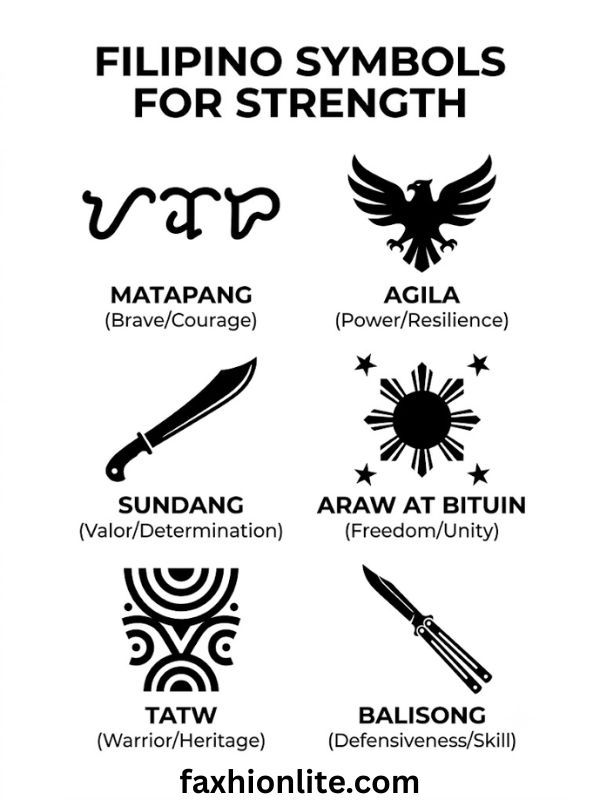
Strength symbols in Filipino culture often come from unexpected places. Not the roaring lion or the clenched fist, but the bent bamboo, the patient carabao, and the survivor tree.
Bamboo is one of the most powerful Filipino symbols of strength and resilience. There’s a well-known Filipino proverb, “Ang kawayan ay yumuyuko ngunit hindi nababali”, meaning bamboo bends in the storm but never breaks. This image captures something essential about Filipino resilience, the ability to absorb enormous pressure, adapt, and spring back without being destroyed.
The Lapu-Lapu figure represents a different kind of strength: active resistance. Lapu-Lapu was the chieftain of Mactan who defeated Ferdinand Magellan in 1521, making him the first Filipino hero to resist foreign invasion. His image now appears on the Philippine five-peso coin, in murals across the country, and in the names of countless Filipino businesses and communities in the US.
Symbols That Represent Filipino Culture
Some symbols have become so deeply associated with Filipino identity that they function almost like a cultural shorthand. See a jeepney and you immediately think Philippines. See a parol lantern in December and you know a Filipino family lives nearby.
The jeepney is perhaps the most uniquely Filipino symbol of all. Originally built from US military jeeps left after World War II, Filipinos transformed them into elaborately decorated community vehicles, adding chrome horses, religious icons, and vivid paintings. The jeepney became a symbol of Filipino ingenuity and creativity, the ability to take something discarded by a foreign power and turn it into something unmistakably your own.
The Barong Tagalog, the traditional formal shirt worn by Filipino men, carries its own symbolic weight. Woven from pineapple fiber or banana silk, it’s worn untucked over a white shirt, creating a look that’s elegant without being ostentatious. It represents Filipino cultural dignity and a pride that doesn’t need to shout.
More Ancient And Cultural Filipino Symbols
Warrior Filipino Symbols
Filipino warrior culture produced some of the most visually striking symbols in Southeast Asian history. The Visayan pintados tattooed their entire bodies in intricate patterns that served as both spiritual armor and social biography. Every mark meant something specific: battles fought, enemies defeated, social rank, tribal affiliation.
The kris, a wavy-bladed sword used in Mindanao and the Sulu Archipelago, is itself a deeply symbolic weapon. Its undulating blade is said to mirror the movement of a flame or a serpent, and the weapon was believed to carry its own spiritual power. Owning a kris wasn’t just about combat capability. It was about possessing a spiritually charged object that connected the warrior to ancestral strength.
The Katipunan, the revolutionary society that fought for Philippine independence from Spain, used the sun with a face as their central symbol, directly borrowing from ancient pre-colonial solar imagery. This connection between ancient symbols and modern resistance is a recurring pattern in Filipino symbolic history.
Ilocano Ancient Filipino Symbols and Meanings
The Ilocano people of northern Luzon developed their own rich symbolic tradition, much of it encoded in their extraordinary weaving practice. Abel cloth, the traditional Ilocano textile, uses geometric patterns that carry meaning about the weaver’s community, status, and spiritual beliefs.
Ilocano symbols tend to be more restrained and geometric than the flowing designs of Mindanao or the bold warrior markings of the Visayas. They reflect the Ilocano cultural value of naimbag a biag, the good life built through hard work and self-sufficiency. Mountain and agricultural symbols appear frequently, connecting communities to the land they’ve farmed for centuries.
For Ilocano-Americans, who make up a significant portion of the Filipino community in the US (particularly in Hawaii and California), these weaving patterns have become powerful identity symbols, appearing in modern fashion, jewelry, and home decor as quiet declarations of heritage.
Deep Symbolic Meaning of Filipino Symbols
Spiritual Level
At the deepest level, Filipino spiritual symbols function as communication devices between humans and the unseen world. Pre-colonial Filipino spirituality centered on the concept of kaluluwa (soul) and the belief that spirits (anito) of ancestors remained actively involved in the lives of the living.
The babaylan, a spiritual practitioner who could be male, female, or gender-fluid, served as the interpreter of symbolic communications from the spirit world. They used specific objects, patterns, and ritual actions as symbolic interfaces with divine forces. Many of the protective symbols still used in Filipino households today trace directly back to babaylan traditions that predate Spanish contact by centuries.
The blending of Catholic iconography with these older traditions created something uniquely Filipino. A home altar might display the Santo Niño (Holy Child) alongside an agimat and specific plants arranged according to folk tradition. None of this feels contradictory to most Filipinos because the underlying spiritual logic, that symbols carry power and protection, remained consistent across both systems.
Cultural Level
On the cultural level, Filipino symbols function as collective memory. They encode what a community has been through, what it values, and who it aspires to be. The eight-rayed sun on the Philippine flag isn’t just a pretty design. It’s a reminder that eight provinces were willing to risk everything for freedom.
This is why the revival of Baybayin script and indigenous Filipino symbols carries such emotional weight for younger generations. These aren’t academic exercises in archaeology. They’re acts of reclaiming a story that colonization tried to overwrite. When a Filipino-American tattoos Baybayin script on their arm, they’re making a statement: this history belongs to me, and I’m carrying it forward.
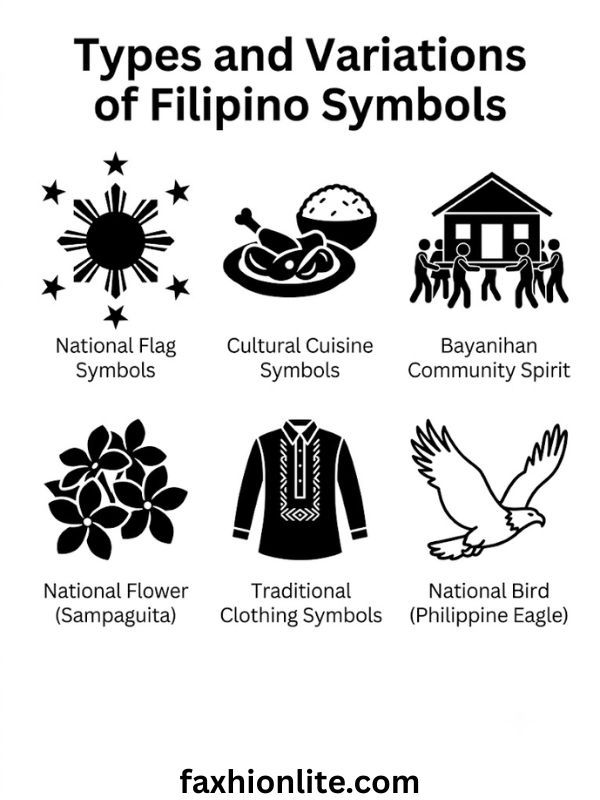
Types and Variations of Filipino Symbols
Sarimanok
The Sarimanok is one of the most visually stunning symbols in all of Philippine culture. Originating in the Maranao tradition of Mindanao, it depicts a stylized rooster holding a fish in its beak or talons, adorned with elaborate geometric patterns in rich reds, golds, and greens.
In Maranao legend, the Sarimanok is a divine bird that serves as a messenger between the human world and the heavens. It appears in royal regalia, architectural carvings, textiles, and ceremonial objects. The fish it carries represents abundance and prosperity. The bird itself represents beauty, nobility, and divine favor.
Today, the Sarimanok has become one of the most widely recognized symbols of Filipino cultural heritage globally. It appears in Filipino-American community art, restaurant decor, festival performances, and contemporary tattoo designs. Its visual complexity rewards attention. The more closely you look, the more intricate patterns you discover.
Baybayin Script
Baybayin is more than an ancient writing system. It’s a symbol of everything that Filipino culture created independently, before outside contact reshaped the archipelago. Each of its 17 characters is built on elegant curves and dots, designed to be written quickly on bamboo with a sharp instrument.
What most people don’t realize is that Baybayin was genuinely widespread before Spanish colonization. It wasn’t a ceremonial script used only by priests or scholars. Ordinary people used it for everyday writing. The Spanish actually documented high literacy rates in Baybayin among the general population, which makes its decline and near-disappearance all the more significant.
The Baybayin revival today is driven largely by young Filipino-Americans who learned about it through social media, cultural organizations, and online communities. Apps, courses, and workshops teaching Baybayin have proliferated across the US, and the Philippine government has taken steps to formalize its return to public life.
Filipino Symbols Across Cultures
Filipino symbols didn’t develop in isolation. The Philippines sits at the crossroads of maritime Southeast Asia, and its symbolic traditions reflect thousands of years of trade, migration, and cultural exchange.
Chinese influence introduced dragon motifs, specific color associations (red for celebration and luck, gold for wealth and divinity), and numerical symbolism that merged with indigenous Filipino beliefs. The number eight, already significant in the Philippine flag’s eight-rayed sun, also carries Chinese lucky associations, creating a natural symbolic overlap.
Spanish Catholic influence contributed crosses, images of saints, and religious iconography that Filipinos adapted in genuinely creative ways. The Santo Niño, the image of the child Jesus, became one of the most powerful symbols in Philippine Catholicism, not just as a religious icon but as a symbol of Filipino identity and resilience dating back to the early contact period.
American cultural influence after 1898 added new symbolic layers: athletic achievement symbols, democratic imagery, and English-language expression. The uniquely Filipino ability to absorb, adapt, and transform outside influences while maintaining a distinct cultural core is itself one of the most important things Filipino symbols communicate.
Filipino Symbols in Art, Movies and Pop Culture
Filipino symbols are breaking into mainstream American culture in ways that would have seemed unlikely just a decade ago. The growing visibility of Filipino-Americans in entertainment, sports, and business has created new platforms for these symbols to reach wider audiences.
In contemporary art, Filipino-American painters and muralists are incorporating Baybayin script, Sarimanok imagery, and okir patterns into works that appear in major US galleries and public spaces. This isn’t nostalgic folk art. It’s confident, contemporary cultural expression that positions Filipino symbolism as a living tradition rather than a museum artifact.
In social media, hashtags around Baybayin, Philippine tribal tattoos, and indigenous Filipino art regularly generate millions of impressions. Young Filipino-Americans are creating content that educates peers about the meaning behind these symbols, building genuine topical authority and cultural pride simultaneously.
Spiritual and Dream Meaning of Filipino Symbols
In Philippine folk tradition, symbols don’t just operate in waking life. They appear in dreams as meaningful messages. Filipino spiritual beliefs around dreams draw from both indigenous animist traditions and later Catholic influences, creating a rich interpretive framework.
Dreaming of the Sarimanok is traditionally interpreted as a sign of incoming blessing or a message from the divine. Dreaming of an eagle suggests strength, freedom, or a call to step into leadership. Water dreams connect to ancestral communication, particularly in coastal communities where the sea represents both life and the realm of spirits.
Baybayin characters appearing in dreams are interpreted by some practitioners as a direct call from one’s ancestors to engage with cultural heritage more deeply. Whether you interpret this literally or psychologically, the meaning is consistent: something important from your past is asking for your attention.
Positive vs Negative Meaning
Not all Filipino symbols carry positive meanings, and understanding the full picture matters, especially for anyone considering incorporating these symbols into tattoos, art, or daily life.
Positive symbols and their meanings:
- Sun: Life, divinity, freedom, and revolutionary pride
- Sampaguita: Purity, love, devotion, and spiritual openness
- Sarimanok: Good fortune, beauty, and divine favor
- Bamboo: Resilience, adaptability, and quiet strength
Cautionary or context-dependent symbols:
- Owl (kuwago): In many Philippine traditions, the owl’s call near a home signals incoming death or misfortune
- Black in certain ritual contexts: While used in modern Filipino fashion without issue, in traditional settings black can carry mourning or spiritual vulnerability associations
- Specific anting-anting patterns: Misused or worn without understanding, some protective amulets are believed to attract the very energies they were designed to repel
The most important principle when engaging with Filipino cultural symbols is context. Regional meaning, family tradition, and the specific spiritual framework within which a symbol was created all matter enormously.
Why Humans Are Attracted to Filipino Symbols
There’s a reason Filipino symbols are resonating with people far beyond the Filipino community. They offer something that many modern visual cultures have lost: depth. Each symbol carries layers of meaning that reward investigation.
Human beings are pattern-recognition creatures. We’re drawn to visual systems that communicate complex ideas efficiently, and Filipino symbolic tradition does exactly that. A single Sarimanok carving contains references to mythology, social structure, spiritual belief, and aesthetic tradition simultaneously.
For Filipino-Americans specifically, these symbols serve a psychological function that researchers who study diaspora communities recognize consistently: they provide continuity. In a culture that moves fast and values the new, having visual anchors to a specific, identifiable heritage creates a sense of groundedness that’s genuinely difficult to replicate through other means.
The growing mainstream interest in Filipino cultural heritage also reflects a broader shift in American culture toward valuing specificity over generality. People are more interested than ever in the particular stories and traditions that make individual cultures unique, and Filipino symbolic tradition offers an extraordinarily rich particular story.
Frequently Asked Questions
What are Filipino symbols?
Filipino symbols represent culture, beliefs, traditions, history, and identity, reflecting the nation’s rich heritage and values.
Why are Filipino symbols important?
They preserve cultural heritage, teach history, strengthen national pride, and connect generations through shared meanings.
What is the most famous Filipino symbol?
The Philippine Eagle is among the most recognized symbols, representing strength, freedom, courage, and national pride.
Do Filipino symbols have spiritual meanings?
Yes, many symbols reflect spiritual beliefs, ancestral traditions, protection, harmony, and connections with nature.
Are Filipino symbols still used today?
Yes, Filipino symbols remain visible in art, festivals, traditions, education, architecture, and everyday cultural expressions.
Conclusion
Filipino symbols are among the most layered, beautiful, and historically significant symbolic traditions in the world. From the Baybayin script that once covered everyday bamboo documents to the Sarimanok bird that carries divine messages in Maranao legend, from the eight-rayed sun that commemorates revolutionary sacrifice to the anting-anting that protects its wearer across generations, these symbols tell a story of a culture that is ancient, adaptive, and deeply alive.
For Filipino-Americans, engaging with these symbols isn’t about living in the past. It’s about carrying the past intelligently into the future. Learning what your family’s traditional symbols mean, wearing them with knowledge, and sharing their stories with people who’ve never encountered them before is one of the most powerful acts of cultural preservation available to you.