NSFW Meaning in Text: What It Really Means (2026)
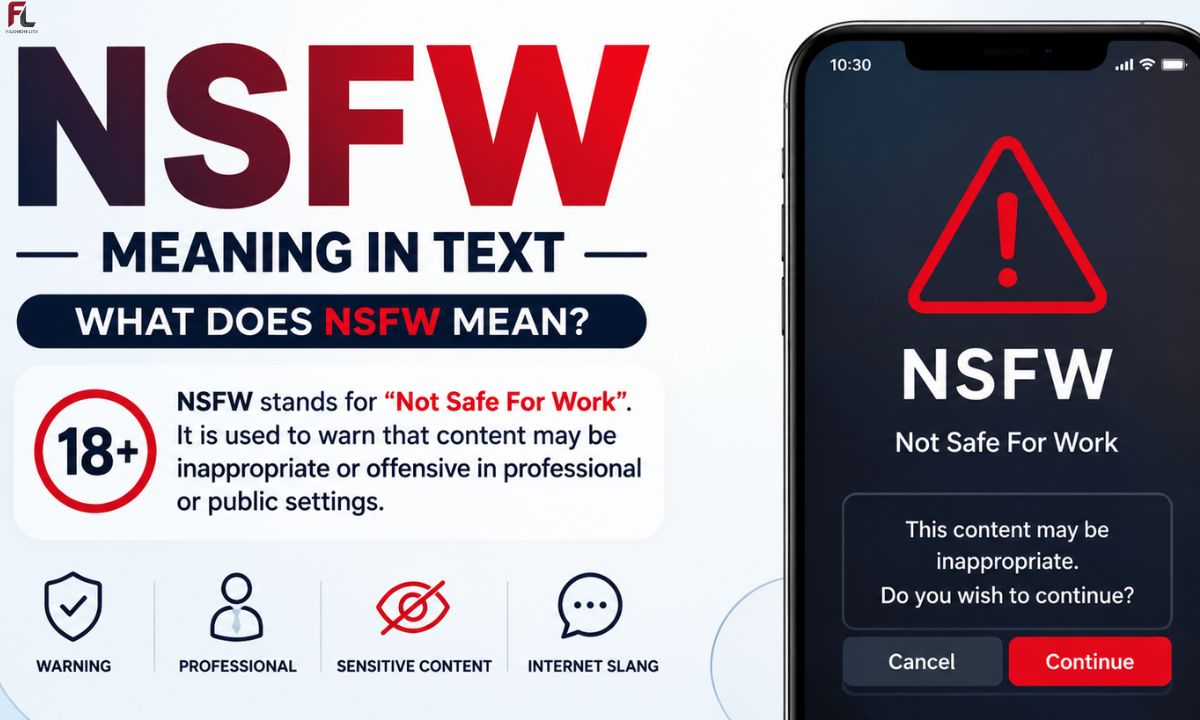
NSFW stands for “Not Safe For Work” — a simple warning that tells you the content ahead might be inappropriate to open around your boss, family, or strangers in public. It shows up in text messages, Reddit posts, Discord servers, group chats, and everywhere else online.
It does not automatically mean sexual or adult content. Violence, strong language, and disturbing topics all count too.Understanding NSFW meaning in text takes about ten seconds, but knowing how to read it, respond to it, and use it correctly is what actually saves you from awkward situations.
The label is a courtesy, not a red flag about the sender. Whether someone’s giving you a genuine heads-up or just making a joke, this guide breaks down exactly what NSFW means, where it appears, and what to do when you see it.
What Does NSFW Mean in Text, Exactly?
NSFW is short for Not Safe For Work (sometimes “Not Suitable For Work”). It works as a quick content warning before something that could embarrass you if the wrong person sees your screen.
It doesn’t mean the content is illegal. It doesn’t mean the sender is a bad person. It just means: check your surroundings before you tap.
The term started on early internet forums in the early 2000s. Sites like Fark.com used it so users could warn each other before posting links to adult or graphic content. By 2015, it was official enough to land in the Merriam-Webster dictionary.
Is NSFW Always About Adult Content?
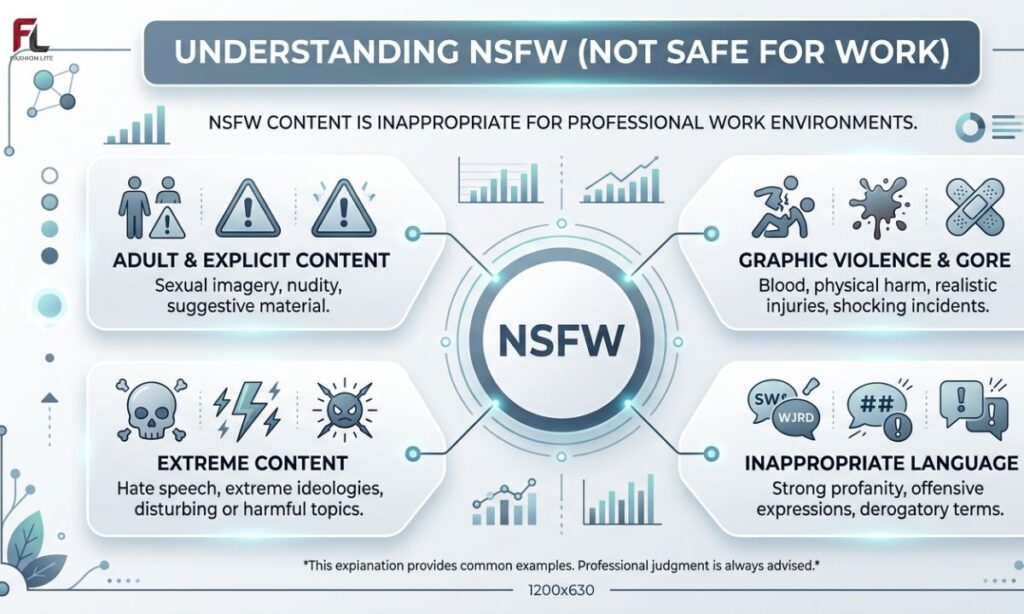
This is where most people get it wrong. NSFW doesn’t automatically mean explicit or sexual.
Sure, that’s the most common reason someone tags something NSFW. But the label also covers:
- Graphic violence — gory clips, crime footage, accident videos
- Heavy profanity — content that’s mostly swearing
- Disturbing topics — trauma stories, upsetting news, shocking images
- Offensive humor — jokes that would raise eyebrows in a professional setting
- Embarrassing content — things you’d cringe to have your boss or parent see
The shared thread isn’t “explicit.” It’s “situationally risky.” If it could cause you a problem depending on where you are or who’s nearby, it might be NSFW.
Is NSFW a Bad Word or Offensive?
No. NSFW is a label, not an insult. Using it is actually the polite thing to do.
Think of it like a “caution: hot” sticker on a coffee cup. The sticker isn’t the problem. It’s just warning you so you don’t get burned.
Sending someone an NSFW-tagged message means you thought about their situation before they clicked. That’s considerate. The issue only arises when someone shares genuinely inappropriate content without a warning, or sends it to someone who didn’t ask for it.
Where People Use NSFW Online
NSFW shows up across every major platform, but it works differently depending on where you are.
Reddit takes NSFW the most seriously of any mainstream platform. Posts and entire communities can be tagged NSFW, which blurs content until you actively confirm you want to see it. Some subreddits are age-gated. If you post content that should be tagged and isn’t, moderators will tag it for you, or remove it.
Discord
Discord applies the label at the channel level, not per-message. Server owners can mark a whole channel as NSFW, which then triggers an age confirmation for anyone trying to enter. Individual messages in non-NSFW channels can’t be tagged by the sender, so the responsibility sits with the server setup itself.
X (Formerly Twitter)
X lets users toggle “sensitive content” on their posts. Since mid-2024, X officially allows labeled adult content, including AI-generated material, as long as it’s marked properly. Without that flag turned on in your settings, sensitive posts show up blurred with a click-through prompt.
TikTok and Instagram
Neither platform has an official NSFW system. Their community guidelines remove explicit content rather than label it. When you see “NSFW” in a TikTok caption, that’s entirely the creator’s own choice, not a platform feature. The apps don’t enforce it in any technical way.
Snapchat
Snapchat doesn’t have a built-in NSFW tag either. When someone writes “NSFW incoming” before a story or message on Snapchat, it’s a personal heads-up, not a platform-enforced blur. The warning only works if you read the caption before tapping through.
Text Messages and WhatsApp
This is purely social courtesy. There’s no filter, no blur, no age gate. If someone texts “NSFW but look at this” before sending a link, that four-letter warning is doing all the heavy lifting. You either see it in time or you don’t.
Gaming Communities and Work Chats
In gaming spaces, NSFW often tags graphic content, mods with adult themes, or dark humor that doesn’t fit a general audience. In work tools like Slack or Teams, NSFW shouldn’t appear at all. If it does, the content probably shouldn’t have been shared to begin with.
Three Real Conversation Examples
Example 1 — Casual texting:
“NSFW but this meme is hilarious, don’t open at your desk”
What it means: A genuine warning. The sender’s being thoughtful. Open it when you’re not in a meeting.
Example 2 — Ironic usage:
“NSFW: my commute this morning” [photo of a traffic jam]
What it means: A joke. The content is completely harmless. The NSFW label is the punchline.
Example 3 — Discord server post:
“New NSFW channel added for 18+ members. You’ll need to verify your age to enter.”
What it means: Formal and platform-enforced. This is the tag working exactly as designed.
NSFW vs. SFW: The Difference
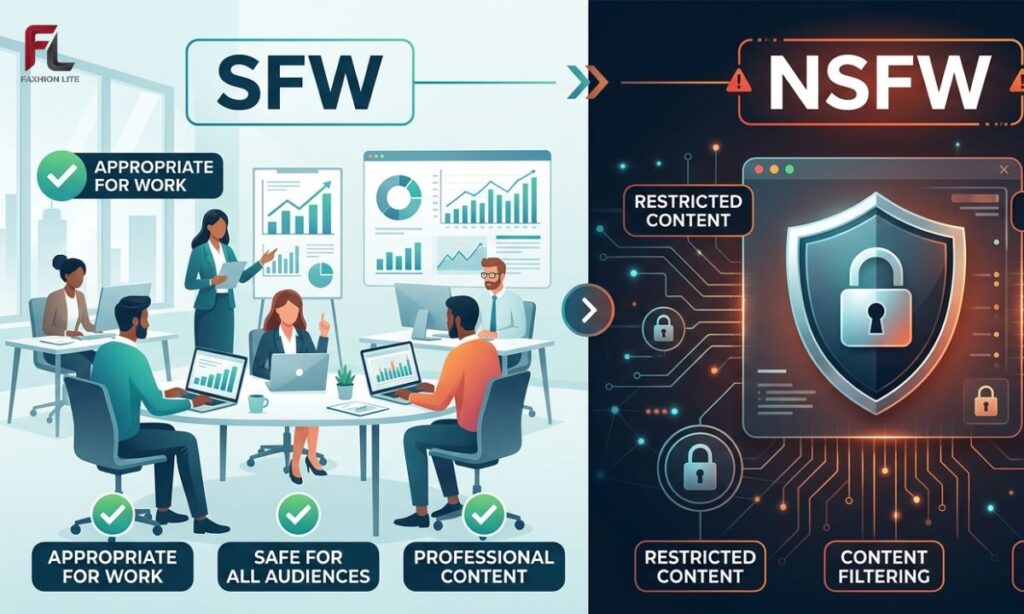
SFW means “Safe For Work.” It’s the opposite. If someone sends a link and adds “don’t worry, it’s SFW,” they’re telling you it’s completely fine to open in public or at your job.
You’ll also see SFW used as a counterpoint when content was expected to be edgy but isn’t. Like: “Click the link, it’s SFW I promise.”
Other related terms worth knowing:
| Term | Meaning | Intensity |
| SFW | Safe For Work | No warning needed |
| NSFW | Not Safe For Work | Standard content warning |
| NSFL | Not Safe For Life | Extremely disturbing, graphic beyond normal NSFW |
| NSFH | Not Safe For Home | Inappropriate around family or kids |
| NSFP | Not Safe For Parents | Gen Z shorthand for the same idea |
NSFL is the one to take most seriously. If someone tags something NSFL, they mean it. That label usually means genuinely horrifying content, not just nudity or strong language.
When to Use NSFW (and When Not To)
Use it when:
- You’re sharing a link that has adult, graphic, or explicit content
- You’re in a group chat with mixed audiences and unsure everyone’s situation
- You’re posting in a public or semi-public community
- You’re forwarding something and the next person might be at work or school
Skip it when:
- You’re in a professional work email or Slack message. If the content needs a warning that strong, it probably shouldn’t be in a work channel at all.
- You’re using it ironically so often it loses meaning. Crying wolf trains people to ignore it.
- The content is just mildly opinionated or edgy. NSFW is for genuine situational risk, not everything slightly controversial.
The rule of thumb: if you have to wonder whether something needs an NSFW tag, it probably does.
How to Reply When Someone Sends You NSFW Content
Most guides just say “set a boundary.” That’s not particularly useful. Here’s what to actually say.
If the warning came through and you’re cool with it:
“Ha, noted. Saving for later.”
If you want to redirect politely:
“All good but keep it SFW in this chat. Work monitors it.”
If it keeps happening and you want to be direct:
“Hey, can you keep it SFW with me? Not really my thing.”
If someone sends NSFW content with no warning:
“Heads up, a warning would’ve been nice. Can you tag stuff like that before sending?”
The tag is a courtesy. When someone skips it, it’s fair to point that out once. If they keep ignoring it, that’s a different conversation entirely.
Common Mistakes People Make With NSFW
Assuming NSFW only means pornographic content. It doesn’t. Violence, disturbing topics, and offensive humor all qualify.
Using it ironically so often it stops working. If you label every slightly embarrassing thing NSFW, people start ignoring your tags. Then when something is actually NSFW, nobody takes the warning seriously.
Thinking a platform label protects you automatically. On text and WhatsApp, there’s zero technical enforcement. The words do the entire job.
Not tagging content that actually needs it. This is the most common mistake. When in doubt, tag it. You’re not hurting anyone by being considerate.
Frequently Asked Questions
Does NSFW always mean 18+ content?
No. NSFW covers anything situationally inappropriate, including violence, strong language, or embarrassing content that isn’t sexual at all.
Can NSFW show up in regular text messages?
Yes. It’s just typed as a word. There’s no built-in system, so it only works if the reader sees it before opening the attachment or link.
Is NSFW allowed on social media?
Depends on the platform. Reddit and Discord support it officially. TikTok and Instagram don’t have an NSFW tag at all. X allows it with proper labeling.
What’s stronger than NSFW?
NSFL, meaning “Not Safe For Life.” It signals content that’s genuinely disturbing rather than just adult or explicit.
Should you ever use NSFW in a work email?
No. If content requires that warning, it almost certainly shouldn’t be in a professional email at all.
Why do people use NSFW ironically?
Because the setup works comedically. Promising something shocking and delivering something mundane is a classic bait-and-switch joke format. Just don’t overdo it.
Final Takeaway
NSFW meaning in text is simple at its core: it’s a polite warning that content might not be safe to open everywhere. Four letters that have been doing their job since the early internet, and they’re not going anywhere.
The nuance is in how you read the tone, which platform you’re on, and whether the person using it is being genuine or just going for a laugh. Now you know the difference.