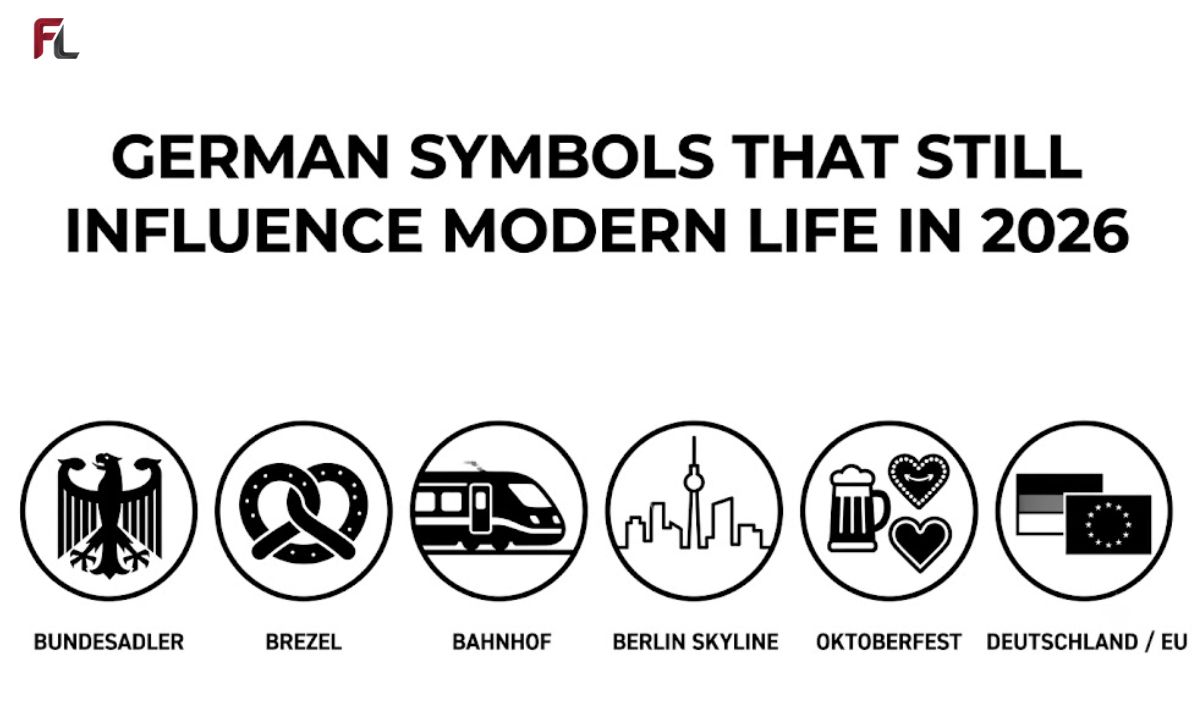
81+ German Symbols That Still Influence Modern Life in 2026
German symbols are some of the most powerful, layered, and widely recognized cultural icons in all of human history. From ancient runic carvings etched into Viking-age stones to the Federal Eagle stamped on every euro coin, these symbols have shaped nations, inspired tattoos, fueled wars, and quietly embedded themselves into everyday American life.
Whether you’re tracing your German ancestry, planning a tattoo, or just trying to understand why the Iron Cross shows up on everything from biker gear to skateboard decks, this guide covers it all.
What Are German Symbols?
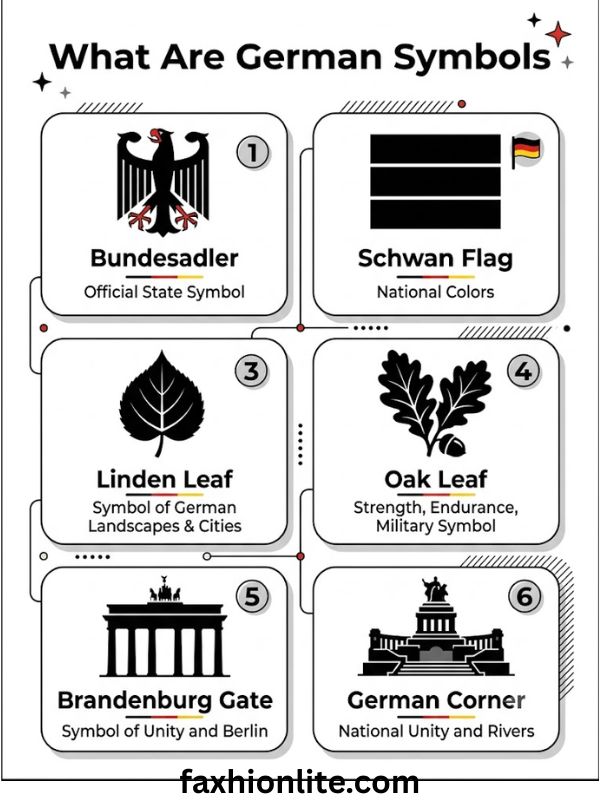
German symbols are visual marks, icons, letters, and emblems tied to the cultural, political, spiritual, and historical identity of the German-speaking world. They range from national emblems like the Bundesadler (Federal Eagle) to ancient runic alphabets, tribal warrior markings, folk traditions, and modern typographic characters like the umlaut (ä, ö, ü) and the Eszett (ß).
What makes German symbols unique is their sheer depth of history. Germany sits at the crossroads of ancient Celtic territory, Roman conquest, Viking-adjacent Norse culture, and medieval Christian Europe. Every wave of influence left its symbolic mark, and those marks piled up over two thousand years into one of the richest symbolic traditions on the planet.
For Americans specifically, these symbols matter more than most people realize. Over 40 million Americans claim German ancestry, making it the largest single ancestry group in the United States. German cultural heritage didn’t just cross the Atlantic; it shaped American holidays (the Christmas tree is a German tradition), American beer culture, and even American engineering aesthetics. Understanding German symbols is, in many ways, understanding a big piece of American cultural DNA.
Ancient German Symbols And Their Hidden Stories
Long before Germany existed as a nation, the peoples who would become Germans were already building a rich symbolic vocabulary. These weren’t decorative doodles. They were practical tools for communication, spiritual protection, and social identity in a world without widespread literacy.
Ancient German Symbols
The oldest German symbols predate the Roman Empire and come from a period when Germanic tribes lived in dense forests across Northern and Central Europe. One of the most significant is the Irminsul, a large pillar or tree-like structure representing the axis of the world in pre-Christian Germanic belief. It connected the earth to the heavens and served as a focal point for communal worship.
The Valknut is another ancient symbol you’ve almost certainly seen without knowing its name. It’s three interlocked triangles and appears frequently on modern tattoos, jewelry, and fantasy media. Historically, it appeared on runestones and burial artifacts and is associated with the Norse god Odin and the concept of the fallen warrior. Its exact meaning is still debated by historians, which somehow makes it more fascinating.
The Triskele (three spiraling arms joined at the center) also appears in early Germanic and Celtic artifact sites across what is now Germany. It symbolized movement, time, and the cycle of life. These ancient carvings and motifs weren’t just decorative; they were the written language of a people communicating across generations without paper.
Germanic Tribe Symbols
The major Germanic tribes each carried their own distinct symbolic identity. The Visigoths, who eventually settled in Spain, used eagle motifs extensively on their jewelry and weaponry. The Franks, ancestors of the French and many modern Germans, used the Francisca (a throwing axe) as both a weapon and a heraldic symbol of identity. The Saxons famously used the Saxon horse symbol, still visible today on the coat of arms of Lower Saxony in northern Germany.
The Lombards carried serpent symbols and distinctive fibula (cloak pins) decorated with animal interlace patterns. The Goths used highly stylized animal art on metalwork that influenced Byzantine and later medieval European decorative traditions. Each of these tribes left symbolic fingerprints across Europe that historians can still trace today through archaeological digs and museum collections.
What’s remarkable is how many of these tribal symbols survived long enough to influence modern national heraldry. The Frankish eagle became the French fleur-de-lis and the German imperial eagle. The Saxon horse became a regional German emblem that’s still in official use today. These weren’t symbols that died with their tribes; they evolved and kept going.
Germanic Symbols
The term “Germanic” is broader than “German.” It refers to the entire linguistic and cultural family that included not just modern Germans, but also the ancestors of the English, Dutch, Scandinavians, and several other European peoples. When we talk about Germanic symbols, we’re talking about a shared symbolic vocabulary that stretched from Scandinavia to the Mediterranean.
The Solar Cross (a circle divided into four quadrants by a cross) appears in Germanic archaeological sites across thousands of miles and thousands of years. It represented the sun, the cycle of seasons, and cosmic order. The Algiz rune (which looks like a trident or a man with arms raised) was used as a protective symbol across the entire Germanic world and still appears in modern contexts ranging from peace signs to military insignia.
These shared symbols tell us something important: the Germanic peoples weren’t isolated tribes bumping into each other occasionally. They were part of a connected cultural network with shared beliefs, shared symbolic languages, and shared artistic traditions. That connected identity is part of what eventually gave rise to the German nation.
German Symbols And Meanings In Modern Culture
Walk through any American city today and you’ll encounter German symbols without even trying. The pretzel at your local bakery, the eagle on federal buildings, the Blackletter font on that craft beer label, and the Iron Cross pendant in the jewelry store window all connect back to the rich tradition of German symbolism.
German Symbols And Meanings
Here’s a quick reference for some of the most important German symbols and what they actually mean:
| Symbol | Original Meaning | Modern Use |
| Federal Eagle (Bundesadler) | Sovereignty and national power | German coat of arms, official documents |
| Black-Red-Gold Flag | Unity, democracy, and freedom | German national flag |
| Iron Cross (Eisernes Kreuz) | Military valor and sacrifice | Military insignia, tattoo culture |
| Oak Tree | Strength, endurance, German identity | German coinage, forestry symbolism |
| Linden Tree | Peace, love, and community | Village symbols, folk poetry |
| Elder Futhark Runes | Communication, divination, identity | Tattoos, jewelry, spiritual practice |
| Irminsul | Cosmic axis, pre-Christian spirituality | Neo-pagan use, art, tattoos |
The meanings of these symbols often shifted dramatically across time. The Iron Cross, created in 1813 as a purely military decoration, became tainted by Nazi appropriation in the 20th century, then was deliberately rehabilitated by the modern German military (Bundeswehr) as a symbol reclaimed for its original honorable meaning. That kind of symbolic evolution is a recurring theme throughout German history.
German Symbolism
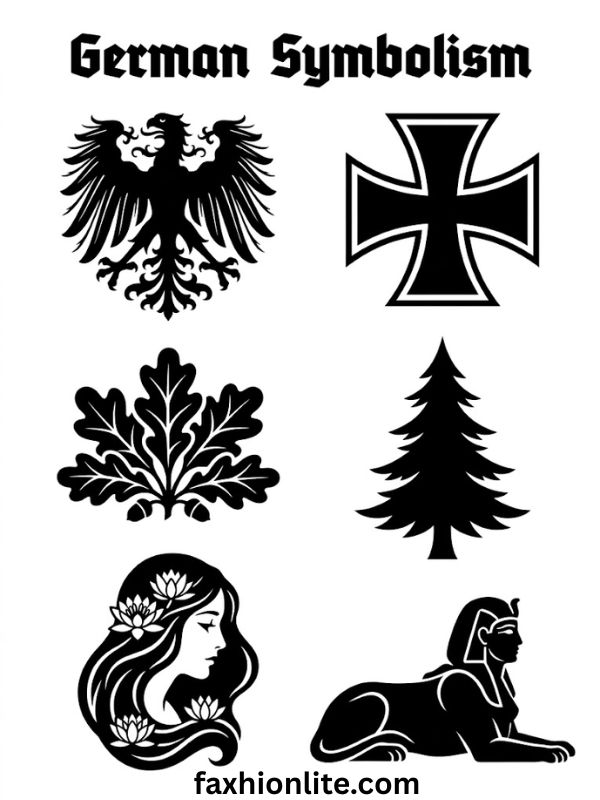
German symbolism as a cultural philosophy reached its height during the Romantic period of the early 19th century. Writers like Goethe and Schiller, and composers like Wagner, believed that symbols could carry universal truths that rational language couldn’t quite capture. Wagner’s operas, for example, are drenched in Germanic mythological symbols: spears, rings, ravens, and fire all function as dense carriers of meaning that audiences were expected to feel as much as understand.
This tradition influenced American art and literature more than most people realize. The German Expressionist movement of the early 20th century, with its jagged shapes, harsh contrasts, and emotionally loaded imagery, directly shaped American film noir, graphic novel aesthetics, and even superhero comic art. When you look at a Batman comic and notice the dramatic shadows and angular architecture, you’re looking at an artistic tradition that traces straight back to German cultural heritage.
Symbols Of Germany
The official symbols of the German nation are actually a carefully curated set designed to represent democratic values while deliberately distancing the country from its darkest chapter. The Bundesadler (Federal Eagle) sits at the top of this list, appearing on the German coat of arms, all official state documents, German coins, and government buildings.
The Brandenburg Gate in Berlin functions as a de facto national symbol even without official designation. Built in the late 18th century as a symbol of peace, it was later used as a backdrop for Nazi rallies, then stood behind the Berlin Wall for nearly three decades, and finally became the iconic symbol of German reunification in 1990. Few structures in the world carry as much compressed symbolic history in a single set of columns.
What Is The Symbol Of Germany?
The primary symbol of Germany is the Federal Eagle, known in German as the Bundesadler. It’s a black eagle on a golden shield, wings spread wide, with a red beak and red talons. This eagle traces its lineage directly from the eagle of the ancient Roman Empire, which Charlemagne adopted in the 8th century when he built the Carolingian Empire centered in what is now Germany.
What separates the modern Bundesadler from its imperial predecessors is its deliberate simplification. Post-WWII Germany’s eagle looks almost friendly compared to the fierce, weaponized eagles of earlier eras. That was intentional. West German designers in the late 1940s wanted a symbol that communicated national pride without aggression, sovereignty without dominance.
German Symbols Text
German has a set of special typographic symbols that set it apart from English and signal German cultural identity even in digital communication. The most important are:
- Umlauts: ä, ö, ü (and their capitals Ä, Ö, Ü) modify vowel sounds and appear in everyday German words
- Eszett (ß): Also called the “sharp S,” this letter represents a double-S sound and appears in words like Straße (street) and Fußball (soccer)
American travelers encounter these constantly in German brand names. Häagen-Dazs (ironically an American brand using fake German-sounding umlauts) shows how powerful these text symbols feel as markers of European sophistication. Real German brands like Würth, Düsseldorf Airport, and Böhringer Ingelheim use them as authentic identity markers.
German Symbols Letters
The most visually striking German letter system is Fraktur, also called Gothic script or Blackletter. This angular, dense typeface dominated German printing from the 15th century through the early 20th century and carries enormous cultural weight. You’ve seen it on craft beer labels, barbershop signs, and tattoos across the United States.
Fraktur’s history is complicated. It was considered quintessentially German for centuries, then ironically banned by the Nazi regime in 1941 (they called it “Jewish letters” in a bizarre reversal). After the war, it became associated with both German heritage and counterculture, which explains why you’ll find it on everything from traditional German restaurant menus to heavy metal album covers.
German Symbols To Copy
Need to use German text symbols on your keyboard? Here are the most commonly needed characters:
- ä: Alt + 0228 (Windows) / Option + U, then A (Mac)
- ö: Alt + 0246 (Windows) / Option + U, then O (Mac)
- ü: Alt + 0252 (Windows) / Option + U, then U (Mac)
- ß: Alt + 0223 (Windows) / Option + S (Mac)
On mobile, simply hold down the relevant vowel key and a menu of accented versions will appear. These symbols are important to use correctly in German names and words; omitting them changes the meaning (sometimes hilariously) of German text.
German Symbols Tattoos
German symbol tattoos are among the most popular Germanic-inspired ink choices in American tattoo culture. The most requested designs include the Iron Cross, Elder Futhark runes, Blackletter script lettering, Germanic eagle designs, and Valknut or Irminsul motifs.
Before getting any ancient Germanic symbol tattooed, do your research. Some runes have been co-opted by hate groups and white supremacist organizations, including the SS bolts (Sowilo runes), the Odal rune in certain stylized forms, and the Life rune in some contexts. A reputable tattoo artist knowledgeable in Germanic history can help you choose designs with authentic historical meaning and no modern toxic baggage.
Iconic, Ancient And Historical German Symbols
Iconic German Symbols
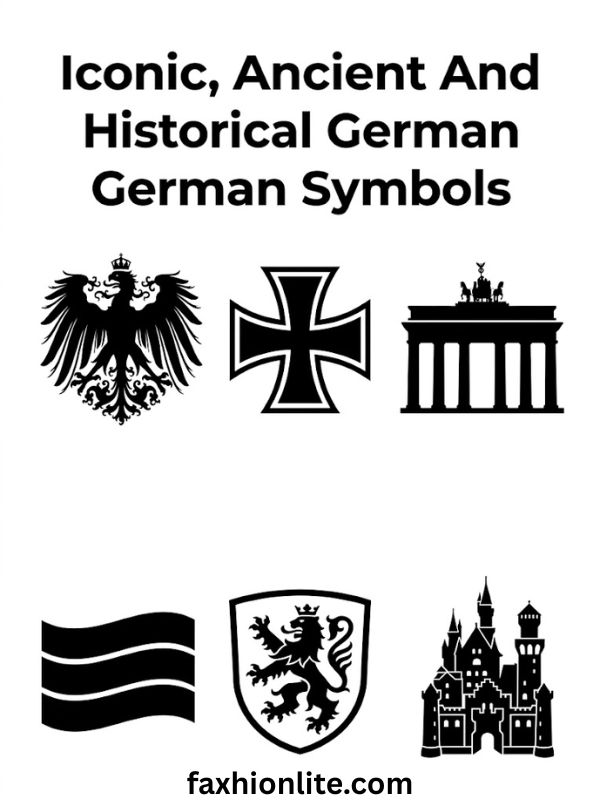
The most internationally recognized German symbols are the Federal Eagle, the Black-Red-Gold flag, the Brandenburg Gate, the Iron Cross, and the Oktoberfest imagery of pretzels, steins, and Bavarian hats. Each of these communicates something specific about Germany to a global audience.
In American pop culture, the most visible German symbols tend to be automotive logos. BMW’s roundel (representing spinning aircraft propeller blades in blue and white, the colors of Bavaria) and Mercedes-Benz’s three-pointed star (representing the company’s ambition to dominate land, sea, and air) are German symbols that most Americans encounter more often than the actual German flag.
Traditional German Symbols
Traditional German folk symbols connect to the land, seasons, and community life that defined pre-industrial German culture. The oak tree is perhaps the deepest of these: it appears in German coinage, military decorations (oak leaf clusters on medals), regional coats of arms, and folk sayings. Germans have called the oak “the German tree” for centuries, and its symbolism of deep roots, endurance, and slow-growing strength resonates with core values in German cultural identity.
The linden tree carries softer symbolism: it represents peace, love, and the gathering place of communities. Medieval German villages typically had a linden tree in the central square where people met, celebrated, and settled disputes. The famous Berlin boulevard Unter den Linden (literally “under the linden trees”) carries this tradition into an urban setting.
Famous German Symbols
Some of the world’s most famous symbols either originated in Germany or were popularized by German culture. The Christmas tree is a German invention that German immigrants brought to America in the 18th and 19th centuries. Gummy bears were invented by German confectioner Hans Riegel in 1922, and the Haribo logo is now one of the most recognized symbols in candy culture worldwide.
Albrecht Dürer’s woodcuts and engravings from the late 15th and early 16th centuries created visual symbols of Germany’s artistic ambition that art historians still reference. His famous rhinoceros woodcut from 1515, created entirely from a written description without ever seeing the actual animal, became one of the most reproduced images in European history.
Ancient German Symbols Tattoos
For tattoo enthusiasts specifically interested in authentic ancient Germanic designs, the Elder Futhark runic alphabet offers the richest source material. This 24-character alphabet was used from roughly the 2nd to 8th centuries CE across Germanic territories.
Popular rune tattoo choices with positive historical meanings include:
- Algiz (ᛉ): Protection and defense
- Tiwaz (ᛏ): Justice, courage, and the warrior spirit
- Fehu (ᚠ): Prosperity and abundance
- Uruz (ᚢ): Strength and raw power
- Berkano (ᛒ): Growth, fertility, and new beginnings
Each of these carries centuries of documented meaning in historical runic inscriptions and can be verified through academic runology resources.
Old German Symbols
Medieval Germany produced a spectacular array of symbolic imagery through heraldry. Every noble family, city, guild, and religious institution needed a unique visual identity, and medieval German heraldry developed into one of the most elaborate systems of symbolic identity in European history.
The Holy Roman Empire’s double-headed eagle is the crown jewel of old German symbols. Dating back to the Byzantine Empire and adopted by the Habsburgs, this eagle with two heads facing in opposite directions represented authority over both East and West, both the temporal world and the spiritual realm. It influenced the heraldry of Austria, Russia, Serbia, and Albania, all of which still use double-headed eagles today.
Meaningful German Symbols
If you’re looking for German symbols that carry genuine emotional and historical depth, these are the ones worth knowing:
The Bundesadler represents the resilience of German democracy rebuilt from the ruins of authoritarianism. The Black-Red-Gold flag specifically evokes the 1848 revolution, when German citizens first fought for democratic freedoms, making it a symbol of political courage as much as national identity. The Iron Cross in its original 1813 form represents sacrifice in defense of freedom, not aggression. And the linden tree carries a quiet but profound symbolism of community, love, and peaceful gathering that cuts through all the martial imagery that dominates German symbolic history.
German Symbols In War, Politics and Family
WW1 German Symbols
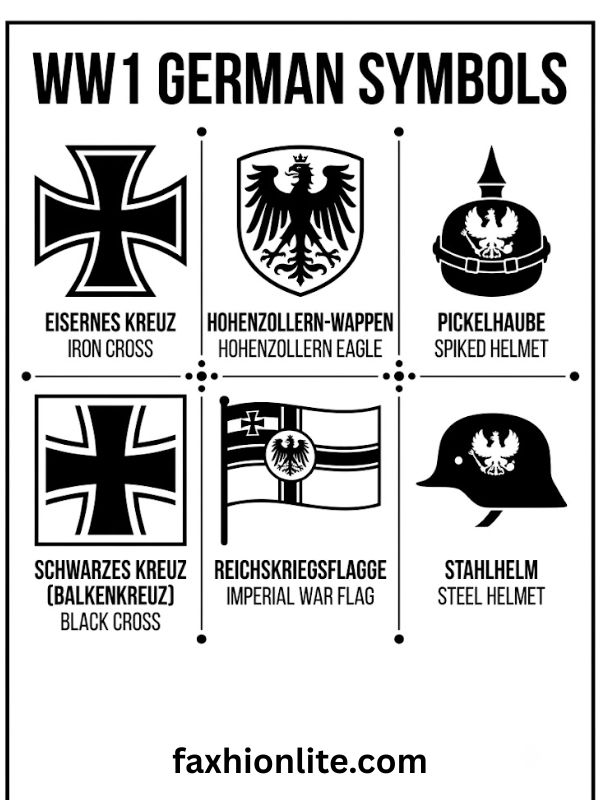
Imperial Germany’s symbolic identity during World War One centered on the Pickelhaube (the spiked helmet that became the war’s defining visual), the Iron Cross (expanded into multiple grades for WWI service), and the Black-White-Red imperial tricolor flag. These symbols represented the Wilhelmine Empire’s confidence, military pride, and sense of imperial destiny.
American soldiers who fought in WWI came home with a complicated relationship to these symbols. Some collected German military medals and helmets as war trophies; others saw them as symbols of a brutal, industrialized warfare that had traumatized a generation. That ambivalence toward German military symbols has never entirely disappeared from American culture.
WW2 German Symbols and WWII German Symbols
Nazi Germany’s symbolic program was one of the most deliberate and sophisticated in history. The regime understood that symbols shape identity and used visual iconography with calculated precision. The Swastika, borrowed from ancient Hindu, Buddhist, and prehistoric European tradition, was rotated 45 degrees and made the centerpiece of German national identity from 1933 onward.
Today, the Swastika and most Nazi-era insignia (SS runes, Reichsadler eagle, Totenkopf skull) are illegal in Germany under Section 86a of the German Criminal Code. Germany takes this seriously: displaying these symbols publicly can result in fines or imprisonment. American law treats them differently, protecting display as free speech while documenting them as hate symbols.
Post-war Germany made a deliberate symbolic break with the Nazi era. The new Federal Republic chose the pre-Nazi Black-Red-Gold flag, redesigned the eagle to look friendlier and more democratic, and systematically de-Nazified public spaces, monuments, and institutions.
East German Symbols
East Germany (the DDR) developed its own distinct symbolic vocabulary between 1949 and 1990. The East German flag added a compass and hammer to the basic Black-Red-Gold tricolor to distinguish it from West Germany and signal socialist ideology. The Volkspolizei (People’s Police) emblem, the hammer-and-compass of the SED party, and the Trabant car all became symbols of life behind the Iron Curtain.
Surprisingly, one of the most beloved East German symbols is the Ampelmännchen, the little pedestrian traffic light man with a wide-brimmed hat. When reunification threatened to replace East German traffic lights with standard West German designs, citizens protested so strongly that the Ampelmännchen was preserved and eventually spread to all of Germany. He now appears on souvenirs, t-shirts, and merchandise worldwide as a symbol of charming East German nostalgia.
German Symbols For Family
For German-American families, heraldic symbols and family crests are the most personally meaningful connection to German heritage. The study of German family coats of arms is called Wappenkunde, and Germany has maintained remarkably detailed heraldic records going back to the medieval period.
Many German families also used Hausmarken (house marks), simple geometric symbols that served as a family’s unique identifier on property, tools, gravestones, and documents before literacy was widespread. These marks were passed down through generations and are some of the earliest forms of what we’d now call a personal brand or logo.
If you have German ancestry, researching your family’s regional symbols can be a profound way to connect with that heritage. German genealogical records are among the best preserved in Europe, and many American families with German roots have successfully traced their ancestry back to specific villages and recovered their family’s traditional symbols.
Popular German Symbols
Beyond the official and historical, some popular German symbols in American culture are simply fun and warm. The pretzel shape originated in early medieval German monastery baking and its crossed-arm shape was once said to represent a child in prayer. Oktoberfest imagery: the blue-and-white Bavarian diamond pattern, the dirndl dress, the steins of beer, and the oompah band have become globally recognized shorthand for German celebration culture.
The German Shepherd dog is itself a kind of living German symbol. Bred in Germany in the 1890s to be the ideal working dog, it became one of the most popular breeds worldwide and carries connotations of loyalty, intelligence, and disciplined strength that mirror how Germany likes to see itself.
Deep Symbolic Meaning of German Symbols
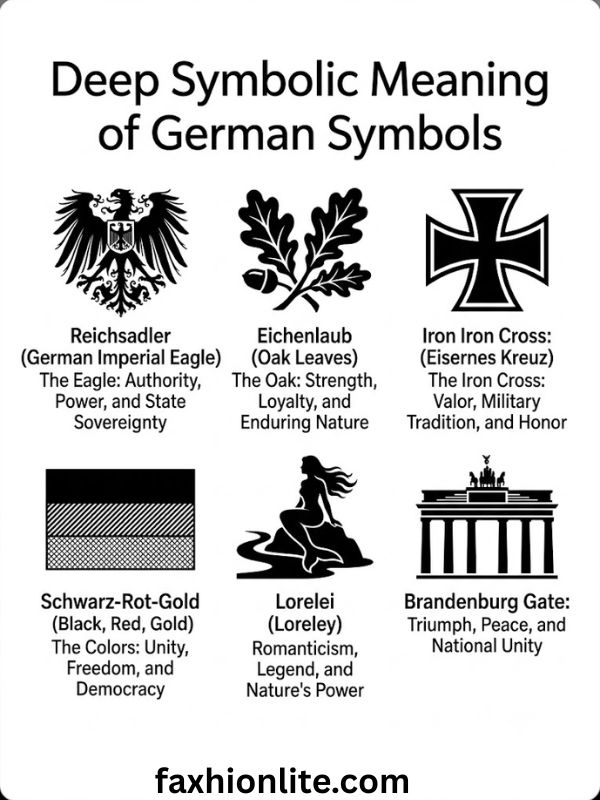
Spiritual Meaning
Before Christianity swept through Germanic territories in the 7th through 10th centuries, Germanic spirituality was deeply entwined with the natural world and expressed through symbols. The runic alphabet wasn’t just a writing system; it was a spiritual technology. Runes were carved onto weapons to make them strike true, onto amulets to protect the wearer, and onto gravestones to honor the dead.
Modern Asatru and Germanic Heathenry movements in the United States draw heavily on this pre-Christian symbolic tradition. These are legally recognized religious communities that use Germanic runes, the Valknut, the Irminsul, and other ancient symbols in spiritual practice. For practitioners, these aren’t historical curiosities; they’re living sacred symbols.
Psychological Meaning
Carl Jung, the Swiss-German psychiatrist who shaped modern psychology, argued that certain symbols tap into the collective unconscious: a deep layer of psychological inheritance shared by all humans. His concept of archetypes explains why symbols like the eagle (power, transcendence), the cross (sacrifice and redemption), and the tree (rootedness and growth) resonate across cultures without people consciously understanding why.
German symbols work on this psychological level powerfully. When you see the Federal Eagle, something in the brain registers authority and strength before any conscious thought forms. When you see the Black-Red-Gold flag after years of watching German soccer, warmth and team identity flood in automatically. Symbols bypass rational thought and speak directly to emotional memory, which is exactly why they’re so durable across centuries.
Cultural Meaning
In modern Germany, symbols carry the weight of a nation still actively processing its most traumatic century. The deliberate embrace of Black-Red-Gold over Black-White-Red, the careful rehabilitation of the Federal Eagle, and the legal prohibition of Nazi symbols are all cultural symbol management strategies of a society working through historical guilt while building new national pride.
Germany’s Day of German Unity on October 3rd each year is now a celebration of the peaceful reunification of 1990, deliberately framed around democratic symbols rather than ethnic or imperial ones. This careful curation of national symbols is something political scientists point to as one of the most successful examples of post-authoritarian cultural reconstruction in modern history.
Types / Variations of German Symbols
1. Federal Eagle (Bundesadler)
The Bundesadler is Germany’s oldest continuously used national symbol in some form, tracing through Charlemagne’s Carolingian eagle, the Holy Roman Empire eagle, the Weimar Republic eagle, and the modern Federal Republic version adopted in 1950. Each version reflects the political values of its era.
2. Black-Red-Gold Flag
The current German flag’s colors were first worn by the Lützow Free Corps fighters in 1813, soldiers whose black uniforms with red trim and gold buttons became associated with the fight for German unification and liberty. The 1848 revolution formalized these as freedom’s colors, and the post-WWII Federal Republic deliberately chose them over the imperial tricolor to signal a democratic fresh start.
3. Iron Cross (Eisernes Kreuz)
Designed by the Prussian architect Karl Friedrich Schinkel and authorized by King Frederick William III in 1813, the Iron Cross was always a democratic military decoration: any soldier regardless of rank or class could earn it for bravery. This egalitarian origin is part of why the modern German Bundeswehr still uses it as their primary military symbol after careful redesign to remove Nazi-era associations.
4. Germanic Runes
The Elder Futhark, the oldest runic alphabet, consists of 24 characters divided into three groups of eight called aettir. Each rune has a name, a phonetic value, and a symbolic meaning documented in medieval runic poems. Runologists have decoded thousands of runic inscriptions across Scandinavia and Central Europe, giving us a detailed picture of what these symbols meant to the people who carved them.
5. Holy Roman Empire Eagle
The double-headed eagle of the Holy Roman Empire of the German Nation is arguably the most influential single symbol in European heraldic history. Adopted in the 15th century by the Habsburg dynasty that led the Empire, it spread to every corner of Europe through dynastic marriage, diplomacy, and conquest. Austria uses it today. Russia used it until 1917. Serbia, Montenegro, and Albania all have it in their heraldry. One German imperial symbol shaped the national imagery of a dozen nations.
German Symbols Across Cultures
Ancient Germanic Tribes
Germanic tribes spread their symbols across Europe through migration, trade, and conquest between roughly 300 BCE and 800 CE. Gothic jewelry designs influenced Byzantine art. Frankish eagle imagery became French royal heraldry. Saxon horse symbols appear in the heraldry of England, where Saxon migrants settled before the Norman Conquest.
Roman Influence
The Romans and Germanic peoples exchanged symbols as much as they exchanged blows. Rome brought the eagle motif, the triumphal arch (which influenced the Brandenburg Gate’s design), and the practice of standardized military insignia. The Germanic peoples gave Rome mercenary soldiers who rose to the highest ranks and influenced Roman military culture from the inside. The Western Roman Empire’s last emperor, Romulus Augustulus, was deposed by the Germanic chieftain Odoacer in 476 CE, a moment that effectively handed European symbolic authority to the Germanic world.
Medieval Europe
Medieval Germany’s Holy Roman Empire made German symbols the prestige symbols of European civilization. Gothic architecture, which spread from France but was enthusiastically adopted and refined in Germany, became the visual language of Christian spiritual aspiration across the continent. German medieval guilds developed elaborate symbolic systems for marking their products, forerunners of modern trademark and logo design.
Modern Europe
Today, German visual identity shapes the European Union’s own symbolic vocabulary. The precision, clarity, and functional beauty of German design philosophy (think Bauhaus, Braun, Dieter Rams) influenced the EU’s minimalist institutional aesthetics. German engineering symbols like the TÜV certification mark (the little diamond-shaped quality assurance logo) appear on products sold across the entire global market.
Global Influence
German Christmas traditions exported to the world include the Christmas tree, the Advent wreath, the Advent calendar, and the Nativity scene as a decorative tradition. All of these carry embedded German folk symbolism. The Christmas tree specifically traces to pre-Christian Germanic winter solstice traditions before being Christianized and then globalized by German immigrants in the 18th and 19th centuries.
German Symbols in Art, Movies & Pop Culture
German symbols saturate American pop culture in ways most people never consciously register. Rammstein, Germany’s most globally successful rock band, has built their entire visual identity around a self-aware collision of industrial German imagery, Gothic script, and Expressionist theater. Their logo, stage design, and music videos are essentially a commentary on German symbolism itself.
In video games, the Wolfenstein series has spent decades exploring what it means to confront Nazi German symbols in a context of resistance and liberation. Hearts of Iron, a strategy game series, introduces millions of young players to the flags, insignia, and military symbols of 20th-century Germany in a historical gaming context.
Marvel’s Thor universe borrows directly from Germanic mythology. Mjolnir, Odin, Asgard, and the concept of the World Tree (Yggdrasil, closely related to the Germanic Irminsul) are all Norse-Germanic symbols that hundreds of millions of American moviegoers now have emotional connections to, even if they don’t know the academic backstory.
Blackletter typography appears constantly in American streetwear, tattoo culture, craft beer branding, and music merchandise. It’s become a shorthand for authenticity, tradition, and a certain rebellious edge. Every time you see that angular Gothic script on a hoodie or an album cover, you’re looking at a German typographic tradition that’s been fully absorbed into American visual culture.
Spiritual & Dream Meaning of German Symbols
In dream interpretation traditions influenced by Jungian psychology, German symbols carry powerful archetypal weight. Dreaming of an eagle is broadly interpreted as a sign of ambition, desire for freedom, or the need to gain perspective on a situation. In Germanic spiritual traditions specifically, the eagle is connected to Odin, the god of wisdom, and a dream eagle might be interpreted as a message to seek deeper knowledge.
Dreaming of runes is interpreted in modern neo-pagan traditions as a call to pay attention to hidden messages or to seek clarity about a decision. Each individual rune carries specific divinatory meanings that practitioners consult through casting or drawing runes, similar to tarot card reading.
For members of American Asatru communities, these interpretive frameworks aren’t casual superstitions; they’re part of a structured spiritual practice that treats ancient Germanic symbolism as living spiritual technology. These communities exist in every major American city and represent one of the fastest-growing alternative spiritual movements in the country.
Positive vs Negative Meaning
Positive Meanings
The vast majority of German symbols carry deeply positive meanings rooted in values that resonate across cultures.
- Federal Eagle: sovereignty, freedom, national pride, democratic governance
- Black-Red-Gold Flag: unity, courage, the hard-won triumph of democracy
- Oak Tree: endurance, deep roots, strength through adversity
- Linden Tree: community, peace, love, justice
- Iron Cross (original meaning): valor, sacrifice, honor regardless of rank
- Germanic Runes (most of them): protection, prosperity, growth, strength
- Christmas tree: family, warmth, generosity, light in darkness
These are symbols that have encouraged soldiers, united communities, identified families, and connected people to something larger than themselves for thousands of years.
Negative Interpretations
Some German symbols carry genuine negative associations that demand honest acknowledgment. The Nazi appropriation of the Swastika transformed an ancient symbol of good luck and prosperity (still widely used in Hindu and Buddhist traditions) into the 20th century’s most recognized emblem of genocidal hate. That transformation is probably permanent in Western cultural contexts.
Several SS-era runes were deliberately chosen by the Nazis because they resembled powerful ancient Germanic symbols, and that connection has tainted them. The Sig rune (which looks like a lightning bolt, used doubled as the SS insignia), certain stylized versions of the Odal rune, and the Totenkopf skull all carry this toxic baggage in contemporary Western societies.
Understanding this history is important not to avoid all German symbols, but to navigate them with the knowledge needed to make informed, respectful choices. Most German symbols have no Nazi connection whatsoever and deserve to be understood on their actual historical merits.
Why Humans Are Attracted to German Symbols
Humans are symbol-making creatures, and German symbols offer something genuinely rare: an unbroken chain of symbolic tradition stretching back more than two thousand years. That depth of history creates a gravitational pull that’s hard to explain rationally but very easy to feel.
There’s also the aesthetic factor. German symbolic design, from the clean geometry of runic letters to the bold heraldic simplicity of the Federal Eagle to the angular beauty of Blackletter script, tends toward visual power and clarity. These are symbols that look like they mean something, because they do.
For the 40 million-plus Americans with German ancestry, these symbols carry the additional emotional charge of heritage and belonging. Finding your family’s medieval coat of arms or understanding that the Christmas traditions your grandmother kept alive were rooted in centuries of German folk culture connects you to something much larger than your individual life.
And for everyone else, German symbols offer a window into one of history’s most dramatically complex nations: a country that produced Beethoven and Goethe, led Europe in science and philosophy for centuries, descended into the worst political horror of the modern era, then rebuilt itself into one of the world’s most stable democracies. That full arc of human experience is encoded in German symbols, and that’s what keeps people coming back to them.
Frequently Asked Questions
What is the most famous German symbol?
The Federal Eagle, known as the Bundesadler, is Germany’s most recognized and officially used national symbol.
What do German runes mean?
Germanic runes are ancient alphabetic symbols used for writing, spiritual protection, divination, and warrior identity across early Europe.
What are the colors of the German flag and their meaning?
Germany’s black, red, and gold flag represents determination, bravery, and generosity, rooted in 19th-century democratic freedom movements.
Which German symbols are commonly used for tattoos?
The Iron Cross, Elder Futhark runes, Blackletter script, and Germanic eagle designs are the most popular German tattoo choices.
What is the difference between German and Germanic symbols?
Germanic covers broader ancestral tribes like Saxons and Goths, while German refers specifically to modern Germany’s national cultural identity.
Conclusion
German symbols are far more than historical artifacts or design inspirations. They’re a living record of one of humanity’s most remarkable journeys: from ancient forest tribes carving runes into sacred wood to a modern democratic nation grappling honestly with its own complicated past.
Whether you’re drawn to the spiritual depth of Germanic runes, the patriotic power of the Bundesadler, the folk warmth of German Christmas traditions, the personal connection of a family crest, or the visual impact of Blackletter typography, there’s a German symbol that speaks to something real and meaningful.