
81+ Iconic War Symbols: The Hidden Meanings Behind Legendary Warriors, Ancient Empires & Epic Battles (2026)
War symbols are visual signs like eagles, swords, shields, skulls, and banners that represent power, conflict, courage, and sacrifice. People have used them for thousands of years. They marked territory.
They rallied armies. They honored the dead. Ancient civilizations built this visual language long before writing existed. This guide breaks down 81+ of these symbols and what they really mean in 2026.
What Are War Symbols?
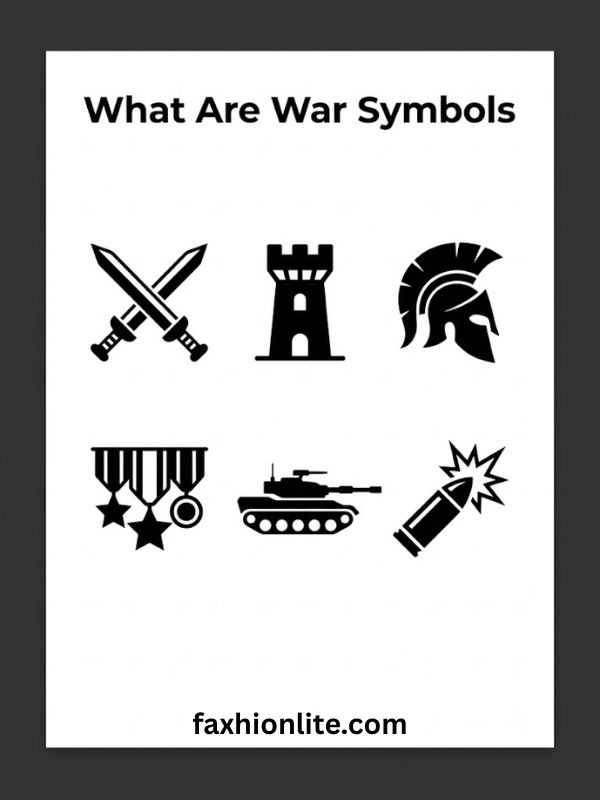
War symbols are images, objects, colors, or gestures that communicate ideas connected to conflict, protection, honor, or death. They act as a kind of shorthand, letting people instantly recognize meaning without needing a single word.
You’ll find these symbols in flags, weapons, animals, and even hand gestures. A raised fist can signal defiance. A red banner can signal rebellion. A shield can signal defense rather than attack. Each of these carries emotional weight that’s been built up over centuries of use, and that weight doesn’t disappear just because the wars themselves have ended.
Unlike peace symbols, which tend to be simple and universal (think the dove or the peace sign from the 1950s), war symbols are often layered with cultural war symbols and regional meaning. A symbol that means courage in one country might mean oppression in another. That complexity is exactly what makes this topic worth studying seriously rather than skimming a quick list.
It’s also worth noting that war symbolism isn’t static. New symbols get created during modern conflicts, and old ones get reinterpreted. The meaning of a symbol in 500 BCE is rarely identical to its meaning today, even if the image itself hasn’t changed much.
Symbols Of War And Their Deep Meanings
The meaning of war symbols goes far beyond the literal image. A sword isn’t just a weapon; it’s a stand-in for justice, honor, or violence depending on the context it appears in.
Understanding this layered meaning matters because symbols carry different weight in different settings. A skull on a pirate flag warns of danger. A skull on a modern fashion jacket signals rebellion or edge. Same image, completely different intent.
Symbols Of War
Common categories of war symbols include weapons (swords, spears, arrows), animals (eagles, wolves, dragons), colors (red, black), and structures (shields, walls, fortresses). Each category taps into a different emotional register, from aggression to protection to fear.
War Symbolism
Symbolism is the layer of interpretation added on top of the image itself. A crossed pair of swords doesn’t just show two weapons; it often communicates readiness for battle or a memorial to fallen soldiers, depending on where you see it.
Symbols That Mean War
If you’re searching for a quick answer: the most universally recognized symbols that mean war include crossed swords, the color red, skulls, broken shields, war drums, and raised spears. These appear again and again across unrelated cultures, which suggests something deeper than coincidence, possibly a shared human instinct to represent conflict visually.
War Symbols Copy And Paste
If you need quick war symbols copy and paste options for social media, gaming names, or text messages, here are commonly used Unicode symbols:
| Symbol | Name |
| ⚔️ | Crossed swords |
| 🛡️ | Shield |
| 🏹 | Bow and arrow |
| 💀 | Skull |
| 🔥 | Fire/destruction |
| ⚡ | Thunderbolt |
These are widely used in gaming usernames, bios, and casual online communication to signal strength or a fighting spirit.
War Symbols Tattoos
War tattoos meanings vary by design. A sword tattoo often represents personal strength or a battle someone has overcome in their own life, not necessarily literal combat. Eagle tattoos are popular among military veterans as a mark of pride and service. Skull tattoos, especially in biker culture, often symbolize fearlessness rather than death itself.
Placement matters too. Chest and back tattoos tend to represent protection, while forearm tattoos, being visible, often signal identity or belonging to a group.
Symbols For War
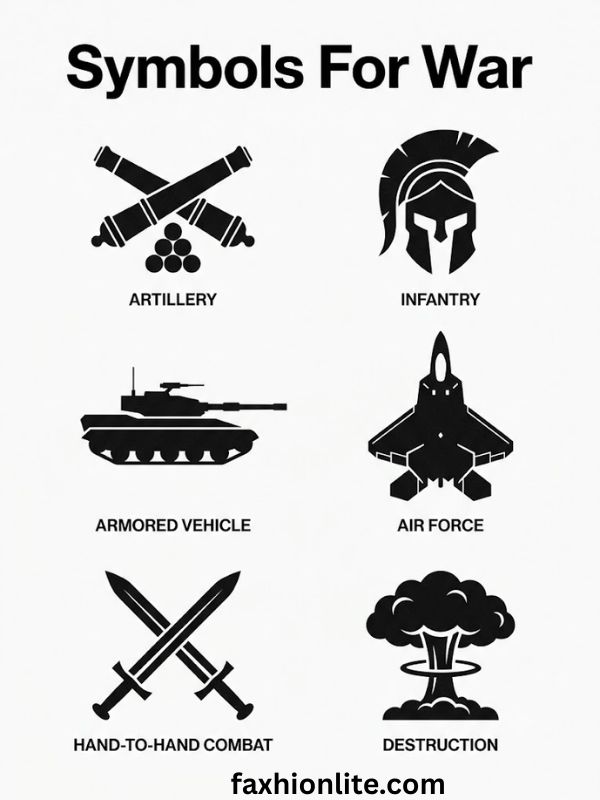
Modern militaries still rely on military symbols for rank, unit identity, and honor. Insignia, medals, and unit patches are the direct descendants of ancient battle standards, serving the same core purpose: instant recognition and morale.
Famous Ancient And Historical War Symbols
Historical war symbols give us a window into how ancient societies organized, fought, and remembered their conflicts. Studying them is less about weapons and more about understanding what each civilization valued most.
War Symbols Emoji
Modern emoji culture has quietly absorbed old war symbolism. The crossed swords emoji, the shield emoji, and the bow and arrow emoji all trace their visual roots directly back to ancient battle iconography, just simplified for a phone screen.
War Symbols WW2
World War II produced some of the most recognizable military symbols in modern history. The V for Victory hand gesture, popularized by Winston Churchill, became a symbol of Allied resolve.
Propaganda posters on both sides used bold, simplified imagery (fists, eagles, stars) to rally public support. This period is a clear example of how war symbolism gets deliberately engineered for mass communication, not just organically evolved over centuries.
War Symbols And Meanings
| Symbol | Core Meaning |
| Eagle | Power, sovereignty |
| Sword | Honor, justice, aggression |
| Skull | Mortality, fearlessness |
| Red Poppy | Remembrance, sacrifice |
| Shield | Protection, defense |
| Dragon | Strength, dominance |
Ancient War Symbols
Ancient war symbols appeared in Mesopotamia, Egypt, and early China well before alphabets were standardized. Sumerian war standards, carried into battle on poles, are considered some of the earliest known military insignia, predating Roman legionary standards by over a thousand years. This is a detail many articles on this topic overlook entirely.
War Symbols Greek
Greek war symbols mythology centers heavily on Ares, the god of war, whose spear represented aggression, and Nike, the goddess of victory, whose winged image symbolized triumph rather than conflict itself. The Spartan shield, marked with the Lambda symbol, became one of the most enduring emblems of disciplined warfare in Western history.
Symbols Of War In Mythology
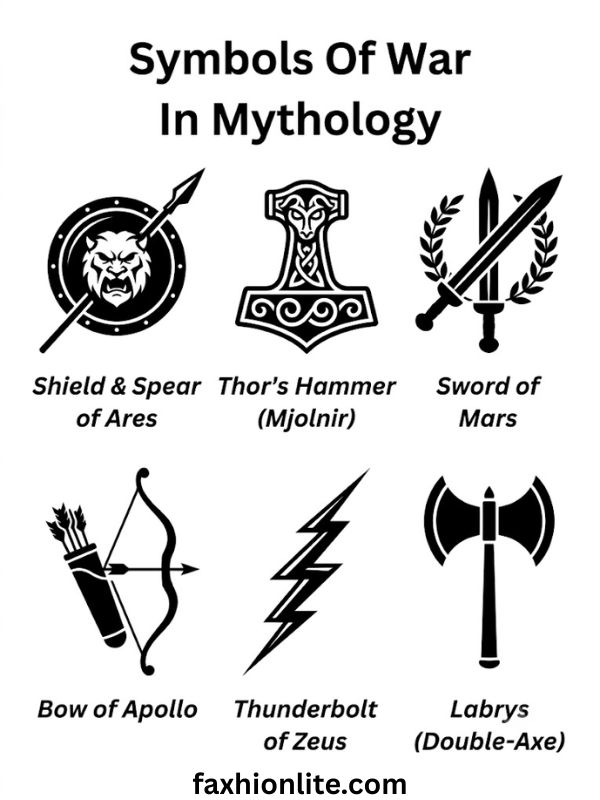
Mythological war symbols span nearly every culture. Norse mythology gives us Odin’s ravens, associated with battlefield knowledge. Hindu mythology offers the Chakravyuha, a symbolic battle formation representing strategy and inevitability. Egyptian mythology features Sekhmet, a lioness war goddess symbolizing both destruction and healing, a duality rarely discussed outside academic circles.
What Symbolizes War?
Direct answer: red color, crossed weapons, skulls, broken shields, war drums, and predatory animals like eagles and wolves are the most common symbols representing war across world cultures.
Deep Symbolic Meaning of War Symbols
War symbols operate on three levels simultaneously: spiritual, psychological, and cultural. Understanding all three gives you the full picture instead of a surface-level one.
Spiritual Meaning
In many traditions, war symbols represent an inner battle rather than a literal one. The spiritual meaning of war symbols often centers on personal transformation, protection from harm, and the idea of the “spiritual warrior” who fights against fear, doubt, or temptation rather than an enemy army.
Psychological Meaning
Psychologist Carl Jung described the “Warrior” as one of the core human archetypes, representing discipline, courage, and the will to act. This helps explain the psychological meaning of war symbols: people are drawn to them not because they crave violence, but because they represent strength during hardship.
Cultural Meaning
The same symbol can mean pride in one culture and pain in another. A flag that represents freedom to one group can represent conquest to another. This is why context always matters more than the image alone when interpreting cultural war symbols.
Powerful Types of War Symbols and Their Meanings
Here’s a closer look at six of the most recognized war symbols in history, broken down by appearance, meaning, and where you’ll actually see them today.
Eagle Symbol
Visual Description: A bird of prey, usually shown with wings spread and talons extended.
Meaning: Power, sovereignty, and dominance. The eagle’s sharp eyesight and hunting ability made it a natural symbol of vigilance and strength.
Where It Appears: Roman legionary standards, the Great Seal of the United States, German and Russian heraldry, and countless modern military insignias.
Sword Symbol
Visual Description: A long blade, often shown upright or crossed with another sword.
Meaning: Honor, justice, and readiness for battle. In many knighthood ceremonies, the sword represents a code of conduct rather than raw violence.
Where It Appears: Coats of arms, knighthood ceremonies, courtroom statues of Lady Justice, and modern tattoos.
Skull and Crossbones
Visual Description: A human skull above two crossed bones.
Meaning: Mortality, danger, and fearlessness in the face of death.
Where It Appears: Pirate flags (the Jolly Roger), certain military unit patches, and biker culture patches.
Red Poppy Symbol
Visual Description: A bright red flower with a dark center, based on the poppies that grew across WWI battlefields in Flanders.
Meaning: Remembrance and sacrifice. It’s one of the few war symbols rooted in mourning rather than aggression.
Where It Appears: Remembrance Day and Veterans Day events across the United States, United Kingdom, and Canada.
Shield Symbol
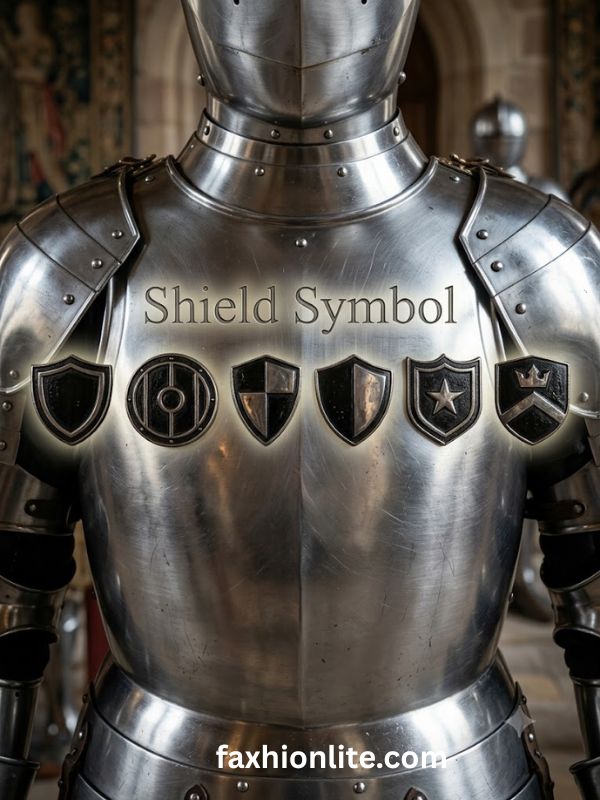
Visual Description: A protective plate, often oval or heater-shaped, sometimes decorated with a family crest.
Meaning: Protection, defense, and identity.
Where It Appears: Medieval coats of arms, sports team logos, and corporate branding meant to suggest trust and safety.
Dragon Symbol
Visual Description: A large, serpentine creature, often depicted breathing fire or coiled in a defensive posture.
Meaning: Strength and dominance, though interpretation shifts by region: protective in East Asian cultures, destructive in much of medieval European folklore.
Where It Appears: The Welsh flag, Chinese military banners throughout history, and medieval European legend.
War Symbols Across Cultures
No two cultures built their war symbolism the same way, and comparing them side by side reveals a lot about each society’s values.
Ancient Roman Culture
Rome’s military identity revolved around the Roman eagle standard, called the aquila, carried by every legion. Losing this standard in battle was considered a catastrophic disgrace, showing just how central the symbol was to military honor.
Viking Culture
Viking war symbols include the Valknut, associated with Odin and fallen warriors, and raven imagery tied to battlefield insight. Thor’s hammer, Mjolnir, also carried protective connotations during raids and conflict.
Japanese Samurai Culture
The samurai mon crest identified individual clans on the battlefield, much like Western heraldry. Paired with the katana and the code of Bushido, these symbols represented discipline as much as combat skill.
Native American Cultures
Native American war paint symbols varied widely by tribe, often representing personal achievements, spiritual protection, or intimidation rather than a single unified meaning. It’s important to note these symbols were, and remain, deeply specific to individual nations rather than interchangeable.
Medieval European Culture
Medieval coats of arms used color, animals, and geometric patterns to identify noble families in battle, a visual system so detailed it eventually became its own formal discipline called heraldry.
War Symbols in Art, Movies and Pop Culture

War symbolism didn’t stop evolving after the battles ended; it simply moved into new mediums.
In Movies
Pop culture war symbols show up constantly in historical epics and fantasy franchises, where armor, banners, and weapons are used to instantly communicate a faction’s identity and values without dialogue.
In Paintings
Classical war paintings often hide symbolic details art historians still study today, from the positioning of a fallen soldier to the specific color of a banner in the background.
In Books
Literature frequently uses battle symbols meaning as metaphor. A sword in a novel might represent a character’s inner conflict rather than an actual weapon.
In Tattoos
Tattoo artists report steady demand for sword, eagle, and skull designs, largely because clients associate them with personal resilience rather than literal violence.
In Fashion
Military inspired streetwear, camouflage patterns, and symbol based jewelry all borrow directly from historical war imagery, often stripped of their original context entirely.
Spiritual and Dream Meaning of War Symbols
Dream interpretation of war imagery is one of the most searched, and least well answered, corners of this topic.
Seeing Swords in Dreams
A sword in a dream is often interpreted as a sign of personal power, conflict resolution, or the need to “cut ties” with something in your life.
Seeing Flags or Banners
Flags or banners in dreams often relate to identity, loyalty, or taking a stand on something important in your waking life.
Seeing Battles or Armor
Dreaming of battles or armor is commonly associated with feeling the need for protection, or facing a challenge that requires inner strength to overcome.
Positive vs Negative Meaning of War Symbols
War symbols carry both light and dark interpretations, often at the same time.
Positive Meanings
Courage, honor, protection, remembrance, and unity are the most common positive associations tied to honor and bravery symbols across cultures.
Negative Meanings
Violence, oppression, division, and trauma represent the darker side. Some symbols, especially those tied to specific atrocities, remain permanently associated with fear and intimidation rather than honor.
Why Humans Are Attracted to War Symbols
People aren’t necessarily drawn to violence itself; they’re drawn to what these symbols represent: strength, identity, and belonging. This is the same psychological pull behind sports team logos and military branding, both of which borrow heavily from warrior symbols to build loyalty and pride.
Frequently Asked Questions
What is the most common symbol for war?
Crossed swords and the color red remain the most widely recognized symbols representing conflict across world cultures.
What animal symbolizes war?
The eagle and wolf are the animals most closely tied to war symbolism across many cultures worldwide.
What color represents war?
Red represents war most consistently across cultures worldwide, symbolizing blood, urgency, sacrifice, and battlefield intensity throughout history.
What is the ancient symbol for war?
Crossed spears and early war standards, like Rome’s aquila, rank among the oldest known war symbols today.
What does a sword tattoo symbolize?
A sword tattoo typically symbolizes personal strength, honor, resilience, or a significant battle the wearer has overcome.
Conclusion
War symbols aren’t just relics of the past. They’re a living visual language that’s been shaped by every empire, mythology, and battlefield in human history. Whether you’re getting a tattoo, decoding a dream, or just curious about the eagle on a coin, understanding war symbolism connects you to something much bigger than a single image.