
45+ Traditional Buddhist Symbols and Meanings: Hidden Messages of Enlightenment, Protection & Inner Peace (2026)
Symbols and meanings in Buddhism carry centuries of wisdom in a single image. A lotus, a wheel, a knot, each one tells a story. These symbols point to enlightenment, protection, and inner peace.
They show up in temples, tattoos, and jewelry alike. This guide breaks down 45+ of the most meaningful ones. By the end, you’ll see these images in a whole new way.
What Are Buddhist Symbols and Meanings?
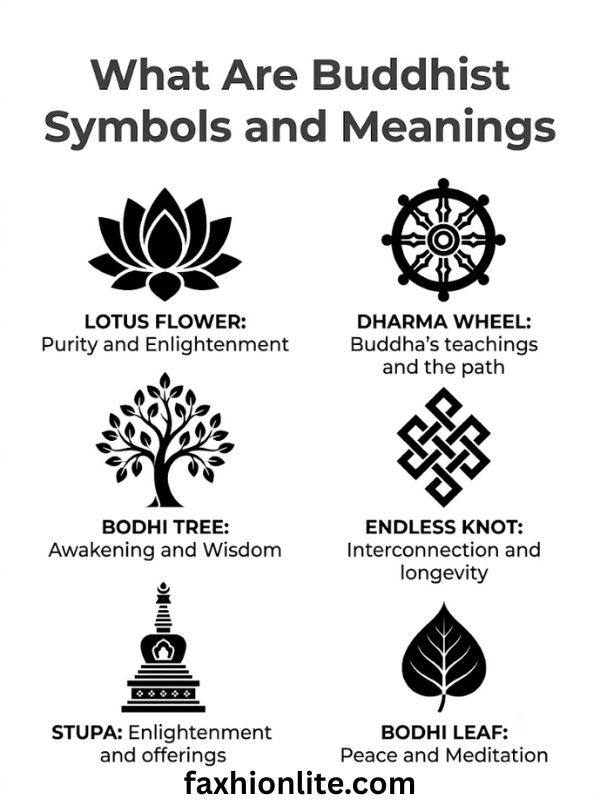
Buddhist symbols are visual representations of the Buddha’s teachings, used to communicate ideas like impermanence, karma, and liberation without relying on words alone. They act as shortcuts to complex philosophy, something a person can glance at and instantly connect to a bigger idea.
Most Buddhist religious symbols trace back to events in the Buddha’s life or to nature imagery he used in his teachings, like the lotus growing out of muddy water. Over time, communities across Asia adapted these images into art, architecture, and personal items such as jewelry and prayer beads.
This is why you’ll find the same core symbol, say the lotus, looking slightly different in a Thai temple compared to a Tibetan monastery.
It helps to think of these symbols and meanings as a form of shorthand. The Dharma Wheel with its eight spokes represents the Noble Eightfold Path, a core teaching that outlines the route to ending suffering.
That single fact tells you why the wheel shows up on flags, temple gates, and even national emblems in Buddhist countries. Understanding a handful of these core symbols gives you a surprisingly deep entry point into Buddhist philosophy as a whole.
Understanding Buddhist Symbols And Their Deep Meanings
Buddhist symbols work on more than one level at the same time, blending religious doctrine, personal psychology, and cultural identity into a single image. That layering is exactly why the same symbol can mean slightly different things depending on who you ask.
On a doctrinal level, a symbol often points directly to a specific teaching. The lotus, for example, isn’t just a pretty flower. It grows in muddy ponds yet blooms clean and untouched above the water, which mirrors the Buddhist idea that awakening is possible even when surrounded by difficulty. On a personal level, though, many practitioners use these same images as reminders during meditation, a visual anchor that pulls the mind back to the present moment.
What Are The 8 Symbols Of Buddhism?
The eight symbols most commonly referenced are known as the Ashtamangala, or Eight Auspicious Symbols. They are the Conch Shell, the Endless Knot, the Golden Fish (usually shown as a pair), the Lotus Flower, the Parasol, the Treasure Vase, the Dharma Wheel, and the Victory Banner. These eight appear together frequently in Tibetan art, often painted along temple walls or woven into textiles.
Each one represents a different aspect of a fulfilled spiritual life, from wealth of the mind to freedom from fear. Seeing them as a set is common in Vajrayana Buddhism, where they’re treated almost like a checklist of blessings a practitioner hopes to embody.
8 Symbols Of Buddhism And What They Mean
The Conch Shell represents the far reaching sound of the Buddha’s teachings, since its spiral shape once served as a natural trumpet in ancient India. The Endless Knot shows the interconnected nature of everything, how cause and effect loop endlessly without a clear start or finish.
The Golden Fish symbolizes fearlessness and freedom, since fish swim without obstruction through water.
The Lotus stands for purity rising out of difficulty, while the Parasol represents protection from suffering and harmful forces. The Treasure Vase is a symbol of inexhaustible wealth, not just material riches but spiritual abundance too.
The Dharma Wheel points to the Buddha’s teachings and the path out of suffering, and the Victory Banner marks the triumph of wisdom over ignorance and ego.
5 Symbols Of Buddhism
If you’re just starting to learn about Buddhism symbols, five stand out as the most recognizable worldwide: the Lotus Flower, the Dharma Wheel, the Buddha statue itself, the Bodhi Tree, and the Om (Aum) symbol. These five show up most often in Western wellness spaces, tattoos, and home décor, partly because their meanings translate easily across cultures.
Each of these five touches on a different part of the spiritual path, growth, teaching, embodiment, awakening, and sound or vibration. Together they give a beginner a solid foundation before diving into more specialized or regionally specific imagery.
Popular Buddhist Symbols And Their Uses In Daily Life
Buddhist symbols show up far beyond temple walls, appearing in tattoos, jewelry, home altars, and even modern branding. Their popularity comes from how naturally they translate into daily reminders of calm, protection, and purpose.
The Buddhist symbol of life is most often represented by the Bhavacakra, or Wheel of Life, a detailed image showing the cycle of birth, death, and rebirth known as samsara. It’s a busy, layered image, often broken into six realms, and it’s used to teach how actions and intentions shape future experiences.
For Buddhist symbols and meanings for tattoos, the lotus and the Dharma Wheel are by far the most requested designs, followed closely by the Om symbol and stylized Buddha eyes.
People often choose these not just for looks but because they represent a personal milestone, like recovering from a hard period in life or committing to a calmer mindset. It’s worth noting that many practitioners consider it respectful to learn the meaning before getting one permanently inked, since some symbols carry sacred weight in specific traditions.
Buddhist protection symbols include the Vajra, a diamond thunderbolt shape representing indestructibility, along with the Endless Knot and certain protective amulets worn in Thailand called Phra Kruang. These items are believed to ward off harm and are often blessed by monks before being worn.
A quick reference table helps organize some of the most searched symbols and their core meanings:
| Symbol | Core Meaning | Common Use |
| Lotus Flower | Purity rising from difficulty | Tattoos, home décor, meditation |
| Dharma Wheel | The Noble Eightfold Path | Temple architecture, flags |
| Endless Knot | Interconnection of all things | Jewelry, protection charms |
| Vajra | Indestructibility, spiritual power | Tibetan ritual objects |
| Om (Aum) | Universal sound and unity | Meditation, yoga spaces |
| Bodhi Tree | Site of enlightenment | Art, temple gardens |
The Buddhist symbol for love doesn’t look like a Western heart. Instead, it’s usually represented through the Endless Knot, which suggests connection without beginning or end, or through paired Golden Fish, which represent harmony and companionship.
Zen Buddhist symbols lean toward minimalism. The Enso circle, drawn in a single confident brushstroke, represents emptiness, the present moment, and imperfection accepted as beauty. This ties into the Japanese aesthetic idea of wabi sabi, which finds value in things that are incomplete or imperfect.
When people search for meaning of Buddha symbols, they’re often really asking about mudras, the hand gestures shown on Buddha statues. The Earth Touching mudra recalls the moment of the Buddha’s enlightenment, the Meditation mudra represents deep focus, and the Teaching mudra shows the Buddha in the act of sharing wisdom.
Statue posture matters too. A standing Buddha typically represents teaching or blessing, a seated Buddha represents meditation, and a reclining Buddha represents the Buddha’s passing into final nirvana, called parinirvana.
Buddha footprints, another lesser discussed image, symbolize the physical presence of the Buddha on earth before statues became common, and they’re still worshipped at several sites across Southeast Asia today.
Inner peace Buddhist symbols most often include the seated meditating Buddha and the lotus in its fully bloomed state, both representing stillness achieved after effort.
Meanwhile, strength Buddhist symbols lean on the Vajra for indestructible resolve, the lion for courage, and the elephant for steady, grounded mental power, since elephants in South Asian tradition are associated with calm strength rather than aggression.
Regional variations add even more depth. Tibetan Buddhist symbols and meanings include the five colored prayer flags, each color representing an element (sky, air, fire, water, earth), along with prayer wheels that are spun to release mantras into the world.
Thai Buddhist symbols and meanings often center on golden Buddha statues and Naga serpent guardians positioned at temple entrances to protect sacred spaces.
Theravada Buddhist symbols and meanings tend to be simpler and more historically grounded, focusing on the life of the historical Buddha rather than the elaborate deity imagery found in Vajrayana traditions.
Deep Symbolic Meaning of Buddhist Symbols
Buddhist symbols operate on three distinct levels at once: spiritual, psychological, and cultural, which is part of why they’ve remained relevant for thousands of years. Understanding all three gives a fuller picture than looking at any single layer alone.
Spiritual Level
On the spiritual level, symbols act as direct pointers to doctrine. The Dharma Wheel doesn’t just look nice, it encodes the entire Eightfold Path in a single geometric shape, making it a teaching tool as much as a decoration.
Psychological Level
Psychologically, these images function as anchors during meditation and moments of stress. Research on mindfulness practices has consistently linked visual focal points, like a lotus or a candle flame, to improved attention and reduced anxiety during meditation sessions.
This is one reason therapists sometimes incorporate Buddhist imagery into mindfulness based stress reduction programs, even for clients who aren’t Buddhist themselves.
Cultural Level
Culturally, these symbols carry identity across generations, especially for diaspora communities who use them to stay connected to heritage. A prayer flag hung outside a home in California can serve the same emotional purpose as one hung in the Himalayas, linking a person back to family tradition and shared belief.
Types and Variations of Buddhist Symbols and Meanings
Beyond the Eight Auspicious Symbols, several standalone images carry enormous weight in Buddhist iconography, each tied to a specific moment or teaching in the tradition.
1. The Dharma Wheel (Dharmachakra)
This eight spoked wheel represents the Noble Eightfold Path and is often the very first symbol a new student of Buddhism learns to recognize.
2. The Lotus Flower
Different colors carry different meanings. White represents purity, pink is reserved for the highest states of enlightenment, blue represents wisdom, and red represents compassion and the heart.
3. The Buddha Image
Statues vary enormously by country and era, but they consistently use posture and mudra to communicate a specific teaching moment from the Buddha’s life.
4. The Endless Knot
With no clear start or end, this symbol represents the interdependent nature of existence, a concept central to Buddhist philosophy known as dependent origination.
5. The Bodhi Tree
This is a sacred fig tree, specifically the type under which the historical Buddha achieved enlightenment near Bodh Gaya in India. Descendants of that original tree are still tended today and treated as living relics.
6. The Stupa
A dome shaped structure believed to house relics or represent the Buddha’s enlightened mind. Famous examples include Boudhanath in Nepal and the Great Stupa at Sanchi in India, both still active pilgrimage sites.
Buddhist Symbols and Meanings Across Cultures
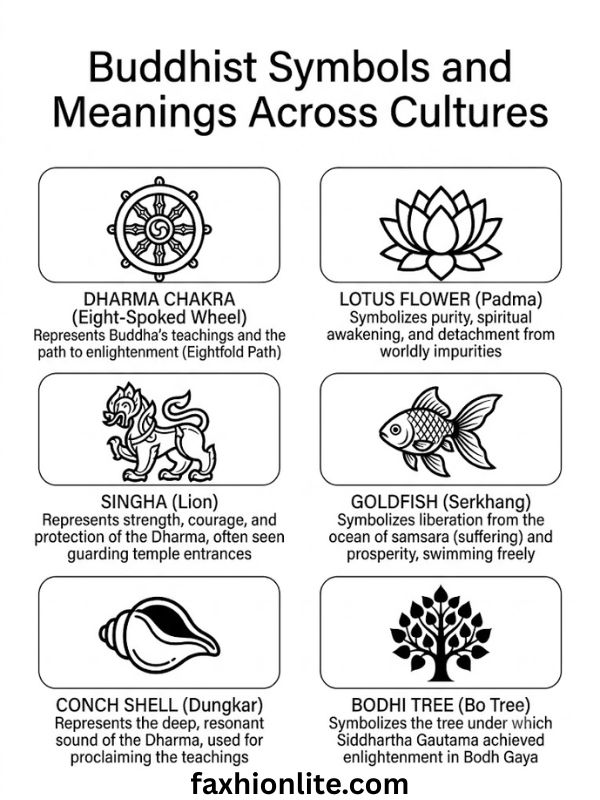
The same core symbols look dramatically different depending on where Buddhism traveled and which local traditions it blended with along the way.
Ancient India
This is where it all started, with the wheel and lotus borrowing from earlier Vedic and Hindu imagery before being reshaped around Buddhist teaching.
Tibetan Culture
Vajrayana Buddhism added elaborate mandalas, prayer wheels, and the snow lion, a mythical creature representing fearlessness and joy.
Chinese Buddhism
Here, Buddhist symbolism blended with Taoist and Confucian visual traditions, giving rise to imagery like the dragon and detailed depictions of Guanyin, the Bodhisattva of compassion.
Japanese Buddhism
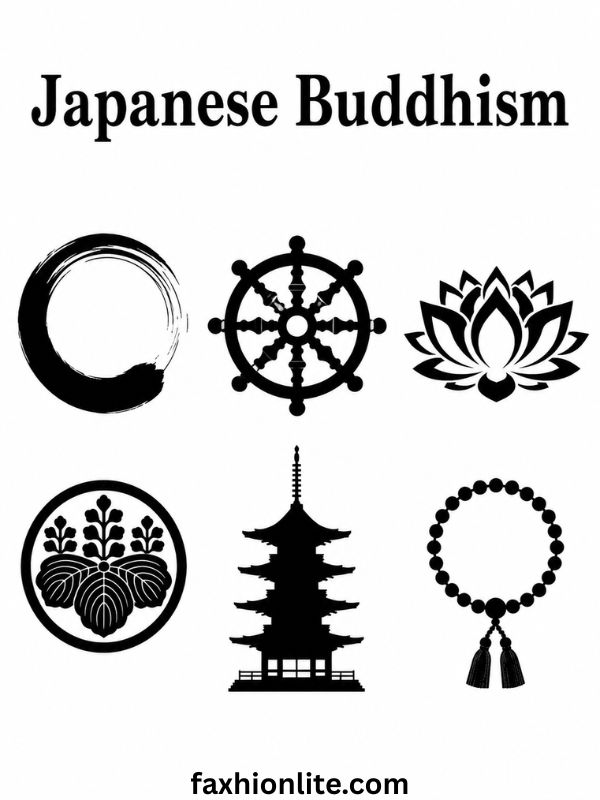
Zen Buddhism stripped things down to their essentials, favoring the Enso circle, bamboo, and cherry blossoms, the latter representing the fleeting, impermanent nature of life known as mono no aware.
Modern Global Culture
Western wellness culture has adopted many of these images, sometimes respectfully and sometimes in ways that strip out the original spiritual context entirely, which has sparked ongoing conversation about cultural appropriation versus appreciation.
Buddhist Symbols in Art, Movies and Pop Culture
Buddhist imagery has become a visual shorthand in Western media for calm, wisdom, or spiritual searching, even in stories that have nothing to do with actual Buddhist practice.
You’ll spot lotus motifs in fashion collections, Enso circles in minimalist logo design, and meditating Buddha statues used as set decoration to signal a character’s inner journey.
This crossover has helped spread awareness of Buddhist philosophy to people who might never have encountered it otherwise, though it has also led to some symbols losing their original context when used purely for aesthetics.
Spiritual and Dream Meaning of Buddhist Symbols
In various spiritual traditions and popular dream interpretation frameworks, seeing a lotus or a Buddha figure in a dream is often associated with a personal need for calm or an unconscious signal of upcoming growth.
These interpretations are cultural and personal rather than doctrinal Buddhist teaching, but they’ve become part of how many people in the West relate to these images.
Positive vs Negative Meanings of Buddhist Symbols
Most Buddhist symbols carry overwhelmingly positive intended meanings, though a few have faced painful misuse outside their original context.
Positive Meanings
The core intended meanings center on growth, protection, compassion, and the path toward enlightenment, exactly as they were designed to function within Buddhist teaching.
Negative or Shadow Meanings
The clearest example of misuse involves the swastika, an ancient symbol of good fortune in Buddhist and Hindu tradition long before it was violently co opted by unrelated 20th century hate movements in the West.
Its original Buddhist meaning has nothing to do with that later misuse, and many Buddhist communities still use it respectfully in its authentic historical context today.
Why Humans Are Drawn to Buddhist Symbols
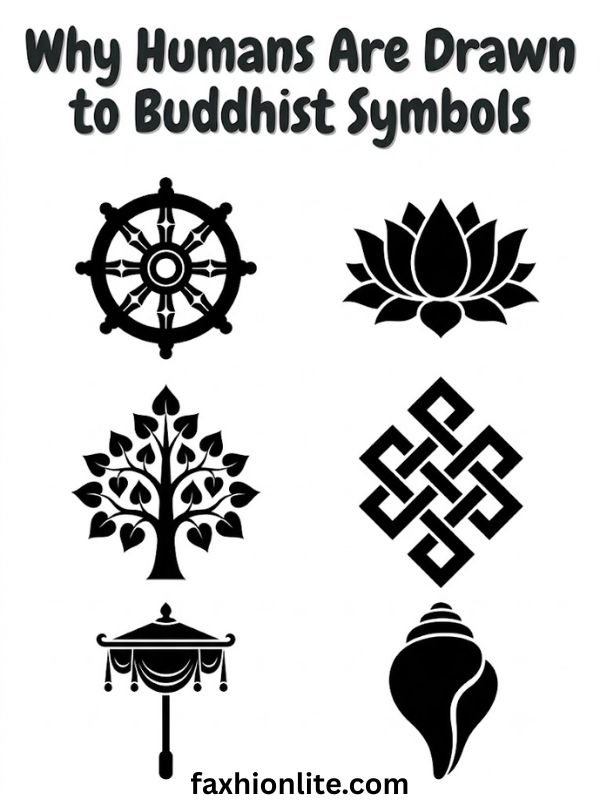
People are drawn to these symbols because they offer a compact, visual form of meaning during a time when many feel overwhelmed by noise and distraction. A single image like the lotus can deliver a complete idea (growth through hardship) faster than paragraphs of explanation ever could.
The global rise of mindfulness and meditation apps over the past decade has only accelerated this interest, introducing millions of people to Buddhist concepts through visual branding long before they ever read a single teaching.
There’s also a simple aesthetic pull. Buddhist art tends to favor balance, symmetry, and calm color palettes, qualities that naturally appeal to people seeking a sense of order in busy modern life.
Frequently Asked Questions
What are Buddhist symbols and meanings?
Buddhist symbols are visual images representing teachings like enlightenment, compassion, and impermanence, used across meditation, art, and daily spiritual practice.
What is the most important symbol in Buddhism?
The Dharma Wheel is considered most important, representing the Noble Eightfold Path toward ending suffering and awakening.
What does the lotus flower mean in Buddhism?
The lotus symbolizes purity and spiritual growth, blooming beautifully above muddy water despite difficult surrounding conditions and circumstances.
Is it disrespectful to get a Buddhist symbol tattoo?
It can be, depending on the symbol. Research meanings first and choose respectfully, honoring the tradition’s spiritual significance.
What is the Buddhist symbol for protection?
The Vajra and Endless Knot are common protection symbols, representing indestructibility and interconnected safety across Tibetan Buddhist traditions.
Conclusion
Buddhist symbols carry real weight, not just pretty designs. Each one holds a lesson in compassion or peace. The lotus teaches growth through hardship.
The Dharma Wheel points toward the Eightfold Path. Learning these meanings deepens your connection to the practice. Start small, and let one symbol guide your journey.