
100+ Powerful Anti Fascist Symbols Explained: Meanings, History & Global Resistance
Anti fascist symbols are visual tools of resistance that people have used for over a century to oppose authoritarian rule, fascism, and the suppression of human rights. From the streets of 1930s Berlin to the protest marches of modern-day America, these symbols carry weight, history, and meaning that goes far beyond a simple image on a flag or a patch on a jacket.
You’ve probably seen them. The clenched fist raised high at a march. The red and black flag at a demonstration. The three arrows sprayed on a wall. But do you actually know what they mean, where they came from, and why people still use them today? That’s exactly what this guide covers.
What Are Anti Fascist Symbols?
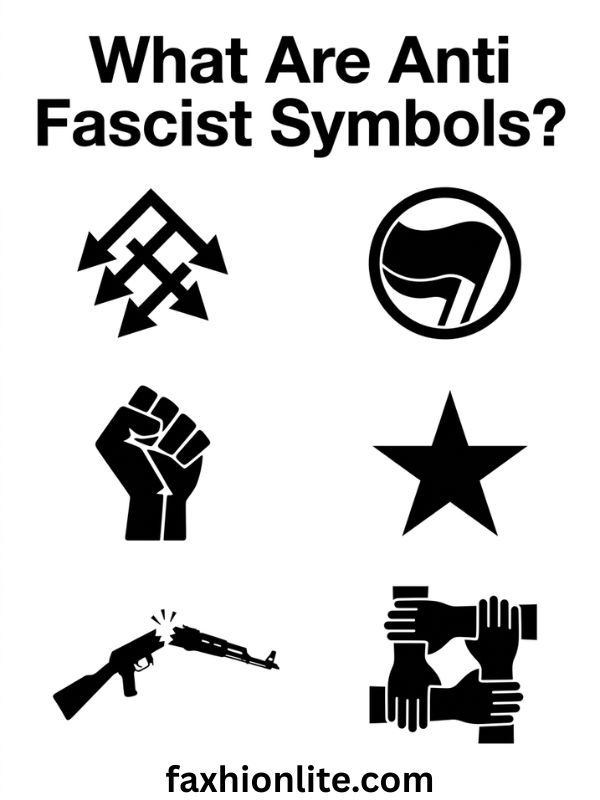
Anti fascist symbols are recognizable visual images, icons, and emblems used to express opposition to fascism, authoritarianism, and the political ideologies associated with them. They function as shorthand communication in spaces where words aren’t enough or aren’t fast enough, and they’ve been doing that job since the early 20th century.
At their core, these resistance symbols serve three purposes. First, they identify the person or group displaying them as part of a broader movement. Second, they communicate a political stance instantly, without a single word. Third, they create solidarity between people who share values of democracy, equality, and human dignity, even across language barriers and national borders.
What makes anti fascist symbols different from other political symbols is their reactive nature. They didn’t emerge from a single party platform or government decree. They grew out of necessity, created by workers, artists, intellectuals, and ordinary people who needed a common visual language to organize against rising authoritarian power. That grassroots origin is part of why so many of them still feel urgent and personal today.
Deep Symbolic Meaning
Every anti fascist symbol works on multiple levels at once, which is a big part of why they’ve proven so durable across generations and cultures. These aren’t just logos or brand marks. They’re compressed expressions of deeply held values.
Spiritual Level
On a spiritual level, anti fascist symbols connect to some of humanity’s oldest and most universal moral instincts. The desire to protect the vulnerable, stand up to tyranny, and build a world where human dignity is respected runs through nearly every major religious and ethical tradition in history.
Many people who display these symbols describe a sense of moral alignment when they do so, a feeling of being on the right side of history. The raised fist, for example, doesn’t just say “I’m angry.” It says “I stand with those who’ve been pushed down, and I’m willing to push back.” That’s a statement with deep spiritual resonance, especially in communities shaped by liberation theology, progressive faith traditions, and social justice ministries.
There’s also something worth noting about how these symbols function in memorialization. When people gather to remember those who died fighting fascism in Spain, in WWII, or in the resistance movements of Latin America, these symbols often appear as a form of sacred tribute. They mark sacrifice. They honor the people who chose solidarity over safety.
Psychological Level
Psychologically, symbols do something that words rarely can: they trigger emotion before rational thought even kicks in. That’s not a flaw; it’s a feature. Political resistance requires not just intellectual agreement but emotional commitment, and symbols are one of the fastest ways to build that commitment in a group.
Research in social psychology consistently shows that shared symbols strengthen group cohesion. When you wear or display a symbol others in your community recognize, you’re sending a signal of belonging. You’re saying “I’m one of you” without opening your mouth. For people in activist communities, that kind of instant recognition can be genuinely powerful, especially in high-stakes situations like protests or direct action.
Carl Jung’s work on archetypes is useful here. He argued that certain symbols tap into shared unconscious patterns that humans across cultures recognize instinctively. The clenched fist, the shield, the banner of resistance, these images echo archetypes of the warrior, the protector, and the rebel against tyranny that appear in myths and stories across every culture on earth. Anti fascist symbols draw on that deep well.
Cultural Level
Culturally, anti fascist symbols work as generational connectors. When a young American in 2025 wears a three arrows patch, they’re linking themselves to German workers in 1931 who used that same symbol to resist the Nazi rise to power. That’s a powerful form of cultural memory, and it’s one that these symbols carry more effectively than most textbooks.
In American subcultures specifically, antifascist imagery moved from political organizing into music, fashion, and street art through the punk and hardcore scenes of the 1980s and 1990s. Bands like Dead Kennedys and later groups in the ska-punk and hardcore traditions brought antifascist symbols into venues and onto t-shirts worn by teenagers who might never have attended a political meeting.
That cultural diffusion kept these symbols alive and evolving. Today they appear in hip-hop, in video game design, in graphic novels, and across social media. Each new context adds a layer of meaning while preserving the original core: resistance to authoritarian power and solidarity with those who resist it.
Types and Variations of Anti Fascist Symbols

There’s no single official anti fascist symbol. The movement has always been decentralized and diverse, and that’s reflected in the wide variety of resistance symbols associated with it. Here are the most historically significant and widely recognized ones.
Three Arrows
The three arrows symbol is one of the most historically specific anti fascist symbols in existence. Created in 1931 for the Iron Front in Germany, the three downward-pointing arrows were designed to visually represent striking down three threats: monarchism, Nazism, and Stalinism. It was explicitly anti-authoritarian across the political spectrum, not just anti-right.
The Iron Front was a coalition of social democrats, trade unionists, and other democratic forces trying to hold the center against extremism from both sides. Their symbol was deliberately chosen to be simple enough to spray-paint quickly on walls, which tells you something about how they expected to be fighting.
In modern America, the three arrows have found new life among democratic socialists, labor organizers, and progressive political groups. The Democratic Socialists of America and various local political campaigns have incorporated it. It resonates particularly with people who want to signal opposition to all forms of authoritarianism, not just right-wing varieties. If you’ve seen it on a protest sign or a bumper sticker lately, now you know why.
Antifa Flag
The antifa flag is the red and black dual-color flag most people associate with the word “antifa” in modern American political discourse. Its origins go back to the Antifaschistische Aktion organization founded in Germany in 1932. The two colors represent the two main traditions that formed the organization: the red of socialist and communist labor movements, and the black of anarchist resistance.
This flag was largely dormant after WWII until it was revived in the 1980s by German antifascist groups fighting neo-Nazi skinhead violence. From Germany, it spread to the United Kingdom and then to the United States through punk networks. American antifascist organizations adopted it through the 1990s and 2000s, and it became widely visible to mainstream American audiences during the political upheaval of 2017.
Raised Fist
The raised fist might be the single most globally recognized resistance symbol on earth. Its history stretches across movements, continents, and decades in a way that no other symbol in this list can match.
It started in labor organizing in the early 20th century, appearing in union literature and socialist publications as an image of worker solidarity. By the 1930s and 1940s, it had been adopted by antifascist resistance movements across Europe. The Spanish Republicans used it. French resistance fighters used it. It appeared on WWII-era antifascist posters throughout the Allied nations.
In America, the raised fist became iconic during the Civil Rights Movement and the Black Power movement of the 1960s. When Tommie Smith and John Carlos raised their fists on the Olympic podium in 1968, they connected that gesture to a global tradition of resistance that went back decades. Since then, it’s appeared in feminist movements, LGBTQ+ rights organizing, immigrant rights marches, and virtually every major progressive social movement in the Western world. It belongs to all of them, and none of them exclusively.
Circle A
The Circle A is the primary symbol of anarchism, and its connection to antifascism is both historical and philosophical. Anarchists were among the very first organized opponents of fascism in Europe, fighting in the Spanish Civil War as part of the anarchist militias that resisted Francisco Franco’s fascist uprising starting in 1936.
The design is simple: the letter A enclosed in a circle. The A stands for anarchy, derived from the Greek word meaning “without rulers.” The circle represents the anarchist principle that anarchy is itself a form of order, a self-organized society without coercive authority. The symbol became widely associated with punk subculture in the 1970s, spreading from political organizing into music, fashion, and street art.
In antifascist contexts, the Circle A represents the most radical end of the resistance spectrum: the belief that fascism isn’t just a political problem but a symptom of hierarchical power itself. For people who display it, it’s a statement that the goal isn’t just to defeat fascism but to build something fundamentally different in its place.
No Fascism Sign
The no fascism sign takes the universal visual language of prohibition, that familiar red circle with a diagonal line through it, and applies it to fascist imagery. Most commonly, it features a swastika or other fascist symbol inside the prohibition circle, making its message immediately clear to anyone regardless of language or cultural background.
This symbol borrows its visual logic from traffic signs and international warning symbols, which makes it one of the most accessible anti fascist symbols ever created. You don’t need to know any history to understand what it means. That simplicity has made it remarkably durable and widespread.
Anti Fascist Symbols Across Cultures

Anti fascist symbols didn’t emerge from one culture or one moment in history. They developed in parallel across multiple continents as people in different countries faced similar threats to their freedom and dignity.
Europe
Europe is where most of these symbols were born, for the obvious reason that fascism as a modern political movement was born there too. Benito Mussolini’s rise in Italy in 1922 and Adolf Hitler’s in Germany in 1933 created an urgent need for organized visual resistance. The symbols created in that period, especially the three arrows and the antifa flag, carry the weight of that specific historical urgency.
The Spanish Civil War from 1936 to 1939 was arguably the defining event for global antifascist symbolism. International volunteers from dozens of countries, including thousands of Americans in the Abraham Lincoln Brigade, came to Spain to fight Franco’s fascism. The imagery from that conflict, the raised fist, the banners, the resistance posters created by artists like Josep Renau, spread worldwide and established a visual vocabulary that’s still in use today.
Modern Europe continues to grapple with these symbols in the context of rising far-right political parties. In Germany, displaying Nazi symbols is illegal, which has ironically made antifascist symbols more visible as a form of counter-expression. Groups like Hope Not Hate in the UK and various German Antifa organizations continue to use this imagery in contemporary organizing.
United States
American antifascism has its own distinct history that often gets overlooked in mainstream narratives. Before WWII, American volunteers who fought in Spain with the Abraham Lincoln Brigade were among the first Americans to physically resist fascism. Back home, Jewish communities, labor unions, and progressive organizations organized against the rise of American fascist groups like the German American Bund throughout the 1930s.
After WWII, antifascist symbolism in America merged with the Civil Rights Movement, the labor movement, and later the feminist and LGBTQ+ movements. The raised fist became a unifying image across all of these struggles. The punk and hardcore scenes of the 1980s, particularly in cities like Washington D.C., Los Angeles, and New York, became major pipelines for antifascist imagery and organizing among young Americans.
The political events of 2017, particularly the Charlottesville white nationalist rally and its violent aftermath, brought antifascist symbols into mainstream American media in a way they hadn’t been before. Since then, debates about what these symbols mean, who gets to use them, and what they represent have become part of the broader American political conversation.
Latin America
Latin America has its own rich tradition of antifascist and anti-authoritarian resistance symbolism, often developed in response to US-backed military dictatorships that ruled much of the continent through the mid-to-late 20th century. The raised fist appears throughout the visual culture of resistance movements in Chile, Argentina, Brazil, and throughout Central America.
Mexican muralism, particularly the work of Diego Rivera and David Alfaro Siqueiros, created a visual language of resistance that blended Indigenous imagery with socialist and antifascist symbolism in a uniquely Latin American form. Those murals influenced American street art and protest imagery in ways that are still visible today, particularly in cities with large Latino populations like Los Angeles, Chicago, and San Antonio.
Asia
In Asia, antifascist symbolism developed primarily in response to Japanese Imperial expansion during WWII. Chinese, Korean, and Southeast Asian resistance movements developed their own visual traditions of opposition to authoritarian military rule. Post-war Japan developed a strong anti-militarism movement that adopted many of the same symbols used by Western antifascist groups, particularly the peace symbol and the raised fist.
More recently, the 2019 to 2020 Hong Kong pro-democracy protests produced a new wave of resistance imagery that drew on both local traditions and global antifascist visual language. The image of protesters in hard hats, gas masks, and raised umbrellas became iconic worldwide and showed how resistance symbols continue to evolve in response to new forms of authoritarianism.
Middle East
In the Middle East, resistance symbolism operates in a complex political landscape where the definition of fascism and authoritarianism is itself contested. Iran’s “Woman, Life, Freedom” movement that erupted in 2022 produced powerful new resistance imagery: the image of women cutting their hair in public, the color red as a symbol of defiance, and the clenched fist raised by women protesters who risked imprisonment and death to do so.
Kurdish resistance movements have developed their own rich visual traditions, blending socialist and feminist antifascist imagery with distinct cultural symbols. Palestinian resistance art has also developed a global visual vocabulary that intersects with broader antifascist and anti-colonial symbol traditions, appearing in solidarity protests across Europe and the United States.
Anti Fascist Symbols in Art, Movies and Pop Culture
Anti fascist symbols have never stayed confined to political organizing; they’ve always moved fluidly between protest spaces and broader culture. Some of the most powerful examples of antifascist art weren’t made for political rallies at all.
Pablo Picasso’s Guernica, painted in 1937 in response to the Nazi bombing of a Basque civilian town during the Spanish Civil War, is arguably the most famous piece of antifascist art ever created. It doesn’t use any of the specific symbols discussed in this article, but it established a visual grammar for depicting the human cost of fascist violence that influenced protest art for decades.
In music, the connection is direct and documented. Rage Against the Machine built an entire visual identity around antifascist and anti-authoritarian imagery, bringing the raised fist and resistance aesthetics to millions of American listeners who’d never been to a political meeting. Billy Bragg in the UK made antifascist symbolism central to his work for decades. The Dead Kennedys put antifascist content into punk music in a way that shaped generations of American political consciousness.
Spiritual and Dream Meaning of Anti Fascist Symbols
When people encounter anti fascist symbols in dreams or feel a powerful spiritual connection to them, it often reflects deep unconscious engagement with themes of justice, courage, and collective responsibility. This isn’t as abstract as it might sound.
Jungian psychology offers a useful framework here. Jung argued that the psyche organizes itself around archetypes, recurring patterns of image and meaning that appear across cultures in myths, dreams, and symbols. The warrior archetype, the figure who stands against oppression even at personal cost, is one of the most universal. Anti fascist symbols often tap directly into this archetype, which is part of why they provoke such strong emotional responses, both positive and negative.
If you dream of raising a fist, standing under a resistance banner, or feeling solidarity with others in a struggle, psychologists would generally interpret this as your subconscious working through themes of personal agency, moral courage, and the desire to be part of something meaningful. In a culture as politically charged as contemporary America, it’s not surprising that political symbols appear in people’s inner lives.
Positive vs Negative Meaning
Anti fascist symbols are among the most contested visual images in contemporary American political culture, and understanding why requires looking at them from multiple perspectives honestly. The same symbol genuinely means very different things to different people, and both perceptions have real roots.
On the positive side, these symbols represent a centuries-long tradition of ordinary people standing up to authoritarian power. For historians, labor organizers, civil rights advocates, and democratic activists, they’re connected to some of the most morally clear-cut resistance in modern history: the people who fought the Nazis, who faced down fascist dictatorships, who marched for civil rights when doing so was genuinely dangerous.
What these symbols mean to those who embrace them:
- Connection to a long history of democratic resistance
- Solidarity with communities facing discrimination and oppression
- Commitment to human dignity, equality, and civil liberties
- Visual identification with a community that shares those values
- Rejection of authoritarianism in all its forms
On the negative side, some Americans, particularly those with more conservative political views, associate these symbols primarily with property destruction during protests and with what they see as left-wing political extremism. It’s worth acknowledging that concern honestly. The imagery has been present at some events where violence or property destruction occurred, and that association is real for many people even if it doesn’t represent the full history or the majority of people who use these symbols.
Why Humans Are Attracted to This Symbol
People are drawn to anti fascist symbols for the same reasons humans have always been drawn to powerful symbols: they offer identity, community, moral clarity, and a sense of participating in something larger than yourself. That pull is completely normal, and it’s been documented across cultures and centuries.
Identity is the first and probably the most powerful driver. In a politically polarized society like the contemporary United States, the symbols you display tell the world who you are and what you stand for before you say a single word. Anti fascist symbols are particularly strong identity markers because they make a specific moral claim: I’m opposed to authoritarianism and I’m willing to say so publicly.
Community is the second major driver. Wearing or displaying these symbols connects you to a visible network of people who share your values. Research in social psychology consistently shows that shared symbols accelerate the formation of trust and solidarity in groups. At a protest, at a concert, or even on social media, recognizing someone else’s use of these symbols creates an instant sense of kinship.
Conclusion
Anti fascist symbols are living pieces of history. They carry the weight of every struggle they’ve been part of, from the streets of Weimar Germany to the marches of modern America, and they continue to evolve as new generations find new contexts for resistance.
Understanding them isn’t just an exercise in political history, though that history is genuinely fascinating and important. It’s also a way of understanding how humans use visual language to build movements, create community, and express values that feel too important to leave unsaid. These symbols work because they tap into something fundamental about how people organize around shared moral commitments.