
Artemis Symbols: Sacred Signs of the Wild Goddess and Their Hidden Meanings
Artemis symbols represent freedom, the hunt, the moon, and the untamed wild, making them some of the most powerful icons in all of Greek mythology. If you’ve ever felt drawn to a crescent moon, a silver bow, or the quiet grace of a deer in the forest, you’re already touching something ancient and deeply meaningful.
She was the daughter of Zeus and Leto, twin sister of Apollo, and one of the twelve Olympians. From birth, she asked her father for eternal independence, a silver bow, and the freedom to roam the wilderness forever.
The crescent moon, silver bow and arrows, sacred deer, bear, and cypress tree aren’t just beautiful images. They are the living symbols of a goddess who refused to be tamed and whose energy still resonates with millions of people today.
What Are Artemis Symbols?

Artemis symbols are the sacred objects, animals, celestial bodies, and natural elements the ancient Greeks associated with their goddess of the hunt, wilderness, and moon. They aren’t just decorative. Each symbol tells a specific story about her powers, her personality, and her relationship with the natural world.
The primary Artemis symbols include the silver bow and arrows, the crescent moon, the deer (especially the golden-horned Ceryneian Hind), the bear, the cypress tree, the quiver, and her hunting boots. You’ll find these in ancient temple carvings, Greek pottery, Roman mosaics, Renaissance paintings, and today’s tattoo parlors and spiritual altars.
What makes Artemis iconography unique is its paradox. She’s a hunter who protects animals. She’s a goddess of childbirth who chose to remain a virgin forever. She’s fierce and wrathful but also deeply protective of the innocent. Her symbols carry that same complexity, which is probably why they’ve never gone stale.
Artemis Symbols And Meanings
Understanding Artemis symbols fully means understanding the goddess herself first. Each symbol grew directly out of her mythology, her personality, and the specific roles ancient Greeks believed she played in their world. Let’s break that down.
Artemis Goddess
Artemis is the Greek goddess of the hunt, wilderness, wild animals, the moon, and the protection of young women and children. She’s one of three maiden goddesses of Olympus, alongside Athena and Hestia, and her identity is built entirely around independence and self-determination.
Born on the island of Delos (or Ortygia, depending on the source), Artemis arrived as the firstborn twin, and according to several myths, she immediately helped her mother Leto deliver her brother Apollo. That detail is significant. A newborn goddess assisting in childbirth became the eternal protector of that sacred, vulnerable moment.
Her followers in ancient Arcadia and Sparta were among the most devoted in the Greek world. Young girls in Athens served at the sanctuary of Brauron, participating in rituals where they dressed as bears in honor of the goddess. Artemis wasn’t a distant deity you prayed to once a year. She was woven into the everyday experiences of women, hunters, and anyone who ventured beyond city walls.
Artemis Powers
Artemis held dominion over the hunt, wild animals, the moon, childbirth, disease, and healing, making her one of the most versatile and feared deities in the Greek pantheon. Her powers weren’t soft or passive. When she acted, people felt it.
She could bring plague with her arrows and lift it just as quickly. The myth of Niobe, a queen who boasted that her many children made her superior to Leto, ends with Artemis and Apollo shooting all of Niobe’s children dead. Swift, permanent, no negotiation. That same decisive energy is encoded in her bow symbol.
The paradox of her power over childbirth is one of the most fascinating things scholars note about Artemis. A virgin goddess who never bore children herself became the protector of women in labor. Ancient Greek women called on her name during delivery. It speaks to something deeper in her symbolism: Artemis presides over transitions and thresholds, the wild space between safety and danger, life and death, youth and adulthood.
Artemis Meaning In Bible

Artemis appears in the Christian New Testament in the Book of Acts, specifically Acts 19, where her cult at Ephesus was so powerful that Paul’s preaching triggered a city-wide riot. The silversmiths of Ephesus, who made their living crafting silver shrines of Artemis, feared economic ruin if Christianity spread. They shouted “Great is Artemis of the Ephesians!” for two straight hours in the theater.
The Artemis of Ephesus was distinct from the Greek huntress figure. She was a fertility goddess, often depicted with rows of protrusions on her torso (historically debated as breasts, eggs, or bull scrota) and elaborate headdresses. Her symbols in this context weren’t bows and moons but abundance, nature’s bounty, and divine authority over all living things.
What the biblical account tells us is remarkable: Artemis worship was so economically and spiritually central to Ephesus that it rivaled and threatened early Christianity’s expansion. Her symbols were literally made of silver, traded, sold, and kept in homes across the Roman world.
Artemis Roman Name
Artemis’s Roman equivalent is Diana, a goddess who shared her Greek counterpart’s love of the hunt, the moon, and the wilderness but developed her own distinct identity within Roman religion.
The Greeks and Romans didn’t simply copy each other’s gods and rename them. Diana became the goddess of the common people in Rome in a way Artemis never quite did. Her most important sanctuary, the grove at Lake Nemi in the Alban Hills outside Rome, was run by a runaway enslaved person who became its priest by killing his predecessor. Anyone could pray to Diana for protection and freedom. That democratic quality shaped how her symbols, the bow, the moon, the stag, were received and used.
The main symbolic difference: Roman depictions of Diana often show her with a full moon above her head, while Greek images of Artemis tend to favor the crescent. That’s not a trivial distinction. The crescent suggests mystery, becoming, and the liminal. The full moon suggests authority, completion, and illumination. Same goddess, slightly different emphasis, and the symbols carried that difference faithfully.
Artemis Personality
Artemis is consistently portrayed in Greek mythology as fiercely independent, deeply just, protective of the innocent, and absolutely uncompromising about her boundaries. She isn’t soft about it. Cross her, and you find out quickly.
The hunter Actaeon stumbled upon Artemis bathing and was transformed into a stag and torn apart by his own hunting dogs. No warning, no second chance. Orion, her beloved hunting companion (in some versions, the only man she ever considered loving), was killed through a combination of her brother Apollo’s trickery and her own arrow. Whether she grieved or not depends on the version, but his image was placed among the stars.
What makes her personality so compelling to modern readers is exactly that refusal to perform softness. Artemis doesn’t bend for anyone, not even Zeus, within the bounds of what he initially agreed to. She is who she is, fully and without apology. That quality, more than any specific myth, is what her symbols communicate to people who wear them, draw them, or place them on their altars.
Who Was Artemis In The Bible?
The Artemis mentioned in the Bible (Acts 19:24-41) was the Ephesian goddess, a major religious and economic institution in the Roman world of the first century CE. She was not the virgin huntress of Greek myth but a powerful, ancient deity who presided over fertility, wild nature, and the city of Ephesus itself.
The Temple of Artemis at Ephesus, rebuilt multiple times over centuries, was one of the largest temples in the ancient world and attracted pilgrims from across the Mediterranean. When Paul arrived in Ephesus and began converting residents to Christianity, the threat to the Artemis cult was taken seriously enough to spark public demonstrations.
The biblical narrative doesn’t present Artemis as evil, just as a competing spiritual force. The townspeople were genuinely devoted. Understanding this helps modern readers grasp just how embedded Artemis and her symbols were in everyday life across the ancient world, from Greece to Rome to Asia Minor.
Artemis Constellation
While no constellation bears the official name Artemis, she is symbolically linked to several star formations, most significantly Ursa Major and Ursa Minor, which connect to the myth of Callisto.
Callisto was one of Artemis’s most devoted hunting companions. After Zeus disguised himself as Artemis and deceived Callisto, she became pregnant. When Artemis discovered this, she expelled Callisto from her band of hunters. Zeus later transformed Callisto into a bear, and her son Arcas nearly killed her while hunting before Zeus placed them both in the sky as Ursa Major (the Great Bear) and Ursa Minor (the Little Bear). The night sky, in this reading, is partly a monument to Artemis’s inner circle.
NASA named its moon program Artemis deliberately. The reasoning was poetic and precise: Apollo went to the moon, so his twin sister would take humanity back. The program aims to land the first woman on the moon, a choice that feels symbolically right for a goddess who spent eternity championing women and the untamed frontier.
Deep Symbolic Meaning of Artemis Symbols
Spiritual Level
At the spiritual level, Artemis symbols represent the sacred wild, the divine feminine in its most sovereign and undomesticated form, and the human soul’s longing for freedom beyond civilization’s borders.
The crescent moon is her most spiritually potent symbol in modern practice. In Wicca, Hellenism, and broader neopagan traditions, the crescent represents the waxing phase of feminine power: potential, mystery, and the gathering of strength before action. Lighting a silver candle under a new moon and invoking Artemis is a common ritual among goddess devotees in the United States today.
Her symbols also mark liminal spaces, the threshold moments where one state of being ends and another begins. Ancient Greek girls left their childhood toys at Artemis’s temple before marriage. Modern practitioners use her symbols during major life transitions: career changes, leaving harmful relationships, or simply reclaiming personal autonomy. The spiritual message of Artemis is always the same: you are allowed to take up space in the wild.
Psychological Level
Through a Jungian lens, Artemis represents the “Huntress” or “Artemis archetype,” the psychological pattern of the woman who is self-sufficient, goal-directed, and comfortable in solitude. Psychologist Jean Shinoda Bolen devoted an entire chapter to Artemis in her landmark book Goddesses in Everywoman, describing the Artemis type as focused, competitive, and driven by a strong inner compass.
Clarissa Pinkola Estés, in Women Who Run With the Wolves, explored what she called the “Wild Woman archetype,” a concept deeply aligned with Artemis energy: the instinctual, untamed feminine self that modern life tries to domesticate. The bow and arrow in this reading become symbols of intentionality: knowing your target, drawing your focus, and releasing without hesitation.
The shadow side of this archetype is also real. The Artemis psychological pattern can lead to emotional isolation, difficulty accepting help, or disproportionate responses to perceived violations. Understanding Artemis symbols psychologically means accepting the whole picture, the protector and the predator, the healer and the one who sends the plague.
Cultural Level
Culturally, Artemis symbols have served as icons of female independence, environmental connection, and the sacred power of the natural world across thousands of years and dozens of societies.
In ancient Greece, her symbols were markers of transition: from girlhood to womanhood, from civilization to the wild, from life to death. In Rome, Diana’s symbols were democratized, available to anyone who prayed at her sacred groves regardless of social standing. In the modern United States, her symbols appear in feminist literature, environmental activism, and the resurgence of goddess spirituality.
There’s something culturally consistent about what people reach for when they invoke Artemis: autonomy, protection, and a return to something primal and true. In an era of digital overload and urban disconnection, her symbols offer a visual shorthand for the part of the human spirit that still wants to run barefoot through the forest.
Types and Variations of Artemis Symbols
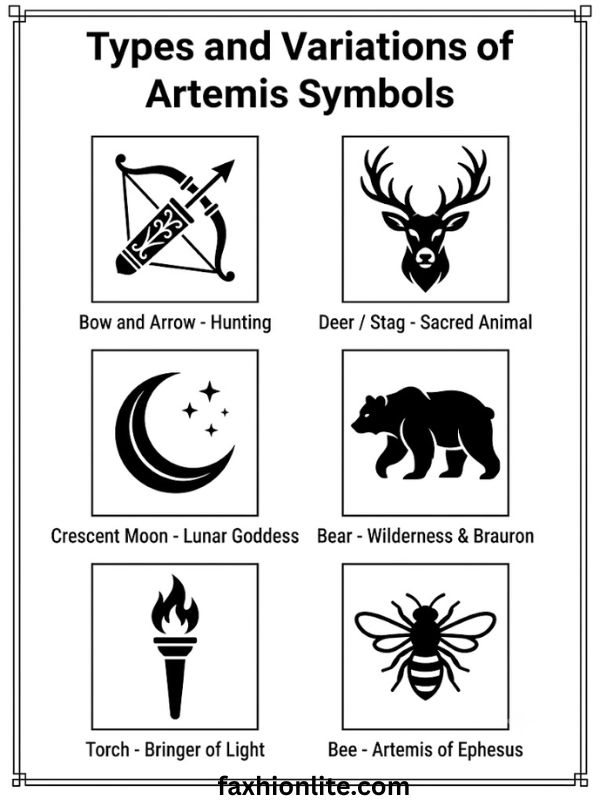
1. The Silver Bow and Arrows
The silver bow is the single most recognizable Artemis symbol and appears in nearly every artistic and literary depiction of the goddess. Crafted by Hephaestus, the divine blacksmith, at her father Zeus’s command, it was one of her first gifts and her primary tool of both hunting and divine justice.
The color silver is deliberate. Apollo carried a golden bow, representing the sun’s power. Artemis carried silver, the metal of the moon: cooler, more reflective, and associated with intuition and the night. Together, the twins represented the full spectrum of daylight and darkness.
Symbolically, the bow represents focused intention, the ability to identify a goal, draw energy toward it, and release at exactly the right moment. It’s why the bow and arrow remain one of the most popular Artemis tattoo choices in the United States today. People aren’t just choosing a pretty image. They’re choosing what it means: precision, purpose, and the confidence to aim.
2. The Crescent Moon
The crescent moon connects Artemis to the rhythms of time, the cycles of nature, and the mysterious pull of the night sky. While the Titan Selene was the original Greek personification of the moon, Artemis gradually absorbed the lunar role and became its dominant goddess in later Greek and Roman traditions.
The crescent specifically (rather than the full moon) is associated with Artemis because it represents the threshold state: neither dark nor fully illuminated, holding potential rather than completion. It’s the moon of beginnings, of setting out before you know exactly how things will unfold.
In contemporary jewelry, fashion, and spiritual practice, the crescent moon is probably the most widely used of all Artemis symbols. It appears on altar cloths, oracle card decks, silver pendants, and tattoo flash sheets across the country. People are drawn to it because it gives visual form to the feeling of being on the verge of something significant.
3. The Deer (especially the Ceryneian Hind)
The deer is Artemis’s most beloved sacred animal, and the Ceryneian Hind is its most mythologically significant form. This was a golden-horned, bronze-hooved deer so sacred to Artemis that capturing it was considered nearly impossible. King Eurystheus sent Heracles (Hercules) to bring it back as his third labor. Heracles spent a full year chasing it before catching it, and even then had to return it to Artemis.
The deer symbolizes grace, swiftness, and the sacred quality of untouched wilderness. What’s fascinating is that Artemis is both the deer’s protector and its hunter, a paradox that mirrors her role as both a destroyer and a preserver of nature. She hunts not to eliminate but to maintain balance.
In modern spiritual practice, the deer is often seen as a messenger of Artemis, and encountering a deer (especially one that holds your gaze without fear) is interpreted by many practitioners as a sign of her presence or blessing.
4. The Bear
The bear connects to one of Artemis’s most poignant myths: the story of Callisto, whose transformation into a bear and subsequent placement among the stars represents both tragedy and eternal honor. Artemis’s sacred festival at Brauron, near Athens, centered on young girls called arktoi (little bears) who served the goddess in multi-year rituals before marriage.
The bear in Artemis symbolism represents maternal ferocity, the protective fury of a mother defending her cubs. It also represents the wild part of human nature that civilization can’t fully tame. Bears don’t ask permission. They take up space, defend their territory, and go where they need to go. That energy aligns perfectly with Artemis’s character.
5. The Cypress Tree
The cypress tree is the most underappreciated of Artemis’s symbols and the one most likely to surprise people who think they know the goddess well. As an evergreen that grows tall and straight without sprawling, it represents eternal constancy, the refusal to bend or change shape to please others.
Ancient sacred groves dedicated to Artemis frequently featured cypress trees. Their dark, vertical silhouettes became visual markers of her presence in the landscape. In funerary symbolism, the cypress represents the boundary between the living world and the realm of the dead, another threshold that Artemis, as a liminal goddess, naturally presides over.
6. The Quiver and Hunting Boots
The quiver and hunting boots are practical symbols that speak directly to Artemis’s identity as a goddess always ready for action. Where other deities held court in marble halls, Artemis moved through the world, always prepared, always mobile.
The quiver says: I carry what I need. The hunting boots say: I go where I choose. Together they form a symbol of prepared freedom, the combination of readiness and autonomy that defines the Artemis archetype. Ancient Greek artists almost never depicted Artemis without at least one of these, because without them, she wouldn’t quite be herself.
Artemis Symbols Across Cultures
Ancient Greece
In ancient Greece, Artemis symbols were embedded in the daily lives of women, hunters, and children in ways that modern readers might find surprisingly intimate. Young girls in Athens dedicated childhood toys and garments to Artemis before marriage, a ritual acknowledgment that girlhood was under her protection and its end required her blessing.
Ephesus (Asia Minor)
The Artemis of Ephesus was a goddess with an entirely different visual vocabulary. Instead of the slim huntress with a silver bow, she was depicted as a towering figure draped in symbols of abundance.
Her temple complex in Ephesus was rebuilt four times and drew pilgrims from across the known world, making her one of the most widely worshipped deities of the ancient Mediterranean.
Roman Empire
In Rome, Diana absorbed Artemis’s symbols and democratized them. Any person, regardless of class or status, could pray at Diana’s sacred grove at Lake Nemi. Her symbols became accessible in a way that Greek Artemis’s sometimes weren’t, appearing in household shrines and public spaces throughout the empire.
Modern Neopaganism
In contemporary Wicca and Hellenism, Artemis symbols are actively used in ritual and devotion. Her crescent moon, silver bow, and deer appear on altars across the United States. Many practitioners invoke her specifically during new moon rituals, asking for clarity of purpose and the courage to pursue goals with precision.
Feminist Spirituality
Artemis has become one of the most powerful symbols in feminist spirituality because she refuses every expectation placed on women by patriarchal culture. She doesn’t marry. She doesn’t bear children. She doesn’t serve.
She hunts, she leads her own band of nymphs, and she holds her own boundaries absolutely. For women navigating questions of autonomy and identity, her symbols offer something rare: a divine model of uncompromising self-determination.
Artemis Symbols in Art, Movies, and Pop Culture

Movies
Artemis appears most memorably in the Percy Jackson film and streaming adaptations, where she leads the Hunters of Artemis, a group of young women who have sworn off romantic love in exchange for eternal youth and the freedom to hunt. Her silver bow and crescent moon are visual shorthand in these productions for a particular kind of feminine power.
The “archer goddess” archetype she inspired appears everywhere: Katniss Everdeen in The Hunger Games, Merida in Brave, and Tauriel in The Hobbit all carry traces of Artemis energy, even when she’s not named directly.
Paintings
Rembrandt, Peter Paul Rubens, and Lucas Cranach the Elder all painted Diana (the Roman Artemis) in memorable works. Rubens’s hunting scenes show her as physically powerful and actively engaged in the chase, a far cry from the passive feminine ideal common in his era.
These paintings used her symbols, bow, hounds, crescent, to communicate something about female power that their male painters found compelling enough to revisit repeatedly.
Books
Rick Riordan’s Percy Jackson series introduced millions of young American readers to Artemis as a complex, morally serious character. In Jean Shinoda Bolen’s Goddesses in Everywoman, Artemis is presented as a psychological archetype that many women recognize in themselves immediately. Clarissa Pinkola Estés’s Women Who Run With the Wolves doesn’t name Artemis directly but maps the same wild feminine territory her symbols have always occupied.
Tattoos
Artemis-inspired tattoos are consistently among the most requested mythology tattoos in American studios. The crescent moon, silver bow and arrow, running deer, and combined goddess imagery all appear regularly. People choose these designs to mark major life transitions, personal autonomy, or a deep connection to nature and the lunar cycle.
Fashion
The crescent moon appears in nearly every celestial jewelry collection from major retailers, often without any direct reference to Artemis but carrying her energy unmistakably. Boho, dark academia, and celestial witch aesthetics that dominate platforms like Pinterest and TikTok all draw heavily on Artemis symbols, even when their creators don’t know the goddess’s name.
Spiritual and Dream Meaning of Artemis Symbols
When Artemis symbols appear in dreams or keep showing up in your waking life, they typically signal a call toward independence, self-protection, or a return to your instinctual self. A silver bow in a dream might mean you’re ready to commit to a goal you’ve been circling.
A deer appearing and holding your gaze could indicate a period of grace and quiet power approaching. The crescent moon in dreams is almost universally linked to new beginnings and the courage to start before you feel fully ready.
In spiritual practice, Artemis symbols are often used to mark and protect boundaries, both physical and emotional. Placing a crescent moon or silver arrow on your altar during times of personal upheaval is a way of invoking her protective, clarifying energy. Many practitioners find that working with Artemis symbols helps them reconnect with instincts they’ve been trained to ignore.
Positive vs. Negative Meanings of Artemis Symbols
Positive Meanings
Artemis symbols carry a wealth of uplifting, empowering associations:
- Freedom and self-determination rooted in her eternal independence
- Protection of the vulnerable, children, young women, and the innocent
- Precision and focus encoded in the silver bow
- Deep connection to nature and the cycles of the natural world
- Feminine courage and strength that doesn’t require external validation
- Lunar intuition and the wisdom of following your inner compass
Negative Meanings
Every powerful archetype carries a shadow, and Artemis is no exception:
- Isolation and emotional unavailability, the shadow of fierce independence
- Disproportionate retaliation, her wrath can exceed the original offense
- Rigidity around purity that can curdle into perfectionism or judgment
- Refusal of vulnerability, which can prevent genuine connection
Understanding the shadow isn’t a reason to avoid Artemis symbols. It’s a reason to engage with them honestly. The symbols that carry the most power are always the ones that tell the whole truth.
Why Humans Are Attracted to Artemis Symbols
People are drawn to Artemis symbols because they give visible form to something most of us feel but struggle to name: the part of the self that refuses to be fully domesticated. In an era of constant connectivity, social performance, and digital surveillance, the image of a goddess running freely through a moonlit forest with a silver bow touches something genuinely primal.
Her symbols also carry a specific cultural weight in the United States right now. Google Trends data shows consistent upward movement for searches around “moon goddess,” “goddess tattoos,” and “Artemis symbols” since 2018, tracking alongside the broader rise of goddess spirituality, astrology culture, and interest in ancient mythology among millennials and Gen Z.
There’s also an environmental dimension that competing pages consistently miss. Artemis is arguably the first great protector of wild spaces in Western mythology. Her sacred groves, her animals, her wilderness haunts, all of it points toward a deep reverence for the natural world that feels urgently relevant in 2025.
People who care about the environment find in her symbols a mythological vocabulary for something they already believe: that the wild deserves protection, reverence, and defense.
Frequently Asked Questions
What are the main Artemis symbols?
The main Artemis symbols include the silver bow, crescent moon, deer, bear, cypress tree, and quiver.
What does the crescent moon represent in Artemis symbolism?
The crescent moon represents feminine intuition, mystery, new beginnings, lunar cycles, and Artemis’s divine connection to the night.
What animal is most sacred to Artemis?
The deer, especially the golden-horned Ceryneian Hind, is considered the most sacred animal of Artemis.
What is Artemis’s Roman name?
Artemis’s Roman name is Diana, the goddess of the hunt, moon, and wilderness in Roman mythology.
Why are Artemis symbols still popular today?
Artemis symbols represent independence, feminine strength, nature connection, and personal freedom, making them powerfully relevant today.
Conclusion
Artemis symbols are ancient, complex, and alive in ways that few mythological icons manage to be. From the silver bow and crescent moon to the sacred deer and bear, each symbol tells a piece of a larger story about freedom, protection, precision, and the enduring human need to connect with the wild.
What makes Artemis exceptional is that her symbols have never been comfortable or decorative. They’re challenging. They ask something of the people who choose them: clarity of purpose, willingness to defend what matters, and the courage to move through the world on your own terms.
Whether you’re drawn to Artemis as a spiritual patron, a psychological archetype, a cultural icon, or simply a beautifully complex figure from ancient myth, her symbols offer the same invitation they always have. Come into the forest. Know what you’re hunting. Don’t apologize for your aim.