

62+ Epic Naruto Symbols That Reveal Hidden Meanings Every True Fan Must Know (2026)
Naruto is filled with powerful symbols that go far beyond exciting battles and unforgettable characters. From legendary clan emblems and hidden village headbands to the Sharingan, Akatsuki clouds, and Sage markings, every symbol carries a deeper meaning rooted in loyalty, sacrifice, destiny, and hope.
These iconic designs reflect the beliefs, history, and emotions that shape the ninja world. In this guide, you’ll discover 62+ epic Naruto symbols, uncover their hidden meanings, and learn why they continue to inspire millions of anime fans around the world in 2026.
What Are Naruto Symbols?
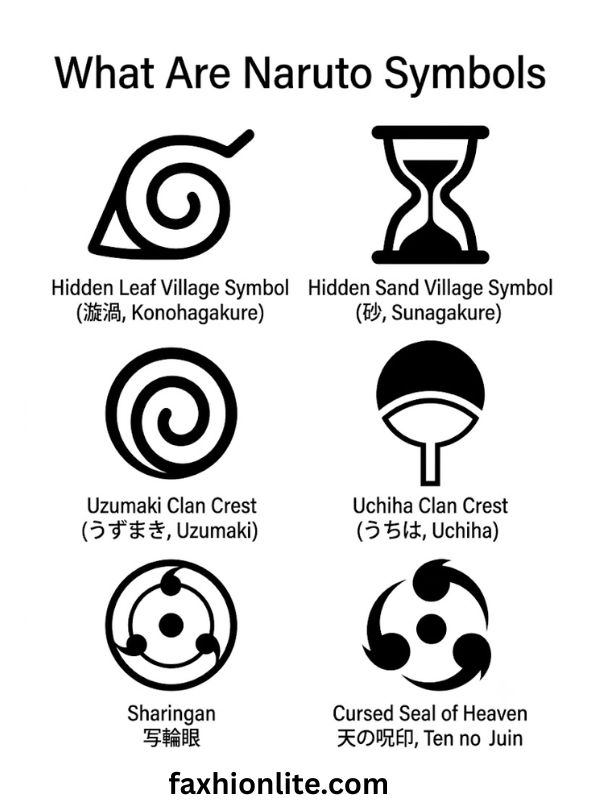
Naruto symbols are the crests, seals, and emblems that identify clans, villages, and individual characters within the Naruto story. They function almost like a visual language, letting viewers instantly recognize allegiance, history, and power just by spotting a mark on a headband or jacket.
Kishimoto did not invent this idea from scratch. Japan has a centuries old tradition of kamon, or family crests, which samurai families used to mark banners, armor, and clothing so allies and enemies alike could identify who they were fighting for. Kishimoto borrowed heavily from that tradition and reshaped it for a shinobi world. That is why so many Naruto clan symbols feel grounded and believable rather than random cartoon logos. They follow the same visual logic real Japanese heraldry used: simple shapes, bold colors, and meanings tied to nature, family, or virtue.
There is also a practical layer to these symbols within the story itself. Ninja village symbols, like the leaf mark of Konoha, appear on headbands to show loyalty and rank, similar to how a soldier’s uniform patch signals which unit they serve. Clan symbols, on the other hand, appear on clothing and buildings to mark bloodline and inherited power, such as the Uzumaki Clan symbol or the Hyuga Clan symbol. Together, these two symbol categories, village and clan, form the backbone of the show’s visual identity system, and understanding the difference is the first step to appreciating just how layered Naruto symbolism really is.
The Deep Symbolic Meaning Behind Naruto Symbols
Naruto symbols work on three separate levels at once: spiritual, psychological, and cultural. That layering is exactly why fans keep finding new meaning in them years after first watching the show.
Spiritual Meaning
At the spiritual level, many Naruto symbols connect directly to chakra, the life energy that powers every jutsu in the series. Chakra itself borrows from real Buddhist and Hindu concepts of internal energy centers, and Kishimoto uses spiral and circular shapes throughout the show to represent that flowing, cyclical force. The Uzumaki spiral is the clearest example, since spirals in many spiritual traditions symbolize the continuous movement of life energy rather than a fixed, static state.
Seals like the one holding Kurama, the Nine Tailed Fox, inside Naruto also carry spiritual weight. A seal in this context is not just a magical lock. It represents the idea of containing something powerful and dangerous within a vessel, a concept that echoes real world spiritual practices around controlling inner darkness rather than destroying it outright.
Even the Sharingan and Rinnegan eye symbols tie into spiritual awakening themes. Both represent a character unlocking a hidden level of perception or power, which mirrors how many Eastern spiritual traditions describe enlightenment as something that was always present internally, just waiting to be revealed.
Psychological Meaning
Psychologically, Naruto symbols often represent identity and internal conflict. The Curse Mark given by Orochimaru, for example, physically marks a character while symbolically representing temptation, corruption, and the struggle between one’s better and darker impulses. It is essentially a visual metaphor for Carl Jung’s idea of the shadow self, the parts of a person’s psyche they try to suppress or hide.
Symbols of belonging, like the Hidden Leaf headband, work in the opposite emotional direction. Wearing that symbol signals acceptance into a community after a long personal journey, which is exactly why Naruto’s own headband means so much to him as a former outcast. Psychologically, that small piece of metal represents validation, purpose, and hard earned identity.
Even facial or eye based symbols like the Mangekyo Sharingan carry psychological cost in the story. Characters like Itachi Uchiha and Sasuke Uchiha only awaken it through extreme emotional trauma, tying the symbol directly to grief and loss rather than simple strength.
Cultural Meaning
Culturally, these symbols root the fictional shinobi world in something familiar to Japanese audiences and, increasingly, to global fans. The clan crest system mirrors real Japanese family heraldry, where a crest instantly communicated lineage, status, and regional identity. Fans researching Naruto symbols in Japanese culture often discover that almost every major clan emblem has a near direct real world counterpart in historical kamon design.
Beyond Japan, these symbols have picked up new cultural meaning as the show spread worldwide. In the United States particularly, clan symbols and village emblems have become shorthand for personal values like loyalty, resilience, and chosen family, values that resonate regardless of the viewer’s cultural background.
Most Important Naruto Symbols and Their Meanings
Here are the five most recognizable Naruto symbols, broken down by appearance, meaning, and where you will spot them throughout the series.
Uzumaki Clan Symbol
Visual Description
A simple red spiral, thick at the center and tapering outward, usually placed on a white or orange background. Naruto wears it prominently on the back of his jacket throughout the series.
Meaning
The spiral represents chakra flow, life force, and the whirlpools associated with the Uzumaki homeland, Uzushiogakure, the Hidden Whirlpool Village. It also symbolizes resilience, since the Uzumaki clan is known for unusually strong life force and vitality even under extreme pressure.
Where It Appears
On Naruto’s jacket, on flak jackets worn by Konoha shinobi, and historically on the walls and architecture of the destroyed Whirlpool Village.
Uchiha Clan Symbol
Visual Description
A red and white fan shape, split into two colors down the middle, resembling a traditional Japanese folding fan.
Meaning
This crest is a near exact reference to real kamon fan designs used by historical Japanese families. In the story, it represents pride, isolation, and tragedy, especially after the clan’s near total destruction. It is one of the most emotionally loaded Naruto emblem meanings in the entire franchise.
Where It Appears
Sasuke’s clothing, the Uchiha compound, and various flashback scenes involving Itachi and Madara Uchiha.
Akatsuki Cloud Symbol
Visual Description
Red cloud shapes outlined in white, scattered across black cloaks worn by the organization’s members.
Meaning
Clouds in Japanese art often represent transience and change, but in this context the symbol also signals danger and secrecy. The Akatsuki cloud has become one of the most searched Naruto icon meanings among fans trying to understand the group’s true motives, since the organization’s goals shift dramatically across the series.
Where It Appears
On every Akatsuki member’s cloak, including Pain, Itachi, and Obito Uchiha during his time with the group.
Hidden Leaf Village Symbol
Visual Description
A stylized leaf shape, usually engraved in metal on a headband, often in silver or grey tones against a blue or black cloth band.
Meaning
The leaf represents growth, protection, and the Will of Fire, a core Konoha philosophy about protecting the next generation above all else. It is arguably the most emotionally significant of all the Naruto village symbols, since earning the right to wear it is treated as a rite of passage.
Where It Appears
On the Hidden Leaf headband worn by nearly every major Konoha character, including Naruto, Sasuke, Sakura, and Kakashi Hatake.
Curse Mark Symbol
Visual Description
A dark, flame like or tomoe shaped mark placed on the skin, usually the neck, which spreads and darkens when activated.
Meaning
Given by Orochimaru, this mark represents corruption, forbidden power, and psychological struggle. It is one of the clearest examples of Naruto symbolism used to externalize an internal battle, since the mark visibly grows as a character loses control to darker impulses.
Where It Appears
Most notably on Sasuke Uchiha’s neck after his encounter with Orochimaru, and on other characters throughout the Sound Village arcs.
Bonus Symbols Every Fan Should Know
The list above covers the five most iconic marks, but the “62+” in this title comes from the wider universe of clan, village, and spiritual symbols fans search for individually.
| Symbol | Quick Meaning |
| Sharingan | Awakened perception, copying ability, tied to Uchiha trauma |
| Mangekyo Sharingan | Advanced Sharingan unlocked through emotional loss |
| Rinnegan | Symbol of godlike power and the Sage of Six Paths lineage |
| Byakugan | All seeing eye tied to the Hyuga Clan |
| Hyuga Clan symbol | Represents the Byakugan lineage and strict clan hierarchy |
| Nara Clan symbol | Shadow based crest tied to strategy and intellect |
| Sand Village symbol | Hourglass shaped mark representing Sunagakure |
| Mist Village symbol | Wave inspired emblem for Kirigakure |
| Cloud Village symbol | Cloud shaped crest for Kumogakure |
| Rock Village symbol | Mountain inspired emblem for Iwagakure |
| Will of Fire symbol | Konoha’s guiding philosophy, tied to the leaf emblem |
| Sage of Six Paths symbol | Ancient origin mark tied to chakra’s creation |
| Anbu symbol | Blank porcelain mask representing anonymity and duty |
| Nine Tails Seal | Containment seal representing balance between man and beast |
Naruto Symbols Across Cultures
Naruto symbols did not appear in a cultural vacuum. Kishimoto pulled from Japanese heraldry, Chinese philosophy, and Hindu spiritual concepts, then reshaped all of it for a modern global audience.
Japanese Culture
Japan’s kamon tradition is the clearest direct influence on Naruto’s clan symbols. These family crests date back over a thousand years and were used on banners, kimono, and armor to instantly identify a family’s lineage. The Uchiha fan and Hyuga symbols especially reflect this historical design language, right down to their simple, bold, two tone patterns.
Chinese Culture
Chinese philosophy shows up most clearly in the show’s approach to balance, particularly the yin and yang concept behind chakra itself, which blends physical and spiritual energy into one whole. The tailed beast seals also echo Chinese sealing traditions used in folklore to contain spirits or demons.
Hindu Spiritual Influence
The concept of chakra is borrowed almost directly from Hindu and Buddhist spiritual systems, where chakras represent energy centers within the body. Kishimoto adapted this idea into a fictional power source, but the spiritual framing, energy that can be unlocked, balanced, or lost, remains intact.
Western Interpretation
American and European fans often interpret these symbols through a more individualistic lens, focusing on themes of personal identity, rebellion against fate, and chosen family rather than strict clan hierarchy. This is part of why the Hidden Leaf symbol resonates so strongly with Western audiences who see it as representing found community rather than birthright.
Modern Global Culture
Today, Naruto symbols exist far beyond the anime itself. They show up in streetwear, gaming culture, and internet meme culture worldwide, proving that a symbol system built around 2000s era Japanese storytelling can still resonate with a completely different generation of fans decades later.
Naruto Symbols in Art, Movies and Pop Culture
Naruto symbols have moved well past the screen and into real world self expression, fashion, and art.
Tattoos
The Uzumaki spiral, the Akatsuki cloud, and the Sharingan are consistently among the most requested Naruto tattoo ideas at shops across the United States. Fans often choose these designs specifically because they are simple, bold, and instantly recognizable, the same qualities that made them work so well as clan crests in the first place.
Fashion
Streetwear brands have released countless hoodies, jackets, and jewelry lines featuring clan crests, especially the Uchiha fan and Hidden Leaf emblem. These designs succeed commercially because they read as stylish even to people unfamiliar with the source material.
Movies and Media
Naruto symbols carry directly into spinoff media like Boruto, feature films, and video games, keeping the visual language consistent across two decades of storytelling. This consistency is part of why the franchise maintains such strong brand recognition compared to anime series that redesign their visual identity more frequently.
Art and Fan Creations
Fan artists constantly reinterpret these symbols, blending clan crests with new color palettes, combining multiple emblems into original designs, or reimagining them in real world contexts like modern logos. This ongoing reinterpretation is a major reason the symbols have stayed culturally relevant well past the anime’s original broadcast run.
Spiritual and Dream Meaning of Naruto Symbols

Some fans search specifically for what it means to dream about these symbols, treating them almost like modern dream dictionary entries.
Seeing the Uzumaki Spiral in Dreams
Dreaming of a spiral often gets interpreted as a sign of ongoing personal growth or cyclical change in your life, mirroring the symbol’s in show meaning tied to chakra flow and resilience.
Seeing the Akatsuki Cloud
Because the Akatsuki cloud is tied to secrecy and shifting motives within the story, some fans interpret dreaming of it as a sign of hidden information or an unresolved situation demanding attention.
Seeing the Hidden Leaf Symbol
This one is usually read positively, often associated with feelings of belonging, protection, or reconnecting with a community, echoing the symbol’s core meaning inside the show.
Seeing the Curse Mark
Given its association with internal struggle, dreaming of the Curse Mark is often interpreted as a reflection of temptation or an internal conflict the dreamer may be currently facing in waking life.
Positive and Negative Meanings of Naruto Symbols
Not every Naruto symbol carries the same emotional weight, and understanding the split between positive and negative symbolism helps explain the show’s deeper themes.
| Symbol | Positive Meaning | Negative Meaning |
| Hidden Leaf symbol | Belonging, growth, protection | Rigid hierarchy, exclusion of outsiders |
| Uzumaki spiral | Resilience, life force | Isolation, loss of homeland |
| Uchiha fan | Pride, skill | Tragedy, generational trauma |
| Curse Mark | Hidden potential | Corruption, loss of control |
| Akatsuki cloud | Unity of purpose | Secrecy, danger |
Why Humans Feel Drawn to Naruto Symbols
People connect with Naruto symbols for the same psychological reasons they connect with real world crests, flags, and logos. Simple, bold shapes are easier for the human brain to remember and emotionally attach to, which is why both the Uzumaki spiral and the Hidden Leaf emblem work so well as instantly recognizable marks.
There is also a strong identity component at play. Just like someone might get a band logo or a sports team crest tattooed as a way of saying “this represents who I am,” fans adopt Naruto symbols to express values like loyalty, resilience, or the idea of chosen family. The symbols become shorthand for personal philosophy, not just fandom.
Finally, nostalgia plays a major role. Many fans grew up watching Naruto, so these symbols are tied to real memories of childhood, friendship, and personal growth, which gives them emotional weight far beyond their original fictional context.
Naruto Symbols and Their Hidden Connection to Real Life
Naruto’s symbol system is not just clever fiction. It is a direct reflection of real historical practices, and recognizing that connection deepens appreciation for how carefully Kishimoto built this world.
Real Japanese families used kamon crests for centuries to mark identity on everything from clothing to gravestones, a practice that still exists today in a more ceremonial form. National flags, corporate logos, and even sports team crests serve a nearly identical psychological function in modern life: instant recognition tied to shared identity and values.
This is why Naruto symbols feel timeless rather than dated. They tap into something universal about how humans have always used visual marks to signal belonging, allegiance, and personal history, whether on a samurai banner five hundred years ago or a hoodie sold online today.
Frequently Asked Questions
What do Naruto symbols represent?
Naruto symbols represent courage, loyalty, sacrifice, family heritage, hidden power, and the enduring bonds connecting every ninja together.
Which Naruto symbol is the most iconic?
The Hidden Leaf Village headband remains Naruto’s most iconic symbol, representing unity, protection, determination, and unwavering ninja pride forever.
What does the Akatsuki cloud symbol mean?
The red Akatsuki cloud symbolizes rebellion, pain, lost dreams, dangerous ambitions, and the organization’s unforgettable legacy throughout Naruto’s story.
Why are clan symbols important in Naruto?
Clan symbols preserve family identity, ancient traditions, inherited abilities, and honor while strengthening each ninja’s cultural heritage across generations.
Are Naruto symbols inspired by Japanese culture?
Yes, many Naruto symbols draw inspiration from Japanese mythology, history, religion, folklore, and traditional beliefs with creative fictional adaptations.
Conclusion
Naruto symbols endure because they were never just decoration. Each spiral, crest, and cloud carries real emotional and cultural weight, borrowed from centuries of Japanese heraldry and reshaped into one of the most recognizable visual languages in modern anime.
Whether you are drawn to the Uzumaki spiral for its resilience, the Hidden Leaf emblem for its sense of belonging, or the Curse Mark for its raw psychological honesty, these symbols continue to resonate because they reflect something deeply human.