90+ Mexican Symbols: Powerful Meanings, Cultural Secrets & Hidden Spiritual Truths
Mexican symbols are one of the richest and most layered visual languages in human history, carrying thousands of years of spiritual wisdom, mythological storytelling, and cultural identity in a single image.
Whether you’ve seen a sugar skull on a coffee mug, an eagle and snake on a Mexican flag, or a marigold-covered altar in a film, you’ve already encountered this extraordinary symbolic world. But most people only scratch the surface. Behind every color, creature, and pattern is a story that stretches back centuries, often millennia.
This article takes you deep inside that world. You’ll discover what these symbols actually mean, where they come from, and why millions of people across the USA and beyond feel so powerfully drawn to them. Let’s start from the beginning.
What are Mexican Symbols?
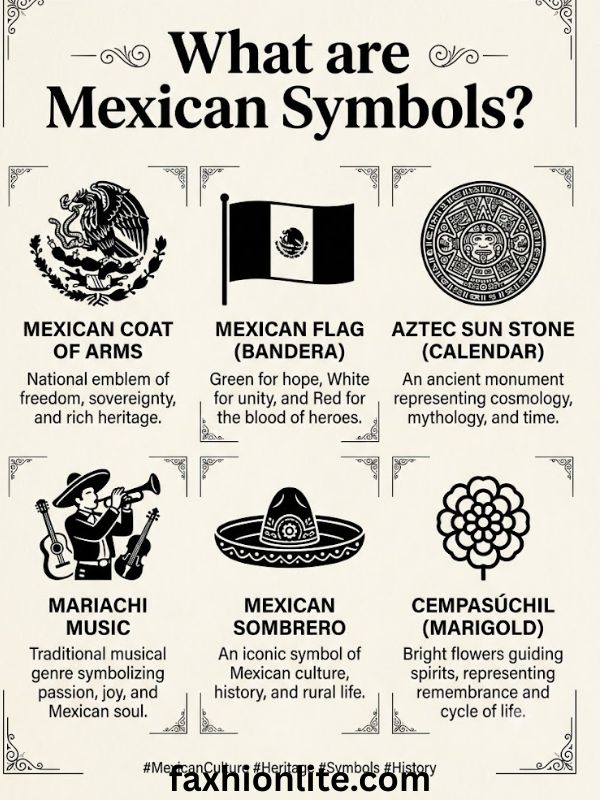
Mexican symbols are visual, spiritual, and cultural markers that represent the beliefs, history, mythology, and identity of Mexican civilization across thousands of years. They aren’t simply decorative. They’re a complete communication system built by multiple civilizations long before the written word existed in the Americas.
The term “Mexican symbols” covers an enormous range of imagery. You have ancient pre-Columbian symbols from the Aztec, Maya, Olmec, Zapotec, and Teotihuacan civilizations. You have colonial-era syncretic symbols that blended indigenous and Catholic imagery. And you have modern national and folk symbols that continue to evolve today.
What makes Mexican symbolism unique is its embrace of duality. Life and death aren’t opposites in this tradition. They’re partners. The same image can represent creation and destruction, the earth and the sky, the mortal body and the eternal soul. That layered thinking is baked into every symbol you’ll encounter in this article.
Key fact: Mexico is home to over 60 recognized indigenous groups, each with its own symbolic traditions, making “Mexican symbols” one of the most diverse cultural categories in the world.
For the roughly 37 million Mexican-Americans living in the United States today, these symbols aren’t history lessons. They’re living connections to ancestry, faith, and identity.
Traditional Mexican Symbols And Their Deep Meanings
Traditional Mexican symbols are not relics frozen in time. They’re active, breathing parts of culture that appear on altars, textiles, tattoos, murals, and everyday objects across Mexico and the USA.
Mexican Flag
The Mexican flag is arguably the most recognized symbol of the country, but most people don’t know what it’s actually saying.
The three vertical stripes carry distinct symbolism. Green represents hope, independence, and the lush natural landscape of Mexico. White originally signified the purity of the Catholic faith during the independence era but has since been reinterpreted to represent unity among the Mexican people. Red honors the blood shed by the heroes of Mexican independence and acknowledges the Spanish heritage woven into the national identity.
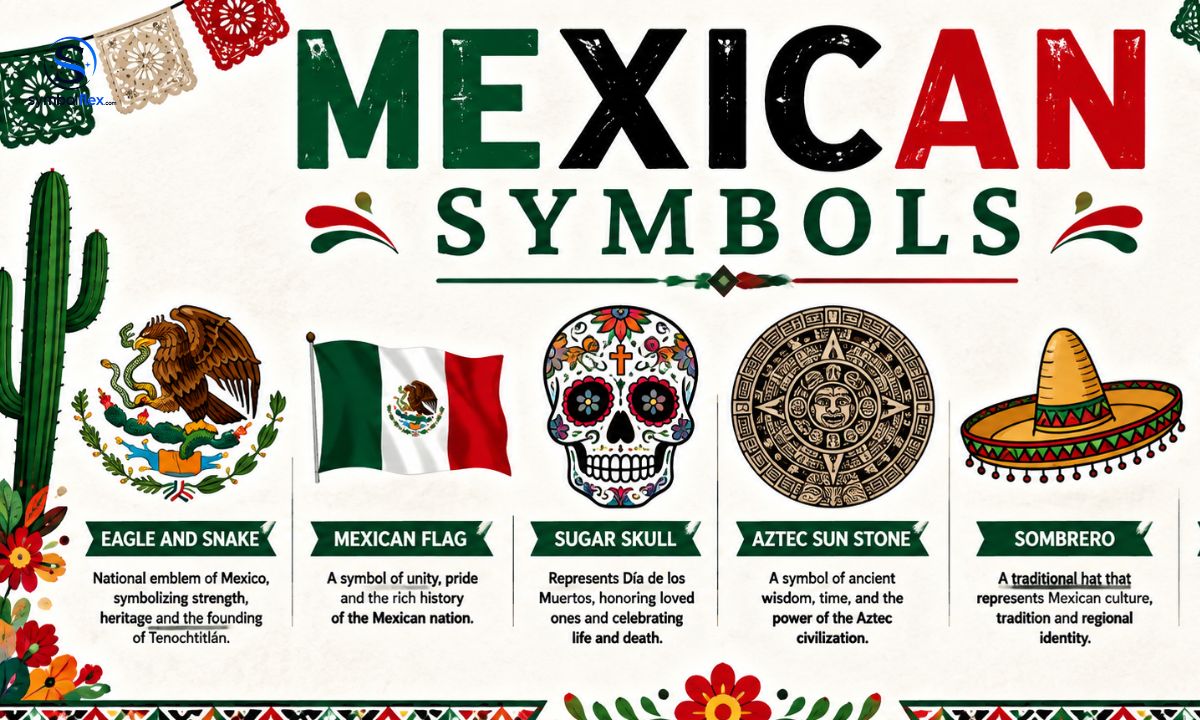
The real story, though, lives in the central coat of arms. It depicts an eagle perched on a nopal cactus, devouring a serpent, surrounded by a wreath of oak and laurel. This image comes directly from Aztec mythology.
According to legend, the god Huitzilopochtli told the Mexica people to build their great city wherever they saw this exact scene. They found it in the middle of Lake Texcoco, and there they built Tenochtitlan, the city that became modern-day Mexico City. The flag has carried this founding myth since Mexico gained independence in 1821.
Mexican Symbols And Meanings
Understanding Mexican symbols means understanding that one image almost always carries multiple simultaneous meanings depending on context, civilization, and era.
The serpent, for example, represents something very different in Aztec cosmology than it does in Catholic interpretation. To the Aztecs, the serpent was a symbol of earth energy, fertility, transformation, and divine power. To the Spanish missionaries who arrived in the 1500s, it was a symbol of evil borrowed from the Garden of Eden story. Today, both interpretations coexist in Mexican culture.
The sun is another perfect example. In Aztec belief, the sun god Tonatiuh required human blood to rise each morning. The sun wasn’t just a natural phenomenon. It was a deity that could fail without devotion. That gives the sun symbol a weight in Mexican culture that it simply doesn’t carry in Western symbolism.
| Symbol | Core Meaning | Civilization of Origin |
| Eagle | Divine power, sun, national identity | Aztec (Mexica) |
| Serpent | Transformation, earth energy, duality | Pan-Mesoamerican |
| Jaguar | Night, underworld, warrior strength | Olmec, Aztec, Maya |
| Marigold | Death, remembrance, guiding souls | Aztec |
| Hummingbird | Love, warrior spirits, divine messengers | Aztec |
| Skull | Life, death, celebration, memory | Pan-Mesoamerican |
| Sun | Creation, sustenance, cosmic cycles | Aztec, Maya |
| Cactus | Resilience, the sacred land, survival | Aztec, National |
Mexican Symbols Tattoos
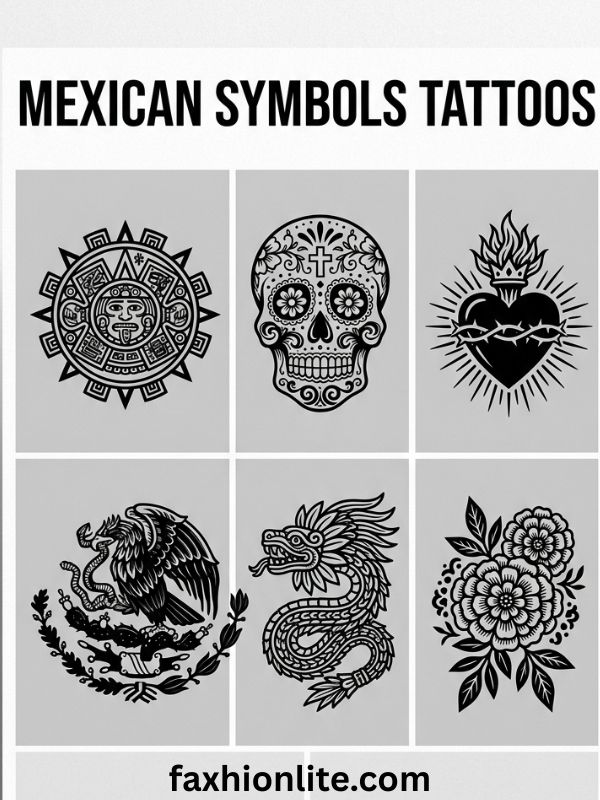
Mexican symbol tattoos have become one of the most popular categories of body art in the United States, and for reasons that go far beyond aesthetics.
Chicano tattoo culture developed in the American Southwest and California during the mid-20th century, largely within Mexican-American communities navigating identity between two worlds. Images like the Virgin of Guadalupe, the Aztec sun, the eagle, and La Catrina became ways to carry cultural pride visibly on the body. This wasn’t decoration. It was declaration.
Today, these tattoos have spread far beyond Mexican-American communities. The sugar skull, the feathered serpent, and Day of the Dead-inspired imagery appear on people from virtually every background. If you’re considering one of these tattoos, it’s worth understanding what you’re choosing.
The Virgin of Guadalupe, for example, is a deeply sacred image to millions of Catholic Mexicans, not simply a stylized portrait. Knowing the story behind what you’re wearing makes the symbol more meaningful, not less.
Mexican Symbols Copy And Paste
Many readers search for Mexican symbols they can use digitally, whether for social media captions, design projects, or cultural celebrations.
Some widely available Unicode symbols connected to Mexican cultural imagery include the skull emoji (💀), the sun (☀), the crescent moon (🌙), the eagle emoji (🦅), the marigold/flower (🌼), and the serpent (🐍). Platforms like Day of the Dead-themed digital events often use combinations of these to create visual shorthand.
It’s worth noting that true indigenous glyphs and Aztec day signs don’t have standardized Unicode representations. If you need authentic symbolic graphics, you’ll want to work with a Mexican cultural designer or use licensed artistic assets rather than emoji approximations.
Ancient Mexican Symbols
Key fact: The Olmec civilization, often called the “mother culture” of Mesoamerica, developed many foundational symbols as early as 1500 BCE that were later adopted and adapted by the Aztec, Maya, and Toltec civilizations.
Ancient Mexican symbols predate the Aztec Empire by over two thousand years. The Olmec were the first to prominently feature the were-jaguar, a half-human, half-jaguar figure that represented rain, earth, and sacred power. This image kept reappearing across civilizations for over 3,000 years.
Of the original Aztec codices (illustrated manuscripts containing their symbolic knowledge), only a handful survived the Spanish conquest. The Codex Borgia, Codex Mendoza, and Codex Fejérváry-Mayer are among the most important surviving records of pre-Columbian symbolism. Spanish missionaries deliberately burned the majority, viewing indigenous knowledge systems as threats to colonial authority. What we lost in that destruction is impossible to fully calculate.
Indigenous Mexican Symbols
Indigenous Mexican symbols are not historical artifacts. Over 60 indigenous groups in Mexico continue to use their traditional symbolic systems in living cultural practice today.
The Huichol people (Wixáritari) of western Mexico create extraordinary yarn paintings and beaded art filled with symbols: the peyote flower (representing spiritual vision), the deer (a sacred intermediary between humans and the divine), the eagle, and the sun. These aren’t folk crafts made for tourists. They’re spiritual documents expressing cosmological knowledge.
The Otomi people of central Mexico produce embroideries featuring animals, humans, and plants arranged in symbolic patterns that represent nature’s cycles and community relationships. Many Mexican-American families in Texas, Illinois, and California have brought these traditions north, creating vibrant communities of indigenous symbolic practice within the United States.
Traditional Mexican Symbols And Meanings
Traditional Mexican symbols work as a complete philosophical system, not a random collection of pretty images.
The Tree of Life (Árbol de la Vida) is one of the most beloved traditional symbols. It represents the connection between the underworld, the earth, and the heavens. Its roots reach into Mictlan (the land of the dead), its trunk exists in the human world, and its branches reach into the celestial realm.
This three-part cosmic structure appears across many world cultures, but in Mexican folk art, it comes alive in painted clay and brightly decorated sculptures that fill homes across both Mexico and the American Southwest.
The nopal cactus carries meanings that go far beyond its appearance on the flag. It’s a symbol of resilience, of thriving in harsh conditions, of nourishment in the face of scarcity. The cactus sustained the Aztecs on their long migration and fed entire civilizations. For Mexican-Americans navigating difficult conditions in a new country, the nopal carries an unmistakably personal resonance.
Mexican Symbols Of Love, Protection And Strength

Mexican symbols of love, protection, and strength are among the most requested and most personally meaningful symbols in this entire tradition. They show up in homes, on bodies, and in spiritual practices because they speak to the most human needs we have.
Mexican Symbols Of Protection
The Ojo de Dios (God’s Eye) is one of the most widely recognized Mexican protection symbols. Created by weaving colorful yarn around two crossed sticks, it originated with the Huichol people as a tool for monitoring a child’s first five years of life, during which the child is most vulnerable to spiritual harm. Each color layer added to the design represents a year of protection.
The concept of mal de ojo (the evil eye) is central to Mexican folk belief and explains why protection symbols matter so deeply. The belief holds that intense envy or admiration can inadvertently cause harm to another person, especially children. Protection symbols, amulets, and rituals are the counterbalance to that invisible threat.
The Virgin of Guadalupe stands as perhaps the most powerful protection symbol in all of Mexican culture. When she appeared to the indigenous man Juan Diego at Tepeyac Hill in 1531, she appeared with indigenous features, speaking in Nahuatl. Her image blends Catholic and indigenous sacred symbolism in a way that neither tradition alone could have created. Today her image is displayed in millions of homes, vehicles, and businesses across the USA as a guardian presence.
Mexican Symbols Of Strength
The Aztec eagle warrior represents the pinnacle of earthly strength in pre-Columbian Mexican symbolism. Eagle warriors were an elite military order who wore feathered helmets styled after eagles and were believed to embody the sun’s daytime power. They didn’t just fight. They were living symbols.
The jaguar represents a different kind of strength: the power of the night, the underworld, and hidden forces. Jaguar warriors were the counterpart to eagle warriors, associated with darkness and the earth. Together, the eagle and the jaguar represented the full spectrum of strength across all realms of existence.
Less discussed but equally important are the great volcanoes Popocatépetl and Iztaccíhuatl, which overlook Mexico City. These aren’t just geographic features. They’re symbols of enduring, patient, unstoppable strength. A legend says they were two lovers turned to mountains, eternally watching over the valley below.
Mexican Symbols Of Love
The hummingbird carries one of the most surprising love stories in Mexican symbolism. The Aztec god of war, Huitzilopochtli, was believed to reincarnate as a hummingbird after death, making these tiny birds the returning spirits of fallen warriors. But hummingbirds are also messengers of love, joy, and vitality in folk tradition, appearing in love amulets and courtship gifts.
Milagros (meaning “miracles”) are small tin or silver charms shaped like body parts, animals, hearts, or people. They’re pinned to the robes of saints or placed on altars as offerings of gratitude or prayers for healing. A heart-shaped milagro left at the feet of the Virgin represents a love-related prayer, a recovered broken heart, or gratitude for love received.
The Sacred Heart is a symbol that arrived with Catholicism but immediately blended with Aztec imagery involving living hearts as the seat of the soul. In Mexican folk art, you’ll often see a human heart with flames, thorns, and a wound, representing love that is fierce, sacrificial, and enduring.
Popular Symbols That Represent Mexico
The most iconic symbols that represent Mexico are the ones that have crossed borders and become recognized worldwide, often because they carry universal emotional themes wrapped in distinctly Mexican imagery.
Iconic Mexican Symbols
La Catrina is one of the most striking examples of a symbol that evolved from political satire into beloved cultural icon. Originally created as an illustration by artist José Guadalupe Posada in the early 1900s to mock indigenous people who adopted European aristocratic fashion, the image was later given a full body and colorful clothing by muralist Diego Rivera. Today, La Catrina represents the Mexican embrace of death as a natural, even elegant part of life.
The Aztec Sun Stone, often incorrectly called the Aztec Calendar, is the single most recognized pre-Columbian artifact in the world. Carved from basalt and weighing 25 tons, it was discovered in 1790 beneath Mexico City’s central plaza. Its central face belongs to the sun god Tonatiuh, surrounded by the symbols of the five cosmic ages.
Mexican Symbolism
Mexican symbolism is built on a philosophical foundation that Western thinking often struggles to hold: the insistence that opposites are not opposites at all. Life and death are the same cycle. Day and night are the same sky. Earth and heaven are the same axis.
This is why a skull in Mexican symbolism isn’t frightening. It’s an invitation to remember that death gives life its meaning. It’s why the serpent can represent both destruction and healing. It’s why marigolds, flowers associated with funerals in many cultures, are the flower of celebration during Día de los Muertos.
Types / Variations of Mexican Symbols
1. Eagle and Snake on Cactus
This is the founding myth of the Aztec civilization made visible. The eagle represents the sun and divine authority. The serpent represents the earth, water, and the conquered enemy. The nopal cactus is the land itself, rooted in sacrifice. Together, they tell the story of a people chosen by their god to build the greatest city in the Americas. That story became the coat of arms of the modern Mexican nation.
2. Quetzalcoatl (Feathered Serpent)
Quetzalcoatl is one of the most important deities across all of Mesoamerica. His name in Nahuatl means “feathered serpent,” combining the quetzal bird (sky, freedom, preciousness) with the serpent (earth, power, transformation). He’s the god of wind, knowledge, and creation. His temple at Teotihuacan is one of the most visited archaeological sites in the world.
3. Aztec Sun Stone
More than a calendar, the Sun Stone is a cosmological statement. At its center is the current age, the Fifth Sun, which the Aztecs believed would end in earthquakes. The four squares around the center represent the four previous ages, each destroyed by a different catastrophe. It’s a meditation on the fragility of existence and the ongoing effort required to maintain the cosmos.
4. Marigold Flower (Cempasúchil)
The marigold’s powerful scent, the Aztecs believed, could guide the souls of the dead back to their families during Día de los Muertos. Petals are scattered in paths from the cemetery to the home altar, creating a fragrant road home. The word “cempasúchil” comes from the Nahuatl words for “twenty” and “flower,” describing the bloom’s many petals.
5. Sugar Skulls
Sugar skulls are gifts for the dead, not decorations for the living. Each one is traditionally made by hand from sugar paste, decorated with the name of a deceased loved one, and placed on the ofrenda altar so their spirit can find it during the holiday.
The transformation of this deeply personal practice into a global aesthetic trend has sparked real conversations within Mexican communities about what it means when sacred symbols become commercial products.
Mexican Symbols in Art, Movies & Pop Culture
Mexican symbols entered the American mainstream not through textbooks but through art, film, and music, and that path has created both wonderful cultural exchange and complex debates about appropriation.
Diego Rivera’s murals at the Detroit Institute of Arts brought Aztec and indigenous Mexican symbols directly into the heart of American industrial culture in the 1930s. His work showed that these weren’t primitive images. They were sophisticated visual philosophy.
Frida Kahlo’s self-portraits are essentially living dictionaries of Mexican symbolism. Her paintings feature hummingbirds, deer, broken spines, monkey companions, and the dual imagery of life and death arranged around her own body as a symbolic landscape. Her image has itself become a global symbol of Mexican identity, feminism, and artistic courage.
Pixar’s “Coco” (2017) did something remarkable: it brought the full complexity of Día de los Muertos symbolism to American children in a form that was both accessible and genuinely respectful. The marigold petals, the ofrendas, the alebrijes (spirit animal guides), and the belief that the dead truly die only when they’re forgotten all landed with emotional authenticity.
Spiritual & Dream Meaning of Mexican Symbols
In Mexican spiritual traditions, symbols aren’t just meaningful when you’re awake. The Aztecs believed dreams were direct communications from the gods and took dream symbolism as seriously as waking omens.
Dreaming of an eagle traditionally signals strength, divine protection, and rising above challenges. A serpent in dreams can represent transformation coming, sometimes uncomfortable but necessary. Marigolds in dreams are associated with the presence of ancestors nearby.
A butterfly, especially a monarch butterfly, is one of the most powerful dream symbols in Mexican tradition because monarchs actually migrate through Mexico each year around Día de los Muertos, and many people believe they carry the souls of the returning dead.
In curanderismo (Mexican folk healing), a healer known as a curandera uses symbolic objects in healing rituals. Eggs, herbs, smoke, and water all carry symbolic meaning during a limpia (spiritual cleansing). The symbols aren’t decorative elements. They’re the medicine.
Positive vs Negative Meaning
Positive Meanings
Mexican symbols carry an extraordinary amount of positive emotional and spiritual energy:
- Life and rebirth: the butterfly, the serpent shedding its skin, the phoenix-like cycle of the Aztec suns
- Protection and guidance: the Virgin of Guadalupe, the Ojo de Dios, the hummingbird as spiritual messenger
- Strength and resilience: the eagle, the jaguar, the nopal cactus
- Love and family: the Tree of Life, the Sacred Heart, the ofrenda altar
- Cultural pride: the coat of arms, La Catrina, the marigold
Negative Meanings
Not every meaning is celebratory:
- The serpent in Catholic colonial interpretation was actively reframed as evil, which created genuine cultural damage because it stigmatized an important indigenous sacred symbol
- Sacrifice imagery in Aztec symbols carries the honest weight of a civilization that practiced ritual human sacrifice as a theological imperative. Acknowledging that history is part of understanding the symbols honestly
- Commercialization has stripped meaning from sacred symbols when corporations use sugar skulls or Day of the Dead imagery as Halloween decoration without any cultural context
- Political misuse of national symbols like the eagle has occurred across Mexican history, with authoritarian governments wrapping themselves in sacred imagery to borrow its legitimacy
Why Humans Are Attracted to Mexican Symbols
The global attraction to Mexican symbols makes complete sense once you understand what they offer that most modern symbolic systems don’t: they make room for death without making it the enemy.
In a culture saturated with messages about staying young, staying productive, and avoiding loss, Mexican symbols walk right up to death and decorate it with marigolds. That’s psychologically revolutionary. It gives people a framework for grief, loss, and mortality that feels honest in a way that sanitized alternatives often don’t.
Beyond that, these symbols are simply visually stunning. The Aztec Sun Stone, Huichol bead art, and Talavera tile patterns activate the visual brain in ways that feel both ancient and immediately compelling. We’re drawn to patterns that encode meaning, and Mexican symbols deliver that at every scale.
For millions of Mexican-Americans, these symbols also carry something irreplaceable: connection. When you’re navigating life between two cultures, a hummingbird tattoo or a Virgin of Guadalupe candle on your windowsill is a thread back to who you are and where you come from.
Frequently Asked Questions
What are Mexican symbols?
Mexican symbols are visual images representing the spiritual beliefs, cultural identity, and historical traditions of Mexican civilization.
What is the most powerful Mexican symbol?
The eagle and serpent on a cactus is Mexico’s most powerful symbol, representing divine destiny and national identity.
What do sugar skulls represent in Mexican culture?
Sugar skulls celebrate life and honor deceased loved ones during Día de los Muertos, representing joyful remembrance, not fear.
Are Aztec symbols and Mexican symbols the same thing?
Aztec symbols are one important subset of Mexican symbols, which also include Mayan, Olmec, Zapotec, and modern cultural imagery.
Why are Mexican symbols so popular in the USA?
Mexican symbols resonate deeply because they embrace life, death, and cultural identity in ways that feel universally human and emotionally powerful.
Conclusion
Mexican symbols are not relics of a vanished past. They’re a living, evolving visual language that continues to communicate across time, borders, and cultures with remarkable power and precision.
From the founding myth of the eagle and serpent on the Mexican flag to the sugar skulls placed on family altars during Día de los Muertos, from Quetzalcoatl’s feathered temple walls to Frida Kahlo’s self-portraits, these symbols carry the accumulated wisdom of civilizations that understood something profound: that images can hold what words often can’t.