50+ Symbols of Hope That Inspire Strength, Faith & New Beginnings
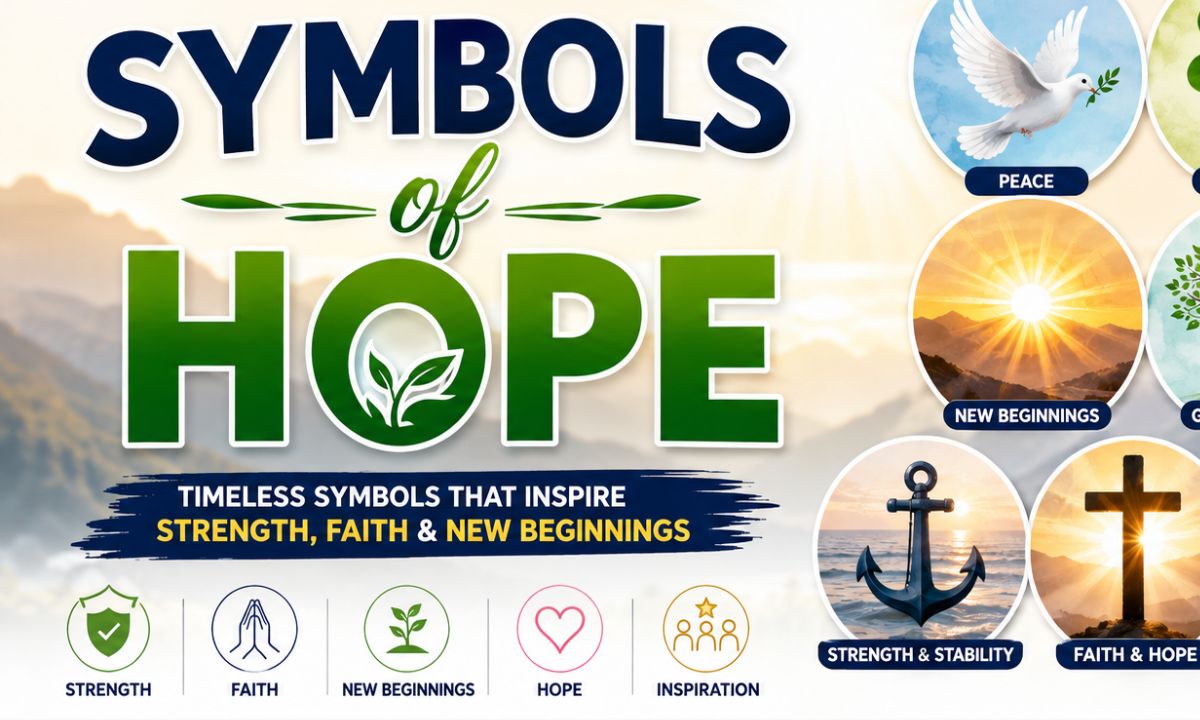
Symbols of Hope give people a visual way to express something deeply human: the belief that life can improve, even when the present feels difficult. From the dove and rising sun to the butterfly, anchor, candle, rainbow, lotus, and phoenix, these meaningful images can represent faith, resilience, healing, transformation, and a better future.
Hope symbols appear everywhere. You may see them in religious artwork, memorial jewelry, tattoos, movies, literature, architecture, or a simple image shared with someone going through a hard time. Their meanings aren’t always identical, but they often point toward the same emotional idea: light after darkness and the possibility of a new beginning.
Hope is more than wishful thinking. Psychologist C. R. Snyder’s influential Hope Theory describes hope through goal directed energy and the ability to identify pathways toward desired outcomes.
What Are Symbols of Hope?
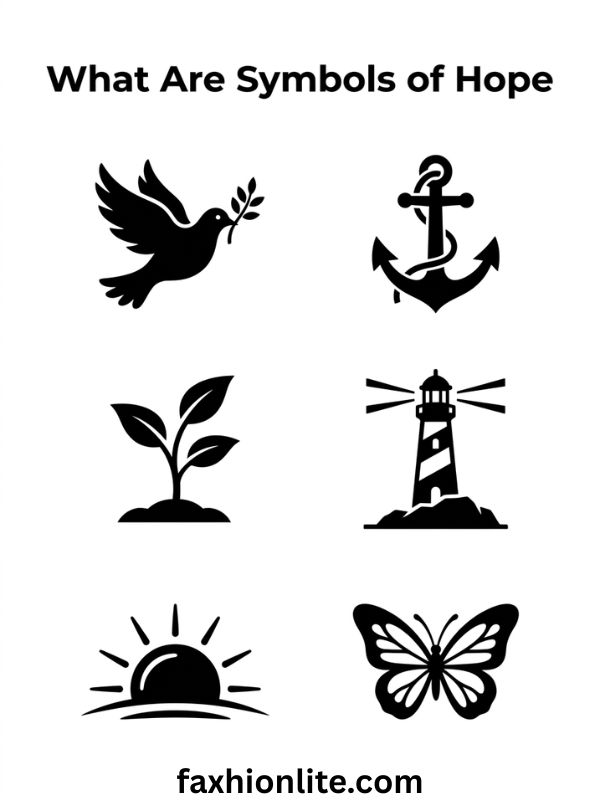
Symbols of hope are images, objects, animals, colors, plants, or natural events that people associate with optimism, renewal, strength, faith, or a positive future. They turn an abstract emotion into something you can see, hold, wear, draw, or remember.
Some symbols come from nature. The rising sun, blooming flower, rainbow, and butterfly can all suggest change and renewal because their physical characteristics naturally lend themselves to those ideas. A flower opens, the sun returns, and a butterfly changes form.
Other symbols of hope come from religion, mythology, history, and cultural traditions. The Christian cross can represent hope through resurrection and faith. The Egyptian ankh represents life. The anchor can represent steadfastness, while the dove is strongly associated with peace.
The important point is that symbolism isn’t a fixed dictionary. Hope symbolism develops through stories, traditions, repeated cultural use, and personal associations. A person choosing a butterfly tattoo may see it as a symbol of recovery, while another person may connect the same butterfly with freedom or a loved one.
Deep Symbolic Meaning of Hope Symbols
The deeper meaning of hope symbols usually centers on the possibility of change, endurance, connection, or renewal. A symbol becomes powerful when its visual form helps people express emotions that are difficult to explain with ordinary words.
Consider a candle. Physically, it’s simply a source of light. Symbolically, however, a small flame can represent light in darkness, remembrance, faith, guidance, and emotional strength. The meaning becomes especially powerful when someone lights a candle during prayer or remembrance.
This is why hope symbols can remain meaningful even when their original cultural context changes. Their symbolism can be inherited, adapted, or personalized. Understanding that difference helps you appreciate the history of a symbol without assuming that every person interprets it in exactly the same way.
Spiritual Meaning
Spiritual symbols of hope often represent faith, divine guidance, renewal, protection, and the belief that hardship isn’t the end of the story. They appear in religious practices because visual images can make abstract spiritual ideas easier to contemplate.
The cross, dove, candle, rainbow, lotus, olive branch, and anchor are examples that can carry spiritual meanings in particular traditions. In Christianity, for example, the cross is closely connected with sacrifice and resurrection, while the anchor appears in Christian symbolism as an image of steadfast hope.
Spiritual meaning remains personal. A candle may remind one person of prayer, another of a deceased family member, and someone else of finding courage during a difficult period. A spiritual symbol can provide comfort without needing to function as a prediction or supernatural sign.
Psychological Meaning
The psychological meaning of hope symbols comes partly from their ability to connect an immediate image with a desired future. Seeing a sunrise can remind someone that circumstances can change, while an anchor can serve as a reminder to remain steady during uncertainty.
Psychologist Charles R. Snyder developed a major psychological theory of hope that focuses on goals, agency, and pathways. In simple terms, hopeful thinking involves wanting a future outcome, believing you can take meaningful action, and identifying ways to move toward that outcome.
This gives hope symbols an interesting role. A symbol doesn’t create resilience by itself, but it can act as a visual cue for resilience and strength. A bracelet, tattoo, photograph, or small object may remind someone of a goal, a promise, a recovery journey, or the person they want to become.
Cultural Meaning
The cultural meaning of hope symbols depends heavily on history, tradition, geography, and community. A flower, animal, or color can carry completely different associations in different societies.
The lotus offers a useful example. It is connected with important religious and philosophical ideas in several Asian traditions, including Buddhism and Hinduism. Its growth from muddy water into an open flower makes it especially powerful as an image of spiritual renewal, transformation, and awakening.
Cultural meaning also explains why it’s risky to call any symbol completely universal. A symbol can become widely recognized while still having a specific historical origin. Understanding that background makes the interpretation richer and helps avoid reducing complex traditions to simple internet definitions.
Types and Variations of Symbols of Hope
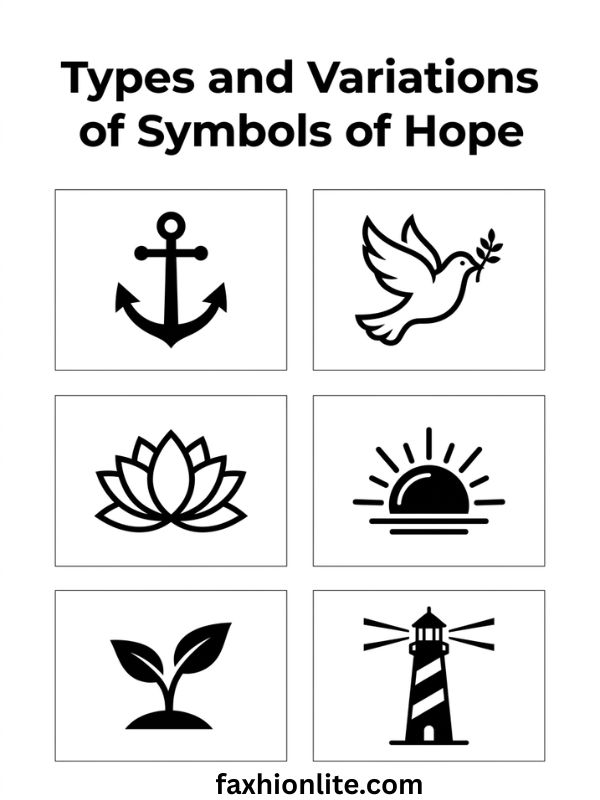
The most recognizable symbols of hope usually come from nature, religion, mythology, and everyday objects. Their meanings overlap around themes such as renewal, peace, stability, transformation, survival, and optimism.
Here are more than 50 meaningful examples you can explore: dove, rising sun, anchor, butterfly, candle, rainbow, lotus flower, phoenix, olive branch, sunflower, four leaf clover, cherry blossom, hummingbird, swallow, crane, deer, elephant, turtle, star, moon, North Star, open door, bridge, key, compass, lantern, heart, infinity symbol, cross, angel, prayer hands, ankh, scarab, Eye of Horus, white feather, mountain, ocean wave, green leaf, spring flower, seed, tree, acorn, spiral, circle, light, fire, rainbow arc, blue sky, gold color, green color, white color, and shooting star.
The best interpretation depends on what you want the symbol to communicate. If you want stability, an anchor may be more suitable than a butterfly. If you want transformation, the butterfly or phoenix may fit better. If you want peace, the dove or olive branch can communicate the idea quickly.
1. The Dove
The dove is one of the most recognizable symbols associated with peace, reconciliation, purity, and hope. Its gentle appearance and long history in religious and artistic traditions have helped make it a powerful visual symbol.
In Christian tradition, the dove is connected with the Holy Spirit, while the biblical story of Noah includes a dove returning with an olive leaf after the flood. That combination has helped create an enduring association between the bird, peace, and the possibility of life continuing after destruction.
A dove can therefore represent more than simple optimism. It can symbolize peace after conflict, reconciliation after separation, and hope after hardship. This makes it especially meaningful in artwork, memorials, religious settings, and meaningful tattoo designs.
2. The Rising Sun
The rising sun represents renewal, fresh starts, optimism, and the arrival of a new day. Few natural images communicate hope more directly because sunrise follows darkness in a predictable daily cycle.
The symbolism is powerful precisely because sunrise doesn’t claim that darkness never existed. Instead, it suggests that darkness isn’t permanent. For someone experiencing a difficult transition, that distinction can make the rising sun a meaningful symbol of resilience and a brighter future.
Sun imagery has also played important roles in ancient civilizations and religious traditions. Its associations can include life, vitality, power, creation, and renewal. Modern uses often simplify these ideas into one encouraging message: tomorrow offers another opportunity.
3. The Anchor
The anchor symbol represents stability, steadfastness, security, and staying grounded when circumstances become difficult. Unlike symbols that focus mainly on change, the anchor emphasizes the strength needed to endure change.
Its physical purpose explains the symbolism. An anchor holds a vessel in place despite wind and moving water. Metaphorically, that makes it a natural representation of someone remaining emotionally grounded during a storm in life.
The anchor can also carry religious meaning. In Christian symbolism, it has been associated with hope and steadfast faith. Today, people often choose anchor tattoos or jewelry to represent inner strength, survival, family, faith, or staying grounded through adversity.
4. The Butterfly
Butterfly symbolism is strongly connected with transformation, personal growth, freedom, and new beginnings. Its life cycle makes it one of the clearest natural examples of transformation and rebirth.
The butterfly begins life in a very different form before emerging with wings. That physical change has inspired centuries of symbolic interpretations involving the soul, transformation, beauty, freedom, and impermanence.
For modern audiences, the butterfly often represents emotional recovery and personal transformation. Someone may choose a butterfly after overcoming illness, grief, addiction, trauma, or another major challenge. Its message isn’t simply “change.” It can mean, “I survived the change and became something new.”
5. The Candle
The candle is a classic symbol of light in darkness, faith, remembrance, guidance, and hope. Its strength comes from contrast: a small flame can make a visible difference in a dark space.
Candles appear in religious ceremonies, memorials, vigils, celebrations, and personal rituals. A single flame may represent prayer or remembrance, while many candles together can represent community and shared support.
The candle is therefore one of the most flexible symbols of healing and encouragement. It can represent someone carrying hope through grief, finding guidance during uncertainty, or keeping faith alive when circumstances are difficult.
6. The Rainbow
Rainbow symbolism often represents hope after hardship, peace, renewal, and the promise of better circumstances. Its appearance after rain makes the image especially powerful.
In the biblical story of Noah, the rainbow is associated with a covenant following the flood. That religious association has contributed to its enduring connection with promise and hope, while modern culture has also given the rainbow many additional meanings.
A rainbow can therefore represent hope and renewal without pretending that storms don’t happen. That’s one reason it remains such a compelling visual metaphor. The storm and the rainbow belong to the same story.
Symbols of Hope Across Cultures
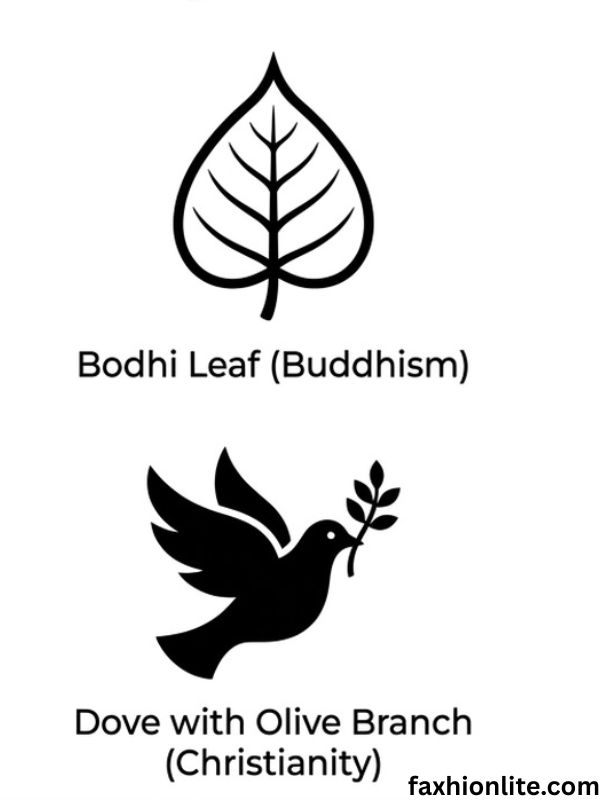
Symbols of hope appear across cultures because humans repeatedly use familiar experiences such as light, growth, survival, and renewal to express difficult emotions. However, the exact meaning of each symbol depends on its cultural setting.
Ancient civilizations often connected life cycles with spiritual cycles. Religious traditions developed their own symbolic languages, while artists and storytellers continued adapting those symbols for new generations.
A useful way to read cultural symbols is to ask three questions: What did this symbol mean originally? How was it used? What does it mean to people today? This approach avoids treating ancient and modern symbolism as if they were identical.
Ancient Egypt
Ancient Egyptian symbolism contains many powerful images connected with life, rebirth, protection, and continuation. The ankh is perhaps the best known, representing life and becoming strongly associated with the idea of eternal life.
The scarab also held important symbolic associations with rebirth and regeneration. The scarab was connected with Khepri, a deity associated with the rising sun and renewal. The lotus likewise became connected with creation, regeneration, and the cycle of life.
These examples show why ancient symbols of hope often overlap with symbols of life and rebirth. For ancient Egyptians, hope wasn’t necessarily an abstract feeling. It could be connected to the continuity of life itself.
Greek Civilization
Greek mythology offers a particularly interesting story about hope through Pandora. In the famous myth, Pandora opens a container from which troubles spread into the world, while hope remains inside.
The story has produced different interpretations for centuries. Some readers view hope as a final source of comfort after suffering enters human life. Others have questioned whether hope remaining inside the container is itself positive or ambiguous.
That ambiguity makes the story useful when studying hope symbolism. Hope isn’t always presented as simple happiness. Sometimes it exists alongside suffering, uncertainty, and the knowledge that life can be difficult.
Christianity
Christian symbolism contains many important images of faith, hope, sacrifice, resurrection, peace, and spiritual renewal. The cross, dove, anchor, light, rainbow, olive branch, and candle can all appear within Christian symbolic traditions.
The cross is especially significant because its meaning combines suffering with resurrection and hope. The anchor can represent steadfastness, while light often serves as a metaphor for guidance and divine presence.
Christian symbolism demonstrates an important principle: a symbol of hope can emerge from an experience of suffering rather than avoiding it. Hope becomes meaningful because it responds to hardship.
Native American Cultures
Native American symbolism cannot be reduced to one shared system because Indigenous nations have distinct histories, languages, traditions, and spiritual practices. Any discussion of Native American symbolism should therefore avoid presenting one meaning as universal.
Animals, plants, landscapes, seasons, and relationships with the natural world can carry important meanings within specific communities. However, those meanings should be understood within the tradition in which they occur rather than being generalized across all Indigenous peoples.
This is especially important when discussing Native American symbolism online. A respectful approach recognizes diversity and avoids assigning a single “Native American meaning” to an image without identifying the particular nation or cultural context.
Eastern Cultures
Eastern cultures contain some of the world’s richest traditions of symbolism involving renewal, enlightenment, impermanence, resilience, and spiritual growth. The lotus is one of the clearest examples.
In Buddhist traditions, the lotus is strongly associated with spiritual development and awakening. In Hindu traditions, lotus imagery also appears in important religious contexts and can be associated with purity, divinity, and spiritual significance.
Cherry blossoms, cranes, bamboo, and other images can carry different meanings across East Asian cultures. Their symbolism often reminds us that beauty, change, endurance, and impermanence can exist together.
Symbols of Hope in Art, Movies & Pop Culture
Artists and filmmakers use symbols of hope because visual storytelling can communicate an emotional transformation faster than dialogue. A sunrise, open door, bird in flight, blooming flower, or beam of light can show that a character’s outlook has changed.
In movies, symbolism often develops throughout a character’s journey. A dark setting may gradually become brighter. A broken object may be repaired. A character may finally step outside, look toward the horizon, or encounter a natural image associated with freedom.
Modern pop culture has also expanded the collection of visual symbols of hope. The semicolon has become associated in some communities with continuing a story rather than ending it. The phoenix represents rebirth. The butterfly represents transformation. Hope tattoos often combine several symbols to create a deeply personal message.
The most effective symbolism isn’t always obvious. Sometimes a symbol becomes meaningful because audiences see it repeatedly alongside a character’s struggle and eventual growth. The meaning comes from the story surrounding the image, not merely the image itself.
Spiritual & Dream Meaning of Symbols of Hope
Spiritual and dream meanings of hope symbols are best understood as personal interpretations rather than fixed predictions. A dream involving a butterfly, sunrise, candle, rainbow, or open door can feel meaningful, but its significance depends on the dreamer’s memories, emotions, beliefs, and circumstances.
A sunrise in a dream might represent a fresh start for one person. For another, it could be connected with a specific memory of a loved one or an important life event. The same image can therefore have different dream meaning for different people.
Common hope related dream imagery includes light after darkness, blooming flowers, clear water, birds, open doors, mountains, stars, and rising suns. Instead of asking only “What does this symbol mean?”, a more useful question is “What does this symbol mean to me right now?”
That approach also helps separate spiritual reflection from certainty. A meaningful dream can provide comfort or inspiration without necessarily being a prediction, supernatural message, or guaranteed sign about the future.
Positive vs Negative Meanings of Hope Symbols
Hope symbols aren’t always exclusively positive. Many powerful symbols contain both comforting and difficult meanings because real life also combines growth with loss, freedom with uncertainty, and renewal with endings.
| Symbol | Positive Meaning | Possible Difficult Meaning |
| Butterfly | Transformation and freedom | Fragility and impermanence |
| Anchor | Stability and faith | Feeling stuck |
| Candle | Hope and guidance | Grief and remembrance |
| Rainbow | Renewal and promise | Reminder of a previous storm |
| Moon | Cycles and renewal | Uncertainty or darkness |
| Phoenix | Rebirth and survival | Destruction before renewal |
| Dove | Peace and reconciliation | Mourning or loss |
| Mountain | Strength and achievement | A difficult challenge |
This contrast is one reason meaningful symbols of hope can feel more authentic than purely cheerful imagery. A phoenix is powerful because rebirth follows destruction. A rainbow matters because rain came first. A candle matters because darkness exists around it.
In other words, hope doesn’t require pretending everything is fine. A symbol can acknowledge pain while still pointing toward healing, recovery, resilience, or a better future. That may be the deepest reason hope symbolism remains relevant across generations.
Why Humans Are Attracted to Symbols of Hope
Humans are attracted to symbols of hope because symbols make complicated emotions easier to remember, communicate, and share. A small image can represent an entire personal story.
There is also a psychological reason hope feels connected with the future. Snyder’s work on hope emphasizes goals, agency, and pathways. People aren’t simply hoping for an outcome; hopeful thinking can involve believing that meaningful action is possible and identifying routes toward a goal.
This helps explain why a personal symbol can be so powerful. A person recovering from a difficult experience may wear a butterfly necklace. Someone focused on stability may choose an anchor. Someone remembering a loved one may light a candle. The object becomes a visual reminder of resilience and strength.
Symbols also create social connection. A rainbow, dove, heart, candle, or flower can communicate support without requiring a long explanation. In moments of grief, uncertainty, celebration, or recovery, that shared visual language can make people feel less alone.
Frequently Asked Questions
What is the most powerful symbol of hope?
There is no single universally accepted symbol of hope. The rising sun, dove, butterfly, rainbow, anchor, candle, and phoenix are among the most widely recognized, but personal and cultural meaning matters most.
What flower symbolizes hope?
The lotus is strongly associated with renewal, spiritual growth, and transformation in several Eastern traditions. Sunflowers can also represent optimism, warmth, and positivity in modern symbolic use.
What animal represents hope and strength?
The phoenix is a powerful mythological symbol of rebirth and survival, while the butterfly represents transformation. Birds such as doves can represent peace and renewal.
What color symbolizes hope?
Green is often associated with growth, renewal, life, and fresh starts. Yellow and gold can suggest optimism, warmth, and light, although color meanings vary by culture and context.
What symbolizes a new beginning?
The rising sun, butterfly, lotus, spring flower, open door, seed, sunrise, and phoenix are common symbols of new beginnings because they represent growth, transformation, emergence, or renewal.
Conclusion
Symbols of hope remind us that difficult moments don’t have to define the entire story. From the rising sun and rainbow to the butterfly, anchor, candle, lotus, dove, and phoenix, these images give shape to ideas of strength, faith, healing, resilience, and renewal.
The most meaningful symbol isn’t necessarily the most famous one. It may be the image that reminds you of something personal: a difficult chapter you survived, someone who supported you, a goal you’re pursuing, or the future you still believe is possible.
That is why symbols of hope continue to appear in religious traditions, ancient civilizations, artwork, movies, memorials, jewelry, tattoos, and everyday life. They offer a simple visual message while carrying layers of history and emotion.