
90+ Powerful Sanskrit Symbols and Meanings That Can Transform Your Life in 2026
Sanskrit symbols are among the most ancient and spiritually powerful signs ever created by human civilization. They come from a language that’s over 3,500 years old, and yet millions of Americans are discovering them for the very first time in 2026, through tattoos, yoga studios, meditation apps, and wellness jewelry. There’s something almost magnetic about these symbols. You don’t need to speak Sanskrit to feel their pull.
If you’ve ever wondered what that spiral “Om” symbol on your yoga mat actually means, or why your friend has a lotus tattooed on her wrist, or what the difference is between a Chakra symbol and a Mandala, you’re in the right place. This guide covers 90+ Sanskrit symbols and meanings in a way that’s straightforward, honest, and genuinely useful.
What Are Sanskrit Symbols?
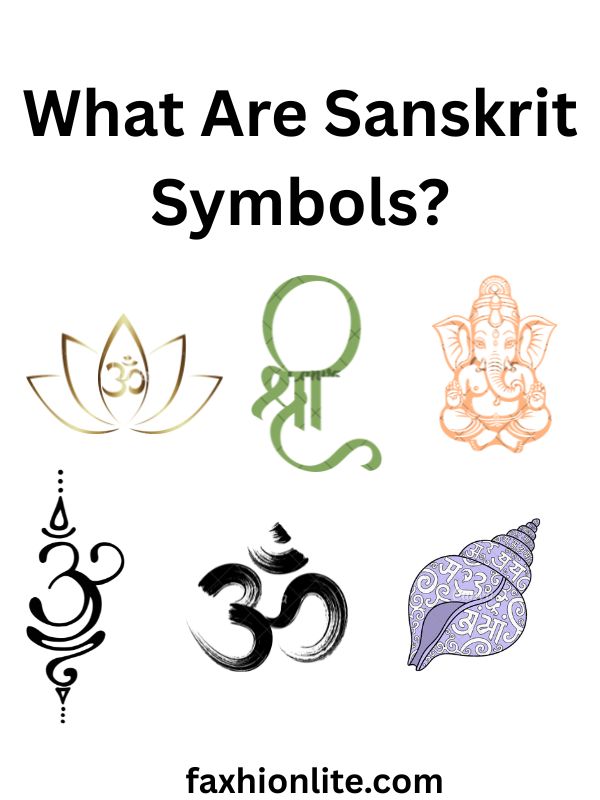
Sanskrit symbols are visual and phonetic representations drawn from one of the world’s oldest known languages: Sanskrit. The word “Sanskrit” itself means “refined” or “perfected” in the original tongue. It’s the sacred language of Hinduism, Buddhism, and Jainism, and it forms the root of dozens of modern languages spoken across South and Southeast Asia.
What makes Sanskrit different from most languages is that it was designed with intention. Each of its 50 letters isn’t just a sound. It’s considered a sacred vibration that carries spiritual energy. When you see a Sanskrit symbol carved into a temple wall or tattooed on someone’s forearm, you’re looking at something that was originally meant to be chanted, meditated upon, and lived.
In the USA today, Sanskrit symbols show up everywhere, from the décor aisle at Target to the walls of boutique yoga studios in Brooklyn and Austin. But their roots run much deeper than modern wellness culture. These symbols appear in ancient texts like the Vedas, the Upanishads, and the Bhagavad Gita, texts that were composed thousands of years before most Western civilizations came into existence. Understanding what they actually mean is the first step toward using them with real respect and intention.
Ancient Sanskrit Symbols And Their Spiritual Meanings
Ancient Sanskrit symbols weren’t just decorative. They were functional tools used by priests, healers, warriors, and everyday people to connect with something larger than themselves. You’d find them inscribed on temple walls in India, woven into silk fabrics along the Silk Road, and carved into sacred objects used in daily rituals.
The concept of Bija mantras is central to understanding why these symbols matter so deeply. A Bija mantra is a “seed syllable,” a single-syllable Sanskrit sound that carries the concentrated essence of a deity, a chakra, or a cosmic principle. When written as a symbol, that seed becomes a visual representation of that same energy. Think of it like a QR code for spiritual power.
Sanskrit Symbols And Meanings
Here’s a core reference list of Sanskrit symbols and their meanings. These aren’t just translations. Each one carries layers of philosophical depth that practitioners spend years exploring.
| Sanskrit Symbol | Pronunciation | Literal Meaning | Spiritual Significance |
| ॐ (Om/Aum) | AUM | Universal sound | Consciousness, creation, the divine |
| शान्ति (Shanti) | Shaan-ti | Peace | Peace of mind, body, and spirit |
| अहिंसा (Ahimsa) | Ah-him-saa | Non-violence | Compassion for all living things |
| धर्म (Dharma) | Dhar-ma | Righteous duty | Moral order and life purpose |
| कर्म (Karma) | Kar-ma | Action | Law of cause and effect |
| मोक्ष (Moksha) | Mok-sha | Liberation | Freedom from the cycle of rebirth |
| प्रेम (Prem) | Pray-m | Love | Divine, unconditional love |
| सत्य (Satya) | Sat-ya | Truth | Absolute honesty and integrity |
| प्राण (Prana) | Praa-na | Life force | Vital energy animating all life |
| आनन्द (Ananda) | Aa-nan-da | Bliss | Pure spiritual joy |
| शक्ति (Shakti) | Shak-ti | Power | Divine feminine creative energy |
| गुरु (Guru) | Goo-roo | Teacher | Spiritual guide who dispels darkness |
| बल (Bala) | Baa-la | Strength | Inner and physical power |
| समा (Sama) | Sa-maa | Equal | Balance and equanimity |
| अमृत (Amrita) | Am-ri-ta | Immortality | Nectar of eternal life |
These aren’t just pretty words. Each one has been used for centuries as a focal point in meditation practices, a reminder in daily life, and a declaration of personal values when worn on the body.
Buddhist Sanskrit Symbols And Meanings
Buddhism and Sanskrit share a deep historical bond. Many of the earliest Buddhist teachings were written in Sanskrit or closely related languages, and Buddhist Sanskrit symbols remain central to practice across Tibet, Thailand, Japan, and beyond.
The Dharma Chakra (Wheel of Dharma) is probably the most recognizable Buddhist Sanskrit symbol. Its eight spokes represent the Noble Eightfold Path, and its circular form symbolizes the continuous cycle of existence and the possibility of liberation from it. You’ll see it on Buddhist flags, temples, and robes worldwide.
The Vajra is another powerful Buddhist Sanskrit symbol that often surprises Westerners. It looks like a ritual scepter or thunderbolt, and in Tibetan Buddhism it represents the indestructible nature of enlightenment. Nothing can corrupt or destroy it. The word Vajra literally means “diamond” or “thunderbolt” in Sanskrit, and it’s used in meditations that emphasize mental clarity and unshakeable awareness.
Other key Buddhist Sanskrit symbols include Padma (lotus, representing awakening), Bodhi (enlightenment), Triratna (the Three Jewels: Buddha, Dharma, and Sangha), and the seed syllable Hum, which is considered the heart of the famous mantra “Om Mani Padme Hum.”
Ancient Sanskrit Symbols
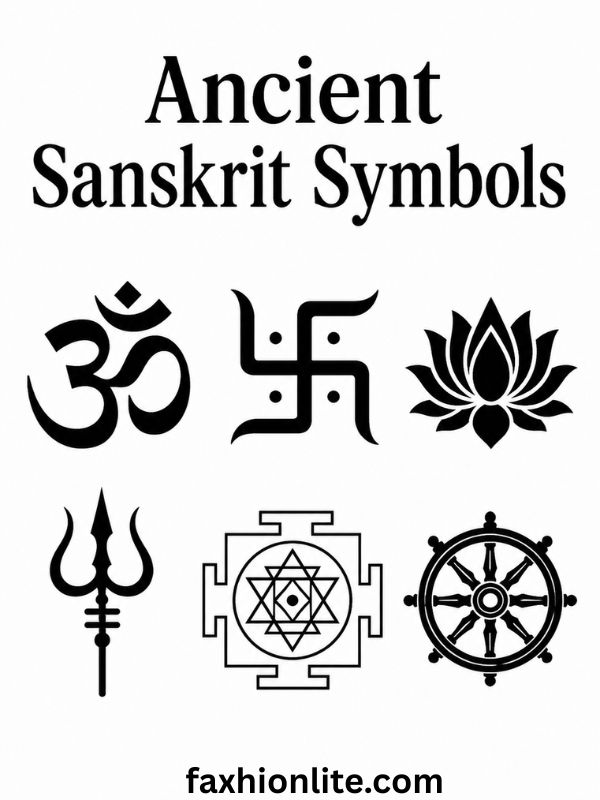
Some Sanskrit symbols predate what we typically call “religious” use. The Indus Valley Civilization, which flourished between 3300 and 1300 BCE, used proto-Sanskrit-like signs on seals and pottery that scholars are still working to decode. These aren’t fantasy. They’re documented archaeological findings that point to how deeply symbolic communication is wired into human culture.
Ancient temple carvings at sites like Ellora Caves in Maharashtra, India and Angkor Wat in Cambodia are filled with Sanskrit inscriptions and symbols that served as both spiritual instruction and historical record. These weren’t just art. They were living texts that worshippers interacted with through ritual, touch, and prayer.
One fascinating and lesser-discussed aspect of ancient Sanskrit symbols is their role in Jyotish (Vedic astrology). Each of the nine planetary bodies in Vedic astrology has an associated Sanskrit symbol, and these symbols were used by ancient astrologers to chart and predict the movement of cosmic energy through human lives. You might recognize some of these from modern astrological jewelry and wellness products.
Sanskrit Symbol For Life
The most direct Sanskrit symbol for life is Prana (प्राण). Prana doesn’t translate to “life” the way we might think of it in English. It’s not just being alive. It’s the animating force that makes life possible, the invisible current that flows through every breath, every heartbeat, every thought. In Ayurvedic medicine, Prana is the fundamental unit of vitality.
Jiva (जीव) is another Sanskrit symbol for life, though with a slightly different nuance. Jiva refers to the individual living soul, the unique spark of consciousness that inhabits a body. If Prana is the electricity, Jiva is the specific lamp it powers.
Americans often choose the Prana or Jiva symbol during moments of profound personal transformation: recovering from addiction, surviving serious illness, welcoming a new child, or starting life over after a major loss. The symbol becomes an anchor, a visible reminder that life itself is sacred and worth protecting.
Sanskrit Symbols For Breathe
Prana (प्राण) is also the most common Sanskrit symbol for breathe, since breath is the most direct physical expression of life force in the body. But there’s a more specific Sanskrit word for breath: Svasa (श्वास), which refers specifically to the act of inhaling and exhaling.
The “breathe” Sanskrit symbol became an unexpected cultural phenomenon in the years following the COVID-19 pandemic. For many Americans, breath had become something fragile, something that could be taken away. Choosing a Sanskrit breathe symbol as a tattoo or piece of jewelry became a way of reclaiming that fragility and turning it into something empowering.
If you’re considering a breathe-themed Sanskrit tattoo, make sure you’re using the correct transliteration. A surprising number of online templates contain errors because Sanskrit is a phonetically precise language. A misplaced vowel marker can change the meaning entirely. Always verify with a Sanskrit scholar or a reliable Devanagari script resource before getting it permanently inked.
Popular Sanskrit Symbols In Tattoos And Modern Design
Sanskrit tattoos are one of the fastest-growing tattoo styles in the United States. Minimalist Sanskrit script, Chakra symbols, and Om designs regularly appear in “most popular tattoo” lists, and Pinterest boards dedicated to Sanskrit tattoo ideas routinely attract millions of saves.
What’s driving this? Partly it’s the visual elegance of Devanagari script, the writing system used for Sanskrit. The flowing curves and dots of the script look beautiful even to people who can’t read a single word of it. But there’s also a deeper pull: people want their tattoos to mean something real, and Sanskrit symbols carry thousands of years of genuine meaning.
Sanskrit Symbols Tattoos
The most popular Sanskrit symbols tattoos in the USA right now include:
- Om (ॐ): Still the number-one Sanskrit tattoo. Often placed on the wrist, inner forearm, or behind the ear. Represents universal consciousness.
- Shanti (शान्ति): A go-to choice after loss, trauma, or burnout. Means peace.
- Prana / Breathe (प्राण): Soared in popularity post-pandemic. Inner wrist is the most common placement.
- Lotus (Padma): Usually depicted as a symbol or illustration rather than text. Means purity and resilience.
- Ahimsa (अहिंसा): Popular among vegans, activists, and animal lovers. Means non-violence.
- Karma (कर्म): A reminder that actions have consequences. One of the most minimalist Sanskrit script tattoos.
- Moksha (मोक्ष): Chosen by people ready to release the past. Means liberation.
- Shakti (शक्ति): Female empowerment tattoo, often paired with lotus or moon imagery.
Celebrity influence has played a real role here. Several high-profile musicians, athletes, and actors have publicly worn Sanskrit tattoos, which introduced these symbols to audiences who might never have encountered them through yoga or meditation.
Sanskrit Symbols And Meanings Tattoos
Getting a Sanskrit tattoo is a serious commitment, and the most common regret people share in tattoo forums isn’t the design itself. It’s not knowing what their tattoo actually says. Sanskrit script is highly precise, and even a subtle scripting error can shift the meaning of a word entirely.
Before you get any Sanskrit symbol tattooed, do these three things:
- Verify the script with multiple sources. Don’t rely on a single online generator. Cross-check using a Devanagari keyboard tool and compare with authoritative Sanskrit dictionaries.
- Ask your tattoo artist about their experience with Sanskrit script. Not all tattoo artists are familiar with the unique stroke weight and vowel markers that make Devanagari readable.
- Understand the full meaning. Some Sanskrit symbols carry layered meanings across different traditions. Make sure you’re comfortable with all of them.
The cultural appreciation versus appropriation debate is real and worth taking seriously. Most Hindu and Buddhist scholars interviewed in mainstream media have expressed that respectful, intentional use of Sanskrit symbols is generally welcomed, especially when the person understands what the symbol means and treats it with care.
Spiritual Sanskrit Symbols
Spiritual Sanskrit symbols go beyond decoration. They’re active tools in meditation, ritual, and daily practice. The Sri Yantra is a stunning example: a complex geometric figure made of interlocking triangles that represents the union of the divine masculine and feminine. Meditating on it is said to help practitioners access deeper states of awareness.
Soham (सोहम्) is another powerfully spiritual Sanskrit symbol. Translated, it means “I am That,” a declaration that the individual self and the universal consciousness are ultimately the same. It’s used in breathwork meditation: “So” on the inhale, “Ham” on the exhale. Meditators report that sustained practice with this symbol can shift how they relate to their own identity and place in the universe.
The Goddess Bija mantras like Hrim, Klim, and Aim are seed syllable symbols associated with specific divine feminine energies. These aren’t widely discussed in mainstream Western wellness content, but they’re foundational in traditional Sanskrit spiritual practices and are experiencing a significant revival among practitioners of Shakta Tantra in the USA.
Sanskrit Symbols Text
In digital spaces, Sanskrit symbols text refers to how these symbols appear as Unicode characters in the Devanagari script range. Designers, content creators, and social media users copy-paste Sanskrit text symbols into bios, artwork, and branding to add visual depth and spiritual resonance.
The Devanagari Unicode block (U+0900 to U+097F) contains all the characters needed to write Sanskrit correctly in digital formats. This matters because many online Sanskrit symbol generators use incorrect character combinations that look right visually but don’t encode correctly for screen readers, searchability, or accurate translation.
For graphic designers working with Sanskrit symbols, choosing the right font matters enormously. Fonts like Noto Serif Devanagari, Mangal, and Shobhika render Sanskrit symbols with proper spacing and diacritical marks. Using a standard Latin alphabet font for Sanskrit text is one of the most common design mistakes seen in wellness branding.
Symbols Of Sanskrit
The symbols of Sanskrit fall into several broad categories that serve different purposes:
- Phonetic symbols: The 50 letters of the Sanskrit alphabet, each representing a unique sound and sacred energy
- Mantra symbols: Written sacred phrases like Om Namah Shivaya or the Gayatri Mantra
- Yantra symbols: Geometric diagrams like the Sri Yantra used as visual meditation objects
- Mudra symbols: Illustrations of sacred hand gestures used in yoga and ritual
- Chakra symbols: Lotus-based diagrams representing the seven energy centers of the body
- Astrological symbols: Vedic planetary symbols used in Jyotish astrology
Each category serves a completely different function. A Yantra is meant to be gazed at during meditation. A mantra symbol is meant to be chanted. A Chakra symbol might be placed on the body during energy healing. Understanding which category a symbol belongs to helps you use it in the most appropriate and effective way.
Sanskrit Symbols Meaning
At its deepest level, Sanskrit symbols meaning operates on three layers that ancient teachers called Artha. The first layer is the literal translation, what the word means in plain language. The second is the associated or implied meaning, the broader context and connotations the word carries. The third is the suggestive meaning, the deeper spiritual resonance that goes beyond words entirely.
Take Karma (कर्म) as an example. Its literal meaning is simply “action” or “deed.” Its implied meaning is the law of cause and effect, the idea that every action generates a corresponding result. But its deepest suggestive meaning points to the entire architecture of how consciousness evolves across lifetimes, a concept that Western audiences often simplify into “what goes around comes around.”
The gap between what a Sanskrit symbol seems to mean and what it actually means at depth is exactly what makes studying these symbols so rewarding. You can spend years with a single symbol and keep discovering new layers.
Sanskrit Symbol For Balance
The most fitting Sanskrit symbol for balance is Sama (सम), which means equal, even, or balanced. It’s the root of the word “Samatvam,” which the Bhagavad Gita describes as the essence of yoga: evenness of mind regardless of external circumstances.
Sthira (स्थिर) is another Sanskrit symbol associated with balance, specifically steadiness and stability. In yoga philosophy, Sthira is one of the two essential qualities of any good asana practice (the other being Sukha, ease). Without Sthira, there’s no real balance, only tension.
The Shiva-Shakti duality is Sanskrit’s most profound expression of cosmic balance. Shiva represents pure consciousness, unchanging awareness, the masculine principle. Shakti represents dynamic creative energy, motion, and power, the feminine principle. Together they represent the two complementary forces that hold the universe in perfect equilibrium. This concept is why you’ll see the Shiva-Shakti symbols paired together in so much sacred Sanskrit art and temple architecture.
Breathe Sanskrit Symbol
The breathe Sanskrit symbol deserves its own dedicated exploration because it’s become one of the most personally significant symbols in modern American wellness culture. For many people, the decision to get a Sanskrit breathe tattoo marks a turning point: the end of a panic disorder, the survival of a health crisis, a commitment to mindfulness after years of running on empty.
Visually, when written in Devanagari script, Prana (प्राण) is an elegant combination of curves and a distinctive nasal marker. Svasa (श्वास) looks different, with a more angular character set that many find visually striking as a standalone tattoo. Both are authentic, but Prana carries significantly more spiritual depth, making it the more meaningful choice for most people.
The connection between breath and Sanskrit symbolism isn’t just philosophical. Pranayama, the yogic science of breath control, uses Sanskrit symbols and mantras as anchors for breathing practices that research has shown can activate the parasympathetic nervous system, reduce cortisol, and improve emotional regulation. The symbol isn’t just pretty. For practitioners, it’s a functional reminder of a practice that changes lives.
Deep Symbolic Meaning
Sanskrit symbols don’t operate the way most Western symbols do. A red stop sign means stop. A skull means danger. These are one-dimensional meanings tied to function. Sanskrit symbolism is multi-dimensional by design.
The ancient Sanskrit concept of Sankalpa (sacred intention) is key here. A symbol activated by clear, sincere intention carries different energy than the same symbol worn carelessly. This isn’t mystical thinking for its own sake. It’s a practical framework for how meaning-making works in the human mind. When you understand your symbol deeply and return to that meaning regularly, the symbol functions like a cognitive anchor, automatically bringing you back to the state of mind you’ve associated with it.
Carl Jung, one of the fathers of modern psychology, spent years studying Sanskrit symbols and recognized in them what he called archetypes, universal patterns that appear in the unconscious minds of people across all cultures. His work on the Mandala as a symbol of the “self” was directly influenced by his study of Sanskrit and Hindu sacred geometry. This bridge between ancient wisdom and modern psychology is one reason these symbols feel so universally resonant, even to people with no background in Indian philosophy.
Types / Variations of Sanskrit Symbols
Om Symbol
Om (ॐ) is the most sacred symbol in Sanskrit tradition, and it’s also the most complex. What looks like a simple curved shape is actually a visual map of the entire structure of consciousness. The large lower curve represents the waking state. The upper curve represents deep dreamless sleep. The middle curve represents the dream state. The arc beneath the dot represents the veil of illusion (Maya), and the dot itself represents pure transcendent consciousness, the state beyond all states.
When chanted correctly as A-U-M (not “ohm”), the three sounds vibrate through different parts of the body: A resonates in the chest and belly, U moves through the throat, and M vibrates in the skull. Ancient yogis considered this full-body resonance to be a physical experience of the unity of all three states of consciousness.
In the USA, Om is everywhere. You’ll find it on everything from high-end yoga mats to dollar store keychains. While some Sanskrit scholars express concern about its commercialization, most teachers agree that any genuine encounter with the Om symbol, even a casual one, plants a seed that can lead to deeper inquiry.
Lotus Symbol
The Lotus (Padma in Sanskrit) is remarkable because it thrives in muddy, stagnant water, and yet it surfaces completely clean and opens into a flawlessly beautiful flower. This is the core teaching: spiritual beauty and wisdom emerge not despite suffering and difficulty, but through it.
In Sanskrit tradition, different lotus colors carry different meanings. The white lotus represents spiritual perfection. The pink lotus is most closely associated with the historical Buddha. The blue lotus symbolizes the wisdom that sees beyond ordinary perception. The red lotus is linked to love, compassion, and the heart. These distinctions matter if you’re choosing a lotus-related Sanskrit symbol for a specific intention.
Major Hindu deities including Lakshmi (goddess of abundance), Brahma (creator deity), and Saraswati (goddess of learning) are depicted seated on lotus thrones. This visual language communicates that divine qualities arise above the mess of ordinary material existence, not apart from it.
Swastika Symbol
Few topics in Sanskrit symbolism require more careful handling than the Swastika. In Sanskrit, the original word is Svastika, derived from “Svasti,” meaning well-being, good fortune, and auspiciousness. This symbol has been used in Hindu, Buddhist, and Jain traditions for at least 3,000 years, predating its 20th-century misappropriation by Nazi Germany by millennia.
The ancient Sanskrit Svastika is typically oriented at equal angles and sometimes rotated in either direction, with both orientations historically considered auspicious in various traditions. Today you’ll find it painted on Hindu temples, woven into Navratri festival decorations, and printed on wedding invitations throughout India and the Indian diaspora.
For American readers, encountering this symbol in a Hindu or Buddhist context is an invitation to understand history in full rather than in fragments. The reclamation discussion is ongoing, particularly in academic circles, but within practicing Hindu and Buddhist communities in the USA, the ancient Sanskrit Svastika continues to hold its original meaning of blessing and good fortune.
Chakra Symbols
The seven Chakra symbols are among the most detailed and visually sophisticated in the entire Sanskrit tradition. Each Chakra symbol is a lotus with a specific number of petals, a specific geometric shape at its center, a Sanskrit seed syllable (Bija mantra), and a corresponding color. Together they form a complete map of the human energy body.
Here’s a quick reference:
| Chakra | Sanskrit Name | Petals | Seed Mantra | Core Theme |
| Root | Muladhara | 4 | Lam | Safety and grounding |
| Sacral | Svadhisthana | 6 | Vam | Creativity and emotion |
| Solar Plexus | Manipura | 10 | Ram | Confidence and willpower |
| Heart | Anahata | 12 | Yam | Love and compassion |
| Throat | Vishuddha | 16 | Ham | Truth and expression |
| Third Eye | Ajna | 2 | Om | Intuition and wisdom |
| Crown | Sahasrara | 1000 | Silence | Divine connection |
In American wellness culture, Chakra symbols appear in everything from Reiki healing sessions to interior design. They’ve also become popular as matching tattoo sets, with people choosing the Chakra symbol that corresponds to the area of their life they’re working to develop.
Mandala
The word Mandala comes directly from Sanskrit and means “circle” or “sacred circle.” But a Mandala is far more than a circle. It’s a complete symbolic universe contained within geometric form, with every element of its design carrying intentional meaning about the nature of reality.
Traditional Sanskrit Mandalas always begin with a central point called the Bindu, representing the source of all creation, the single point from which the entire universe unfolds. Rings of lotus petals, geometric shapes, and protective gates radiate outward from the Bindu, mapping the journey from the infinite (outer boundary) to the absolute (center point).
Carl Jung was so struck by the Mandala’s power that he made his patients draw their own Mandalas during therapy as a way of accessing and integrating the unconscious mind. Modern art therapy still uses this practice. In everyday American life, Mandala coloring books became a bona fide cultural phenomenon, with researchers finding that the focused attention required to color Mandalas produces measurable reductions in anxiety. This isn’t coincidence. It’s the ancient science of sacred geometry doing exactly what it was designed to do.
Sanskrit Symbols Across Cultures
Sanskrit symbols didn’t stay in India. They traveled along ancient trade routes, Buddhist missionary networks, and royal diplomatic exchanges to become woven into the cultural fabric of Southeast Asia, East Asia, and eventually the Western world.
In Bali, Indonesia, Sanskrit symbols are part of everyday life. Offerings placed outside temples and homes contain Sanskrit inscriptions, and Balinese script (which descends directly from ancient Sanskrit) appears on ceremonial objects throughout the island. In Thailand and Cambodia, Sanskrit mantras and symbols are inscribed on temple walls and amulets. The famous ruins of Angkor Wat in Cambodia contain extensive Sanskrit inscriptions that document the religious and political history of the Khmer Empire.
In the United States, Sanskrit symbols entered mainstream consciousness gradually. The early 20th century brought Indian philosophy to American shores through teachers like Swami Vivekananda and later Paramahansa Yogananda. The 1960s counterculture embraced Sanskrit symbols as part of a broader rejection of materialism. And the modern yoga and mindfulness boom of the 2000s and 2010s turned Sanskrit symbols into the cultural currency they are today.
Sanskrit Symbols in Art, Movies & Pop Culture
If you’ve watched Marvel’s Doctor Strange, you’ve seen Sanskrit-inspired sacred geometry in action. The Mystic Arts visualizations drawn by characters in that film are directly modeled on Yantra geometry and Sanskrit sacred diagrams. The film’s production designers consulted traditional sources to create the visual language of the magical universe, and the result is a remarkably accurate tribute to Sanskrit symbolic art.
Eat Pray Love introduced millions of American women to Sanskrit spiritual culture in a personal, accessible way. The “Ashram in India” section of the film brought Sanskrit mantras, Bija syllables, and the experience of sitting with Sanskrit symbols in meditation into the cultural mainstream.
In the music world, numerous artists have incorporated Sanskrit symbols into album art, stage design, and visual branding. The Om symbol in particular has appeared on everything from rock album covers to luxury fashion collections by brands like Stella McCartney and Alexander McQueen.
Social media has accelerated all of this exponentially. Sanskrit symbol posts on Instagram regularly generate millions of engagements, and the hashtag community around Sanskrit tattoos, Mandala art, and Chakra healing is one of the most active wellness communities on Pinterest and TikTok.
Spiritual & Dream Meaning of Sanskrit Symbols
In the ancient Vedic text called Swapna Shastra (a sacred text specifically about dream interpretation), dreams are understood as a liminal space where the conscious mind loosens its grip and deeper patterns of consciousness can emerge. Sanskrit symbols seen in dreams were taken very seriously as messages from the deeper self or from divine sources.
If you dream of the Om symbol, traditional Vedic interpretation suggests you’re being called toward a deeper spiritual practice or awakening. Dreaming of a Lotus is typically understood as a sign of emerging clarity, something beautiful rising from a period of difficulty or confusion. Chakra symbols appearing in dreams often point to which energy center in your body is either blocked or awakening.
From a modern psychological perspective, people who meditate regularly or practice yoga with Sanskrit symbols report seeing these symbols in hypnagogic states (the threshold between waking and sleep) with notable frequency. This aligns with research on visual cortex priming: symbols we engage with intentionally during the day create stronger neural traces that surface during the brain’s consolidation processes at night.
Positive vs Negative Meaning
Sanskrit philosophy is deeply sophisticated about duality. Almost no symbol in the Sanskrit tradition is purely positive or purely negative. Instead, most symbols embody what Sanskrit calls Dvandva, the natural pairing of opposites that exists throughout all of reality.
Kali, for example, is one of the most visually striking Sanskrit deity symbols and one of the most misunderstood in Western culture. She’s depicted with dark skin, wild hair, and a necklace of skulls. To Western eyes, she reads as frightening. But in Sanskrit tradition, Kali is an intensely compassionate force. She destroys illusion, ego, and attachment, which are the very things that cause human suffering. Her “darkness” is the darkness that removes darkness.
The Trishula (Shiva’s trident) similarly carries dual meaning. It represents the power to destroy, but what it destroys is ignorance, the ego, and the binding force of karma. In Sanskrit tradition, this kind of destruction is the highest form of compassion.
Even the gentle Om symbol has a shadow side in contemporary life: its overuse and commercialization can strip it of meaning. Sanskrit teachers often note that a symbol treated carelessly loses its energetic potency for the person using it. This isn’t about punishment. It’s about attention. A symbol only transforms you if you actually pay attention to what it means.
Why Humans Are Attracted to Sanskrit Symbols
The attraction to Sanskrit symbols runs deeper than aesthetics, though the visual beauty of Devanagari script and sacred geometry certainly plays a role. There are several genuine, well-supported reasons why these symbols resonate so powerfully with people across cultures.
Vibrational design. Sanskrit is one of the only languages in which the shape of the written character corresponds to the physical shape the mouth makes when producing the sound. This creates an unusual harmony between the visual and auditory dimensions of the language that the nervous system perceives, even without conscious awareness.
Sacred geometry. Many Sanskrit symbols, particularly Yantras and Mandalas, are built on mathematical ratios that appear throughout nature: the Golden Ratio, Fibonacci sequences, and fractal patterns. The human brain recognizes these patterns at a pre-cognitive level. They feel right because they mirror the structure of the natural world we evolved within.
Personal transformation anchoring. For many Americans, the first encounter with a Sanskrit symbol happens during a significant life change. A divorce, a recovery, a spiritual retreat, a health crisis. The symbol becomes permanently associated with the transformation, making it feel deeply, personally meaningful.
Community. Displaying a Sanskrit symbol connects you to a vast, global community of people who share your values around spirituality, mindfulness, and inner growth. In an increasingly fragmented social landscape, that sense of belonging matters enormously.
Conclusion
Sanskrit symbols are far more than beautiful designs. They’re living expressions of one of humanity’s oldest and most sophisticated wisdom traditions, refined over thousands of years to help people connect with something beyond the everyday rush of modern life.
Whether you’re drawn to the universal resonance of Om, the resilience encoded in the Lotus, the vital energy of Prana, or the cosmic balance of Shiva-Shakti, there’s a Sanskrit symbol that speaks to exactly where you are in your own journey. The key is to approach them with curiosity and genuine respect, understanding what they mean before you wear them, display them, or meditate upon them.