45+Pokémon Type Symbols Explained: The Complete Guide to All 18 Types
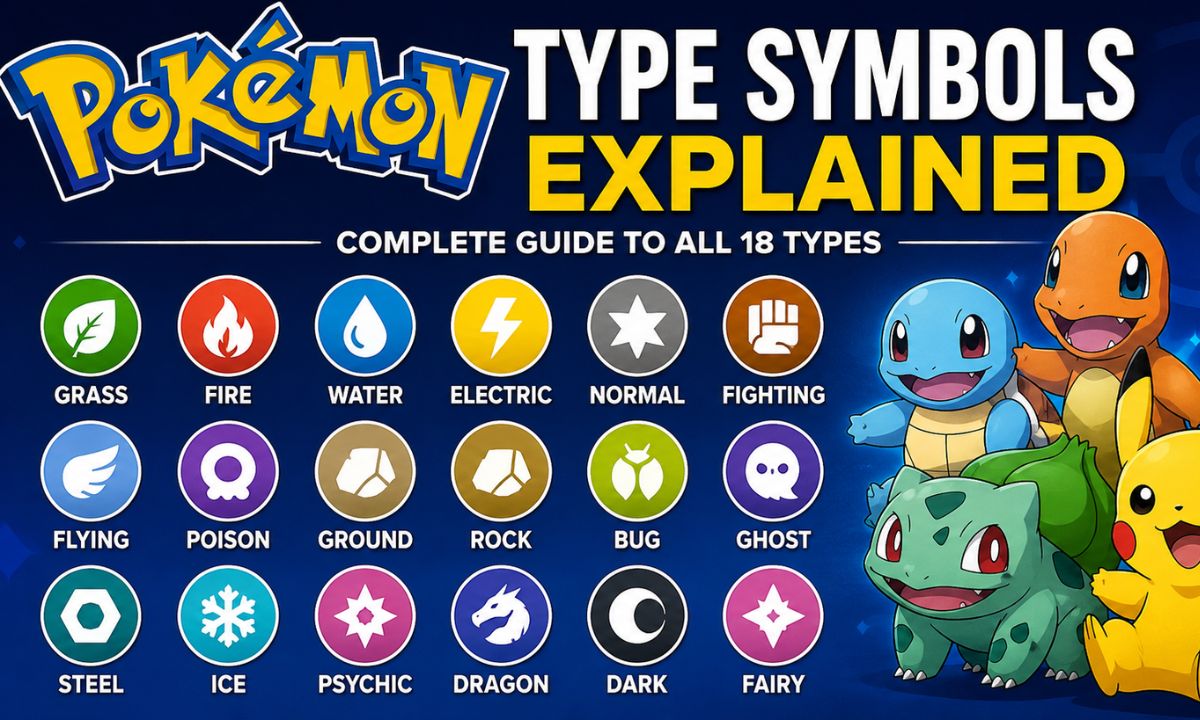
Pokémon type symbols are the small colored icons attached to every move and every Pokémon that instantly tell a trainer which of the eighteen elemental categories a creature or attack belongs to. These icons are not decoration. They represent an entire system of strengths, weaknesses, and battle strategy that has shaped the franchise since its earliest games.
For nearly three decades, this type system has been the beating heart of Pokémon battles. Whether you are a parent, a new player, or a longtime fan, understanding these symbols is the fastest way to improve at the games. This guide breaks down every type, every symbol, and every matchup in simple, practical language.
What Are Pokémon Type Symbols?
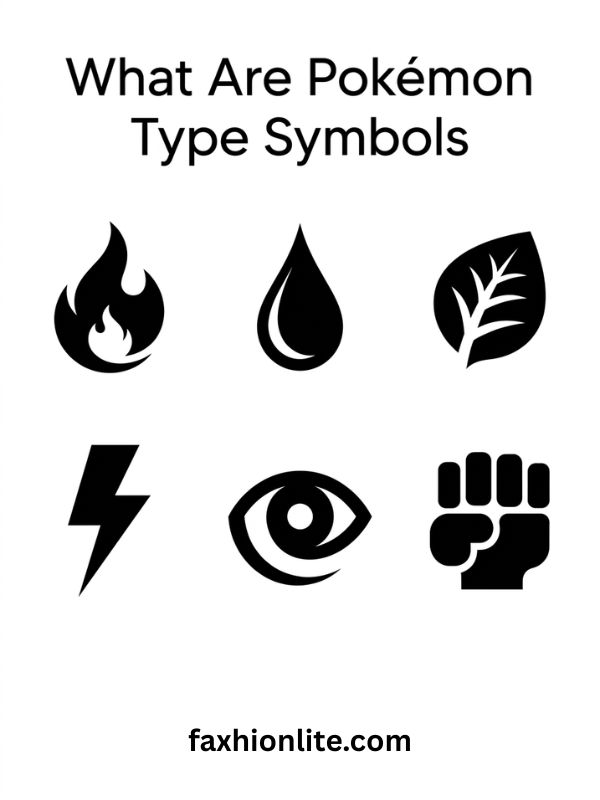
Pokémon type symbols are the visual icons Game Freak uses to represent each of the eighteen elemental categories that define a Pokémon’s identity and combat behavior.
Every Pokémon species belongs to one or two of these types, and every move a Pokémon learns also carries a type of its own. In the main series games, these symbols appear as small round or shield shaped badges next to a move’s name during battle, showing a stylized icon such as a flame for Fire or a droplet for Water. On the Trading Card Game, the symbols appear as colored energy icons in the corner of each card, designed separately from the video game versions but built from the same conceptual framework.
The purpose is simple. Rather than forcing players to read text mid battle, the symbols let trainers recognize a type at a glance. A Pokémon type chart built around these icons has been a staple of strategy guides since the original Red and Blue games launched in 1996. The icons have been redesigned several times, most notably when Generation 6 introduced cleaner circular badges after the Fairy type was added, but the underlying meaning of each symbol has never changed.
The Complete List of All 18 Pokémon Types
There are exactly eighteen official Pokémon types, and every species and move in the games belongs to one, two, or in the case of some moves, none of these categories.
The eighteen types are Normal, Fire, Water, Electric, Grass, Ice, Fighting, Poison, Ground, Flying, Psychic, Bug, Rock, Ghost, Dragon, Dark, Steel, and Fairy. Seventeen of these existed from early on, but Fairy was not introduced until Pokémon X and Y in 2013, making it the newest addition and one specifically designed to check the previously dominant Dragon type.Each type carries its own thematic identity rooted in real world elements or abstract concepts.
Fire, Water, Grass, and Electric draw directly from natural forces, while others are more conceptual, such as Psychic representing mental power and Dark representing cunning rather than literal darkness. Understanding this thematic logic makes it easier to predict how an unfamiliar Pokémon might behave before you ever look up its official data.
| Type | General Theme |
| Normal | Ordinary creatures with no elemental specialty |
| Fire | Heat, flame, and combustion |
| Water | Oceans, rivers, and aquatic life |
| Electric | Lightning and electrical energy |
| Grass | Plants, photosynthesis, and nature |
| Ice | Cold, snow, and freezing |
| Fighting | Martial arts and physical combat |
| Poison | Toxins and venom |
| Ground | Earth, sand, and terrain |
| Flying | Air, wind, and airborne creatures |
| Psychic | Mental power and telekinesis |
| Bug | Insects and arthropods |
| Rock | Stone, minerals, and geology |
| Ghost | Spirits and the supernatural |
| Dragon | Powerful mythical serpentine beings |
| Dark | Trickery, cunning, and shadow |
| Steel | Metal and mechanical armor |
| Fairy | Whimsical and mystical magic |
What Do Pokémon Type Symbols Mean?
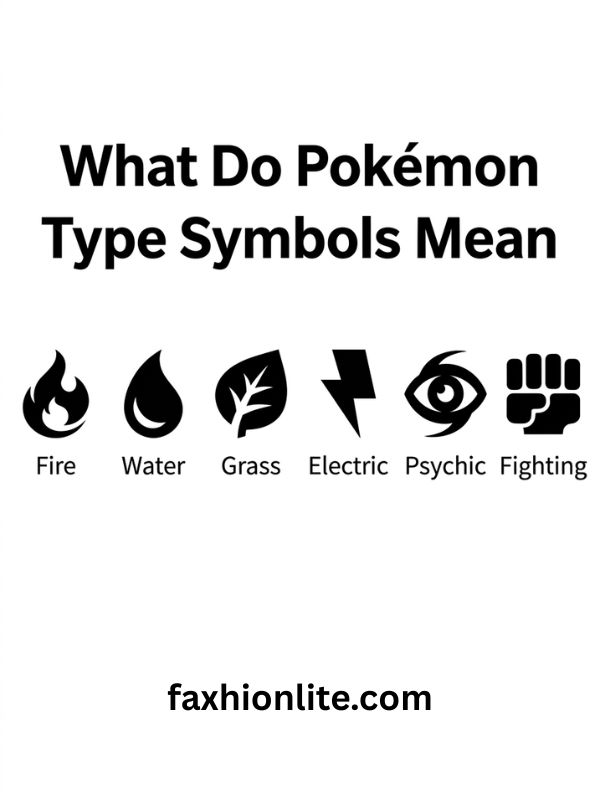
Each type symbol is a simplified pictogram designed to represent its type’s core theme in a way that is recognizable even at a very small size on screen.
The Fire symbol shows a stylized flame, the Water symbol shows a droplet, the Grass icon is a leaf, the Electric icon is a lightning bolt, and the Ice icon is a snowflake. These four are the easiest to memorize because the imagery maps directly onto the real world element it represents.
Some symbols need more context, such as the Fighting icon resembling a clenched fist, the Ghost icon using a wisp shape, and the Fairy icon using a soft pink star or flower motif to stand apart from every other icon.
The color coding of Pokémon type symbols stays consistent across nearly every official product, from the mainline games to the trading card game to spinoff titles, so a player who learns the Electric type icon in one game instantly recognizes it in another. This consistency is a deliberate branding choice that reinforces the type system as one unified visual language across the entire franchise.
How Pokémon Type Effectiveness Works
Pokémon type effectiveness determines how much damage a move deals based on the move’s type compared to the type or types of the defending Pokémon.
A move that is super effective deals double damage, shown with the message “It’s super effective!” A move that is not very effective deals half damage, and a move with no effect deals zero damage entirely, such as Electric moves against Ground type Pokémon.
When a Pokémon has two types, these modifiers stack, meaning damage can be quadrupled or reduced to a quarter, which is one of the most important concepts for any player moving beyond casual play.
The logic follows a rock paper scissors structure. Water beats Fire, Fire beats Grass, and Grass beats Water, forming one of the most recognizable triangles in the system. No single type is unconditionally dominant, which is why experienced trainers build teams that collectively cover as many weaknesses as possible rather than choosing Pokémon on appearance alone.
Pokémon Type Chart: Strengths and Weaknesses
The type chart is the master reference showing which types are strong, weak, or neutral against every other type in the game.
| Attacking Type | Strong Against | Weak Against |
| Fire | Grass, Ice, Bug, Steel | Water, Ground, Rock |
| Water | Fire, Ground, Rock | Electric, Grass |
| Grass | Water, Ground, Rock | Fire, Ice, Poison, Flying, Bug |
| Electric | Water, Flying | Ground |
| Ice | Grass, Ground, Flying, Dragon | Fire, Fighting, Rock, Steel |
| Fighting | Normal, Ice, Rock, Dark, Steel | Flying, Psychic, Fairy |
| Poison | Grass, Fairy | Ground, Psychic |
| Ground | Fire, Electric, Poison, Rock, Steel | Water, Grass, Ice |
| Flying | Grass, Fighting, Bug | Electric, Ice, Rock |
| Psychic | Fighting, Poison | Bug, Ghost, Dark |
| Bug | Grass, Psychic, Dark | Fire, Flying, Rock |
| Rock | Fire, Ice, Flying, Bug | Water, Grass, Fighting, Ground, Steel |
| Ghost | Psychic, Ghost | Ghost, Dark |
| Dragon | Dragon | Ice, Dragon, Fairy |
| Dark | Psychic, Ghost | Fighting, Bug, Fairy |
| Steel | Ice, Rock, Fairy | Fire, Fighting, Ground |
| Fairy | Fighting, Dragon, Dark | Poison, Steel |
| Normal | none especially | Fighting |
Reading this chart means checking both directions of every matchup. A Fire move is strong against Grass, but a Fire Pokémon defending against a Water move is on the receiving end of a weakness.
It also helps to remember complete immunities, such as Ground moves having no effect on Flying types, Normal and Fighting moves having no effect on Ghost types, and Electric moves having no effect on Ground types. These immunities can completely neutralize an opponent’s signature attack when used correctly.
Dual Type Pokémon Explained
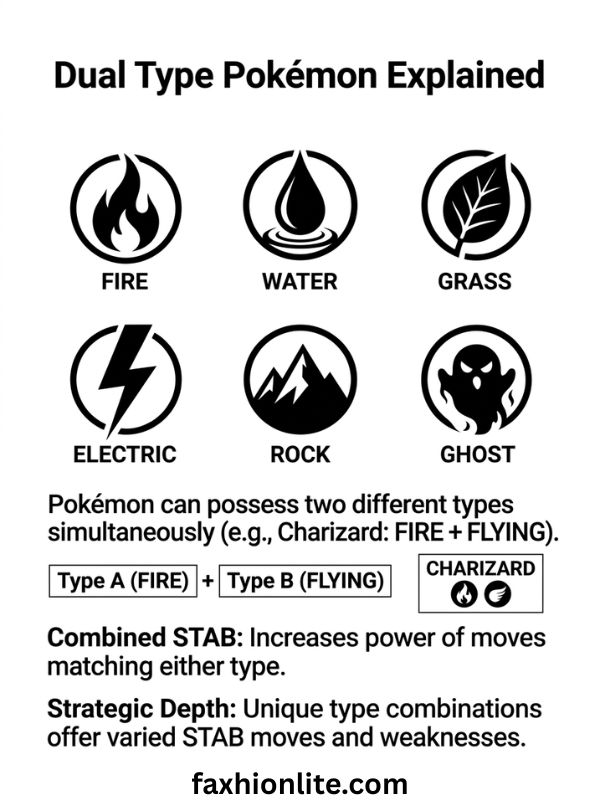
A dual type Pokémon carries two types simultaneously, combining the strengths and weaknesses of both into a single, more complex profile.
Roughly half of all Pokémon species have two types, and this combination changes performance dramatically. A Fire and Flying type resists Grass attacks more strongly than a pure Fire type, since resistances multiply together.
That same combination is quadruple weak to Rock moves, since both types are independently weak to Rock and those weaknesses stack rather than cancel out. A Pokémon with two weaknesses to the same attacking type takes four times normal damage, not simply double, which explains why some strong looking Pokémon are considered fragile competitive picks.
Some dual type combinations are prized specifically because their weaknesses rarely overlap. Steel and Fairy is widely regarded among competitive players as one of the most defensively sound combinations, since Steel resists a huge number of attacking types and Fairy patches over most of its remaining weaknesses. Recognizing these synergies, rather than judging types in isolation, is what separates a casual player from a strategic one.
Type Symbols in Games vs Trading Cards
The type symbols used in the video games and the Trading Card Game share the same meaning but differ in visual design and function.
In the video games, icons appear mainly as badges next to move names, helping players identify a move’s category quickly. In the card game, type is shown through colored Energy symbols printed on each card, and these correspond to physical Energy cards players must attach for a Pokémon to attack at all, tying type directly to a resource system rather than a simple label.
Pokémon GO uses yet another style optimized for mobile screens, though the core color palette, red for Fire and blue for Water, stays consistent everywhere.For competitive card players, recognizing symbols quickly under time pressure is essential, letting a player glance at a board and instantly understand which attacks are realistically threatening without reading every card in detail.
Best Type Combinations for Battle Strategy
A well built team typically covers Water, Fire, and Grass to maintain the classic elemental triangle, plus a Ground or Rock type for Electric and Flying coverage, and often a Fairy or Dark type for Dragon and Psychic threats.
Combinations like Water and Ground, Steel and Fairy, and Dragon and Flying are frequently cited across competitive communities for having few exploitable weaknesses relative to their broad offensive coverage. Combinations like Grass and Ice or Rock and Ground accumulate overlapping weaknesses, which is why they see less use at the highest levels despite sometimes strong raw stats.
No single type in the modern Pokémon games is completely unbeatable, and that balance is precisely what has kept the competitive scene evolving for decades. New generations continue introducing fresh Pokémon and occasional adjustments, but the eighteen type framework itself has proven durable enough to support a huge competitive ecosystem.
Common Mistakes Trainers Make
Building a team entirely around favorites without checking overlapping weaknesses is a common error; if four of six team members are all weak to Ice, a single well placed Ice move can devastate the team quickly.
Forgetting that dual types can carry quadruple weaknesses leads players to send out a Pokémon they assumed was safe, only to see it faint from one hit. Others keep using Electric moves against Ground type opponents out of habit, not realizing the attack deals zero damage regardless of power.
Finally, players sometimes overvalue type advantage while ignoring actual stats and move sets. Type effectiveness is a powerful multiplier, but a frail Pokémon with an advantage can still lose to a bulkier opponent with strong defenses. Treating the chart as one tool among several is what separates intermediate players from truly skilled ones.
Frequently Asked Questions
How many Pokémon types are there in total?
Eighteen, with Fairy being the most recently added during Generation 6.
What is the strongest Pokémon type?
No single type is universally strongest, since the system is intentionally balanced around counters rather than a fixed hierarchy.
Can a Pokémon have three types?
No, the core games limit every species to a maximum of two types at once.
Why was the Fairy type added
To provide a counter to the previously unchecked Dragon type, restoring competitive balance.
Do type symbols differ between games?
The visual style has changed across generations and platforms, but the color and meaning of each symbol stay consistent throughout the franchise.
Conclusion
Pokémon type symbols may look like simple icons, but they represent one of the most carefully engineered strategy systems in modern gaming. From the eighteen elemental categories to the web of strengths, weaknesses, and immunities connecting them, this system has been the backbone of Pokémon battles for nearly thirty years.
Whether you are teaching a child the basics, preparing for a local tournament, or simply satisfying curiosity, understanding these symbols turns Pokémon from a game of chance into a game of genuine skill. The next time a small flame or water droplet icon flashes across the screen, you will know exactly what it means and why it matters.