68+ Timeless Symbols of Love & Their Deep Meanings Through History
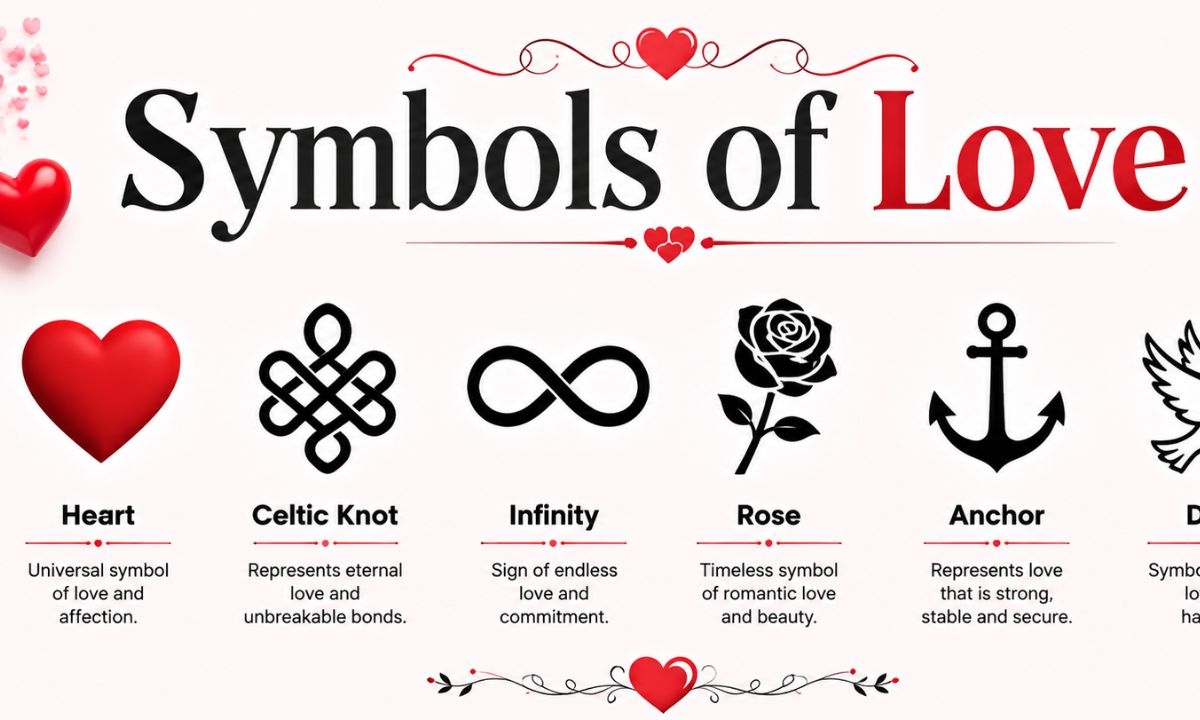
Love has been expressed in countless ways throughout human history—but some symbols of love have survived for centuries, carrying powerful messages of romance, devotion, loyalty, and connection.
From the classic heart symbol and intertwined rings to ancient flowers, sacred knots, doves, and meaningful gemstones, these timeless signs have helped people express feelings that words sometimes cannot capture.
In this guide, you’ll discover 68+ timeless symbols of love and their deep meanings, including where they came from, what they represent, and why they continue to inspire people today.
What Are Symbols of Love?
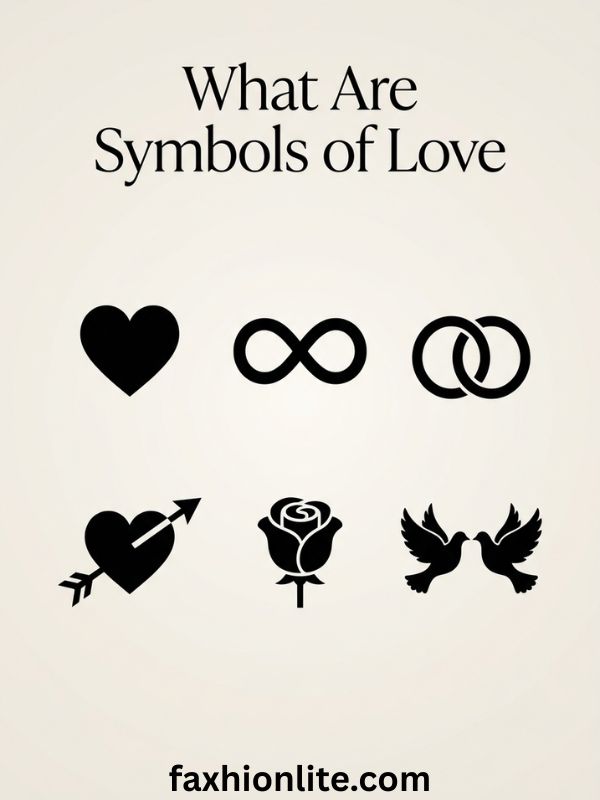
Symbols of love are images, objects, or signs that represent romantic, spiritual, familial, or universal feelings of affection, devotion, and emotional connection. They serve as a shorthand for emotions that often feel too large for ordinary language.
Humans are visual creatures. Long before widespread literacy, people relied on symbols to communicate complex ideas. Love, being one of the most complex human experiences, naturally developed its own rich visual vocabulary. The heart, the rose, the dove, these aren’t random choices. Each symbol earned its meaning through centuries of storytelling, religion, art, and lived experience.
What’s especially fascinating is that love symbols don’t belong to just one culture or time period. Every civilization in recorded history has developed its own symbols of romantic and spiritual love. Ancient Mesopotamians used the goddess Ishtar’s star as a symbol of desire. Greeks adorned temples with myrtle branches sacred to Aphrodite.
Medieval Europeans exchanged knotted ribbons to pledge loyalty. Today, Americans send billions of heart emojis daily. The form changes, but the need to symbolize love never does.
Deep Symbolic Meaning of Symbols of Love
Love symbols are rarely just decorative. They carry layered meaning across spiritual, psychological, and cultural dimensions that most people never stop to consider.
Spiritual Meaning
Spiritually, love symbols function as sacred bridges between human emotion and divine energy. Across virtually every religion and spiritual tradition, love is considered one of the highest forces in existence, and symbols are how humans honor and invoke that force.
In Christianity, the Sacred Heart of Jesus is one of the most powerful love symbols in history. It represents divine compassion, sacrifice, and unconditional love for humanity. The image of a flaming heart encircled by thorns carries enormous emotional and theological weight for millions of American Catholics and Christians.
In Hinduism, the lotus flower is the sacred symbol of spiritual love and divine beauty. Because it grows out of muddy water and blooms in perfect purity, it represents how love can emerge from suffering and become something transcendent. The love story of Radha and Krishna is considered the ultimate expression of devotion (Bhakti), and their images surrounded by lotuses and peacock feathers appear in sacred art across the Indian subcontinent.
Psychological Meaning
Psychologically, love symbols work as emotional anchors that trigger deeply conditioned feelings of warmth, safety, and connection. Psychiatrist and psychologist Carl Jung described certain recurring symbols as “archetypes,” universal images embedded in the collective unconscious that carry consistent emotional meaning across cultures and individuals.
The heart, the ring, the flame, these appear again and again in dreams, myths, and art precisely because they tap into something fundamentally human.When you see a red heart, your brain doesn’t just recognize a shape.
It activates a network of emotional associations built up over a lifetime of seeing that symbol used in contexts of love, care, and celebration. Neuroscience research shows that visual symbols can trigger dopamine release similarly to the actual experience they represent, which is why love symbols can make you feel something even in passing.
Cultural Meaning
The same love symbol can carry entirely different meanings depending on the culture interpreting it. This is one of the most important and underappreciated aspects of love symbolism, and it’s something that frequently causes misunderstandings in our multicultural world.
Take the color red. In Western cultures, red is the color of passionate romantic love. It’s Valentine’s Day, it’s roses, it’s lipstick. But in many East Asian cultures, red is primarily the color of luck, prosperity, and life energy. Chinese brides wear red, not white, for their weddings. The romantic overlay exists, but it coexists with much broader cultural meanings.
Cultural love symbols are passed down through generations via folklore, religious ceremony, art, and family ritual. They become embedded in cultural identity itself, which is why the Claddagh ring means so much to Irish-Americans, or why Mandarin ducks appear on nearly every Chinese wedding gift. These symbols aren’t just pretty; they’re carriers of ancestral meaning and collective memory.
Symbols of Love and Their Meanings
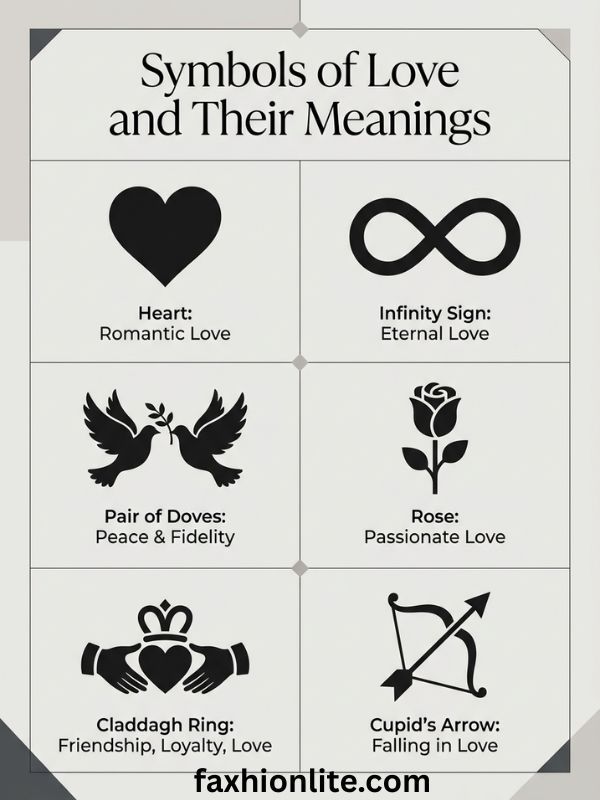
The Heart Symbol
The heart symbol is that iconic two-lobed shape that narrows to a point at the bottom, and it looks almost nothing like an actual human heart. It appears in red, pink, gold, and countless other variations, outlined or filled, simple or elaborately decorated. Interestingly, scholars have proposed several theories about where this shape originated.
Visual Description
The heart symbol is that iconic two-lobed shape that narrows to a point at the bottom, and it looks almost nothing like an actual human heart. It appears in red, pink, gold, and countless other variations, outlined or filled, simple or elaborately decorated. Interestingly, scholars have proposed several theories about where this shape originated.
Some believe it traces back to the ivy leaf, which was associated with fidelity in ancient Greece. Others suggest it came from the stylized image of two swan necks curving together. One popular theory connects it to early anatomical drawings from ancient anatomy texts that misrepresented the heart’s true shape.
Meaning
The heart symbol is the single most recognized symbol of romantic love on Earth. Its association with love solidified during the Middle Ages in Europe, when poets and troubadours of courtly love culture began using the heart image in manuscripts and love poetry. Before that, the heart was primarily a religious symbol. The Sacred Heart of Jesus in Catholic tradition preceded the secular Valentine’s Day heart by centuries.
Today the heart means many things simultaneously. It represents romantic passion, yes, but also compassion, empathy, friendship, and self-love. The heart emoji alone accounts for billions of digital interactions daily, making it arguably the most used symbol in human history. What’s remarkable is that a shape with unclear origins became the definitive universal shorthand for the deepest human emotion.
Where It Appears
You’ll find the heart symbol on Valentine’s Day cards, engagement rings, wedding cakes, hospital logos, social media reactions, charity campaigns, and children’s artwork. It crosses every age group, income level, and cultural background. Few symbols in history have achieved that kind of universal reach.
Red Rose
Visual Description
The red rose is a layered, velvety bloom in deep crimson, growing on a thorned green stem, with a fragrance that has been described as one of the most universally pleasing scents in nature. The contrast between its soft beauty and its sharp thorns is not accidental from a symbolic standpoint. That visual tension tells the whole story of love in a single flower.
Meaning
The red rose has been a symbol of passionate romantic love for over 2,500 years. In Greek mythology, the rose was sacred to Aphrodite, goddess of love. Roman mythology transferred that association to Venus.
During the Victorian era, the elaborate language of flowers called floriography formalized what people already intuitively knew: a red rose meant “I love you” while a yellow rose meant friendship and a white rose meant purity.
William Shakespeare cemented the rose’s romantic identity in Western literature. Poets from Rumi to Pablo Neruda have used the rose as a central love metaphor. What’s most fascinating is the symbolic duality the thorns represent. Love, like a rose, is beautiful but capable of drawing blood. To hold one is to accept both the beauty and the risk.
Where It Appears
Over 250 million roses are sold in the United States alone in the days surrounding Valentine’s Day. Red roses appear in wedding bouquets, funeral tributes, romantic gestures, perfume branding, national emblems (England’s Tudor Rose), and tattoo parlors across the country.
Cupid
Visual Description
Cupid is depicted as a chubby winged baby or young boy armed with a bow and arrow. Modern versions are soft and cute, but the original Roman god of desire was a far more complex figure, sometimes shown as a mischievous young man capable of causing both ecstasy and suffering.
Meaning
Cupid originated as Eros in Greek mythology, son of Aphrodite, the god of erotic love and desire. His golden arrows caused those struck to fall deeply in love, while his lead arrows caused instant aversion.
This dual nature captures something true about attraction: it strikes involuntarily and not always conveniently. The deeper myth of Cupid and Psyche is one of the most psychologically rich love stories in classical mythology, exploring how love survives jealousy, doubt, and impossible trials.
By the 19th century, Cupid had been commercialized into the Valentine’s Day mascot, softened into an infant to make him non-threatening and marketable. But beneath that cute exterior lies a symbol of love as an unstoppable force that no human fully controls.
Where It Appears
Valentine’s Day cards, classical paintings by Raphael and Bouguereau, fine jewelry, decorative architecture, and tattoo designs.
Swans
Visual Description
The swan is a large, elegantly white water bird with a long, curved neck. When two swans face each other, their necks naturally form a perfect heart shape, making them a living, breathing love symbol.
Meaning
Swans are one of the most powerful symbols of eternal love and loyalty precisely because they mate for life. This biological reality gave rise to centuries of symbolic meaning across cultures.
In Greek mythology, Zeus transformed into a swan. In Celtic legend, lovers were transformed into swans as a sign of their unbreakable bond. Swans represent grace, fidelity, and the kind of quiet, enduring partnership that outlasts passion.
Where It Appears
Wedding centerpieces, Tchaikovsky’s Swan Lake, luxury hotel décor, couple tattoos, and romantic literature.
Infinity Symbol
Visual Description
The infinity symbol (∞) is a horizontal figure-eight with no beginning and no end. In jewelry and tattoos, it’s often intertwined with hearts, feathers, names, or flowers to add personal meaning.
Meaning
Mathematician John Wallis introduced the infinity symbol in 1655 to represent a mathematical concept. Its adoption as a symbol of eternal love came much later, driven by the intuitive appeal of something that never ends.
Saying “my love is infinite” uses infinity as both emotional statement and spiritual declaration. In New Age and spiritual communities, the infinity symbol also represents karmic cycles, twin flames, and soul connections that transcend a single lifetime.
Where It Appears
Promise rings, couples’ tattoos, anniversary jewelry, greeting cards, and wedding stationery.
Love Knots
Visual Description
A love knot is an intricate, looping design with no visible beginning or end. Celtic love knots, sailor’s knots, and Chinese endless knots all share this quality of apparent inescapability.
Meaning
Love knots symbolize two lives intertwined with no exit point, which is exactly why they became wedding symbols. The phrase “tying the knot” comes directly from this tradition. Celtic cultures used complex knotwork to represent eternal bonds. Sailors tied love knots for the partners they left behind at sea, a physical token of connection across distance. In Chinese and Buddhist traditions, the endless knot represents interconnection, good fortune, and love that continues beyond physical existence.
Where It Appears
Wedding rings, Celtic jewelry, friendship bracelets, tattoos, and traditional textiles.
Doves
Visual Description
The dove is a small, soft-feathered white bird, often shown in pairs or carrying an olive branch. Unlike the rose’s fiery passion, the dove communicates tender, peaceful, enduring love.
Meaning
Doves have been symbols of love, peace, and faithfulness across nearly every major civilization. In ancient Mesopotamia, the goddess Ishtar was associated with doves. Greek and Roman mythology connected them to Aphrodite and Venus. Christian tradition uses the dove to represent the Holy Spirit, divine love, and hope. Biologically, doves return to their mates, which reinforced their symbolic identity as faithful partners.
Where It Appears
Wedding ceremonies (dove releases), religious art, Valentine’s Day imagery, and peace movements worldwide.
Symbols of Love Across Cultures
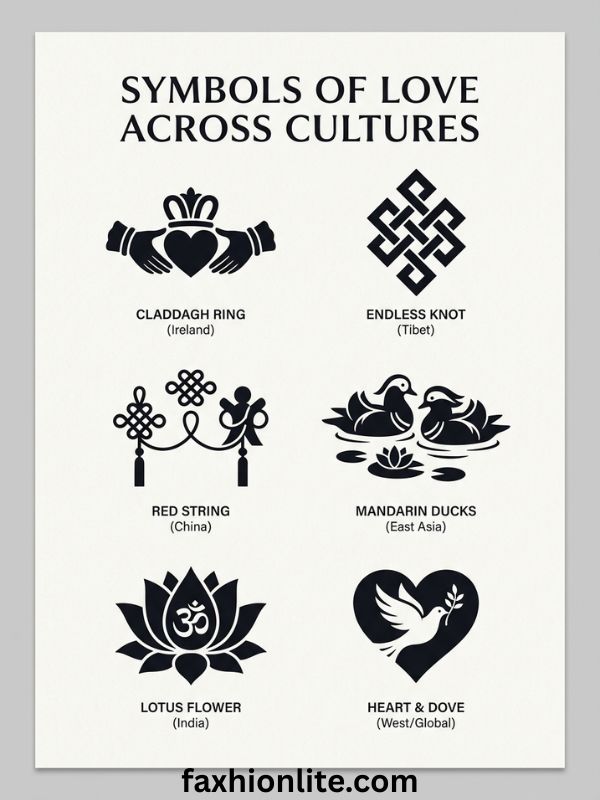
Love is universal, but how cultures choose to symbolize it is beautifully diverse.
Ancient Egypt
Ancient Egyptians expressed love through some of the world’s earliest romantic poetry, discovered on papyri dating back over 3,000 years. The Ankh, the cross with a looped top, symbolized eternal life and was given as a love offering to represent the wish for everlasting connection.
The goddess Isis and her devoted search for her husband Osiris across death itself became one of history’s most enduring love myths. The lotus flower symbolized rebirth and pure love emerging from the waters of the Nile. The scarab beetle represented transformation and was exchanged between lovers as a symbol of protection and devotion.
Ancient Greece
The ancient Greeks were arguably history’s most sophisticated analysts of love, and they didn’t think one word (or one symbol) was enough to contain it. They identified multiple distinct types: Eros (passionate romantic love), Philia (deep friendship), Storge (family affection), and Agape (universal, unconditional love).
Aphrodite’s sacred symbols included the myrtle tree, the sparrow, the dolphin, and the rose. Eros and his arrows personified the involuntary nature of attraction. Even the apple carried love symbolism: throwing an apple at someone in ancient Greece was a declaration of romantic interest.
Chinese Culture
Chinese love symbolism centers on harmony, partnership, and lasting happiness. The Double Happiness character (囍) is the most iconic Chinese love symbol, used in virtually every traditional wedding.Mandarin ducks (yuanyang) are the ultimate Chinese symbol of devoted, monogamous love because they pair for life and are rarely seen apart.
The Qixi Festival, sometimes called Chinese Valentine’s Day, celebrates the myth of the Weaver Girl and the Cowherd, star-crossed lovers permitted to meet just once a year. Peonies, called the “king of flowers,” symbolize romantic love, beauty, and a prosperous partnership.
Celtic Culture
Celtic love symbolism is among the most recognizable in America, particularly in Irish-American communities. The Claddagh ring features a heart held by two hands and topped with a crown, representing love, friendship, and loyalty respectively. The way it’s worn signals relationship status, a tradition still observed today.
Celtic love knots and the Triquetra (three interlocking arcs) symbolize eternal, unbreakable bonds. These symbols have seen a massive revival in modern American wedding culture, appearing on rings, tattoos, and ceremony décor.
Indian Culture
Indian love symbolism is deeply interwoven with spirituality and ritual. The lotus represents divine love and spiritual purity. The love story of Radha and Krishna is considered the highest expression of devotional love in Hindu tradition, and their imagery appears everywhere from temple walls to wedding invitations.
Mehndi (henna) applied during wedding ceremonies contains hidden love symbols, and tradition says the groom must find his name hidden within the bride’s henna design before the wedding night. The Hamsa hand offers protective love, and the peacock feather, associated with Krishna, symbolizes grace and romantic beauty.
Symbols of Love in Art, Movies and Pop Culture
In Movies
Hollywood has long used visual love symbols as emotional shorthand. A single red rose delivered unexpectedly, two characters looking up at the same moon, a locket snapping shut on a photograph.
These moments work because the audience already carries the symbolic meaning. Certain films have actually shifted cultural relationships with specific symbols. When a particular style of jewelry becomes central to a romantic storyline, sales of that item frequently spike in the weeks that follow.
In Paintings
Artists throughout history used established love symbols because they communicated instantly with literate audiences who shared that visual vocabulary. Gustav Klimt’s “The Kiss” uses golden interlocking patterns to suggest two souls becoming one. Sandro Botticelli’s “The Birth of Venus” connected feminine beauty, roses, and divine love in a single image.
Rodin’s sculpture “The Kiss” conveys the physical reality of love without a single word or symbolic prop, relying purely on form. The consistent presence of doves, roses, hearts, and Cupid figures across Renaissance and Baroque paintings shows how stable love iconography has been across centuries.
In Books
Literature has always embedded love symbols in metaphor and imagery. F. Scott Fitzgerald’s green light across the bay in “The Great Gatsby” is one of American literature’s most analyzed love symbols, representing longing, idealized love, and the impossibility of recapturing the past.
Nathaniel Hawthorne’s scarlet letter transformed a symbol of shame into one of forbidden love’s most complex icons. In Charlotte Brontë’s “Jane Eyre,” fire and ice imagery carries the weight of passionate versus controlled love throughout the novel.
In Tattoos
Love-themed tattoos consistently rank among the most popular in America. The most requested designs include infinity symbols (especially on wrists or fingers), red roses, anatomical hearts, lock and key pairs for couples, Claddagh symbols, and dove silhouettes.
The permanence of a tattoo makes it uniquely powerful as a love symbol. People ink love symbols to memorialize relationships, honor lost loved ones, declare commitment, or simply to carry something meaningful on their body every day.
In Fashion
Love symbols have moved far beyond Valentine’s Day novelty wear. Heart motifs appear year-round in luxury fashion collections, from Moschino’s iconic heart-shaped handbags to delicate gold heart pendants that have become everyday jewelry staples.
Rose prints cycle through fashion seasons repeatedly because their symbolic warmth never goes stale. Infinity jewelry sold as everyday wear now outpaces its sale as explicitly romantic gifts, suggesting that people wear love symbols as personal identity statements rather than relational declarations.
Spiritual and Dream Meaning of Symbols of Love
When love symbols appear in dreams, many spiritual traditions consider them significant messages from the subconscious or from divine sources. Carl Jung viewed recurring symbols in dreams as communications from the unconscious mind, reflecting the dreamer’s emotional state, unmet needs, or spiritual growth.
Dreaming of a red rose in full bloom is widely interpreted as a sign of flourishing love or emotional readiness to give and receive affection. A wilting rose in a dream often signals anxiety about a relationship fading or a fear of abandonment. Dreaming of doves is considered a positive omen in Christian, Islamic, and New Age traditions, representing peace, divine guidance, and love entering your life. A glowing heart in a dream may indicate emotional healing or the opening of the heart after a period of grief.
Angel numbers have become modern spiritual love symbols, particularly in American New Age culture. The number 222 is widely associated with relationship harmony and partnership. 1111 is interpreted as a signal that a significant love connection is entering or deepening in your life. Whether or not you subscribe to numerology, these numbers function exactly as ancient love symbols did: as focal points for emotional meaning and intention.
Positive and Negative Meaning of Symbols of Love
Positive Meanings
Love symbols carry extraordinarily affirming energy when understood in their fullest context. The heart represents compassion, empathy, and the courage to be emotionally vulnerable. The dove symbolizes hope, new beginnings, and the tender side of love that doesn’t demand anything in return.
The infinity symbol in jewelry or tattoos communicates an unwavering commitment to another person or to oneself. Some therapists and relationship counselors actually incorporate love symbols into their practice, using them as visual anchors for clients working to rebuild trust or emotional safety.
Negative Meanings
Love symbols can also carry darker dimensions that are worth acknowledging honestly. The broken heart is perhaps the most understood, representing grief, betrayal, and the particular devastation of losing someone you loved deeply.
Interestingly, “Broken Heart Syndrome” (medically known as Takotsubo cardiomyopathy) is a real condition where extreme emotional stress can cause temporary heart dysfunction, proving that the broken heart symbol isn’t just poetic.
The thorns of the rose have long represented love’s capacity for pain alongside its beauty. Cupid’s arrows, when examined closely, symbolize love as something that happens to you rather than something you choose, raising philosophical questions about agency and emotional control that poets have argued about for centuries.
Why Humans Are Attracted to Symbols of Love
Humans are drawn to love symbols for reasons that are simultaneously evolutionary, neurological, and social. From an evolutionary psychology perspective, visual symbols that signal bonding, loyalty, and partnership were adaptive. Early humans who could quickly identify potential mates and committed partners had survival advantages. Symbolic communication about love was part of how communities formed and held together.
Neurologically, love symbols activate the brain’s reward pathway. When someone who is in love sees a heart symbol or a red rose, their brain responds with a mild dopamine release, the same neurotransmitter activated by the experience of love itself. This is why love symbols feel good even in the abstract. They’re not just representing love; they’re triggering a fragment of it.
Socially, love symbols work through collective meaning-making. When everyone in a culture agrees that a particular image represents love, that image becomes genuinely powerful for every member of that culture. The heart symbol means love not because hearts and love have an inherent connection, but because millions of people across centuries have agreed that they do. That shared agreement creates real emotional weight.
Famous Love Symbols People Often Misunderstand
Broken Heart Symbol
Most people see the broken heart as purely negative, a symbol of sadness, loss, or rejection. But psychologists and philosophers point out that a broken heart is also evidence of having loved deeply, and that’s never a failure.
Buddhist teachings describe the “open heart” as a heart that has been broken enough to become spacious and compassionate. In this reading, the broken heart symbol represents emotional growth, empathy, and the vulnerability required to love at all.
Lock and Key
The lock and key as a love symbol is often misread as representing possession or control in a relationship. Its original meaning is almost the opposite. It symbolizes trust and voluntary vulnerability: you are giving someone the key to your heart, the most private and protected part of yourself.
Victorian-era lovers exchanged miniature lockets and keys as romantic keepsakes. The modern couples’ lock-and-key tattoo carries that same original meaning when understood correctly.
Apple Symbol
Americans today associate the apple primarily with health or technology, but the apple has been a love symbol for over 3,000 years. In Greek mythology, golden apples were love offerings and prizes of desire. The famous Apple of Discord that triggered the Trojan War was fundamentally a love story.
In Norse mythology, apples given by the goddess Idun represented eternal youth and desire. In folk traditions across Europe, apples were used in love divination, and the phrase “an apple for the teacher” has roots in gifting apples as tokens of affection.
Moon and Stars
The moon and stars aesthetic is often dismissed as surface-level romance, the kind of generic imagery found on mass-produced Valentine’s cards. But their symbolic depth is real. The moon has represented feminine love, emotional cycles, and longing across virtually every culture in history.
The image of two people separated by distance gazing at the same moon is one of the most universal romantic metaphors in world literature and poetry. Stars symbolize destiny and the idea that love is somehow written into the cosmos, a concept found in everything from Shakespeare’s “star-crossed lovers” to modern astrology’s soulmate readings.
Frequently Asked Questions
What is the most famous symbol of love?
The heart is the most recognized love symbol, representing affection, romance, emotional connection, and deep feelings worldwide.
What do roses symbolize in love?
Red roses traditionally symbolize passionate love, romance, desire, devotion, and strong emotional feelings between two people.
What does an infinity symbol mean in love?
The infinity symbol represents everlasting love, eternal connection, endless devotion, and a relationship believed to have no end.
Which symbols represent eternal love?
Infinity signs, wedding rings, intertwined hearts, knots, and circles commonly represent eternal love, commitment, unity, and lasting devotion.
Why have love symbols existed throughout history?
Love symbols helped cultures express powerful emotions visually, preserving messages of romance, devotion, fertility, loyalty, and spiritual connection.
Conclusion
Symbols of love are far more than decorative images. They’re vessels of human experience, carrying thousands of years of longing, devotion, joy, and heartbreak within a single shape or image.
Whether it’s a Celtic love knot worn on a ring finger in Chicago, a lotus flower painted in a temple in Chennai, or a red heart emoji sent at midnight, the impulse behind them is identical: to communicate something too large and too important for ordinary words.
What’s striking, when you step back and look at all of these symbols together, is how consistent the underlying human need has been across every culture, era, and belief system. People have always needed to externalize love, to make it visible and tangible, to hold it in their hands or press it against their skin or carve it into stone.